Rate Monotonic Realtime Scheduling
TL;DR
Rate Monotonic CPU Scheduling follows a priority-based algorithm with preemption, assigning priority based on deadline requirements, and can potentially cause deadline misses.
Transcript
click the bell icon to get latest videos from akira hello friends today we will discuss about one type of real-time CPU scheduling that is a rate monotonic scheduling in this way how we can implement this real-time screen view scheduling and what are the advantages and how to miss or attain a deadline using this algorithm the rate monotonic CPU sch... Read More
Key Insights
- ⚾ Rate Monotonic CPU Scheduling is a priority-based algorithm that applies preemption and assigns priority based on deadline requirements.
- ✋ The algorithm aims to execute processes consecutively with shorter burst times having higher priority.
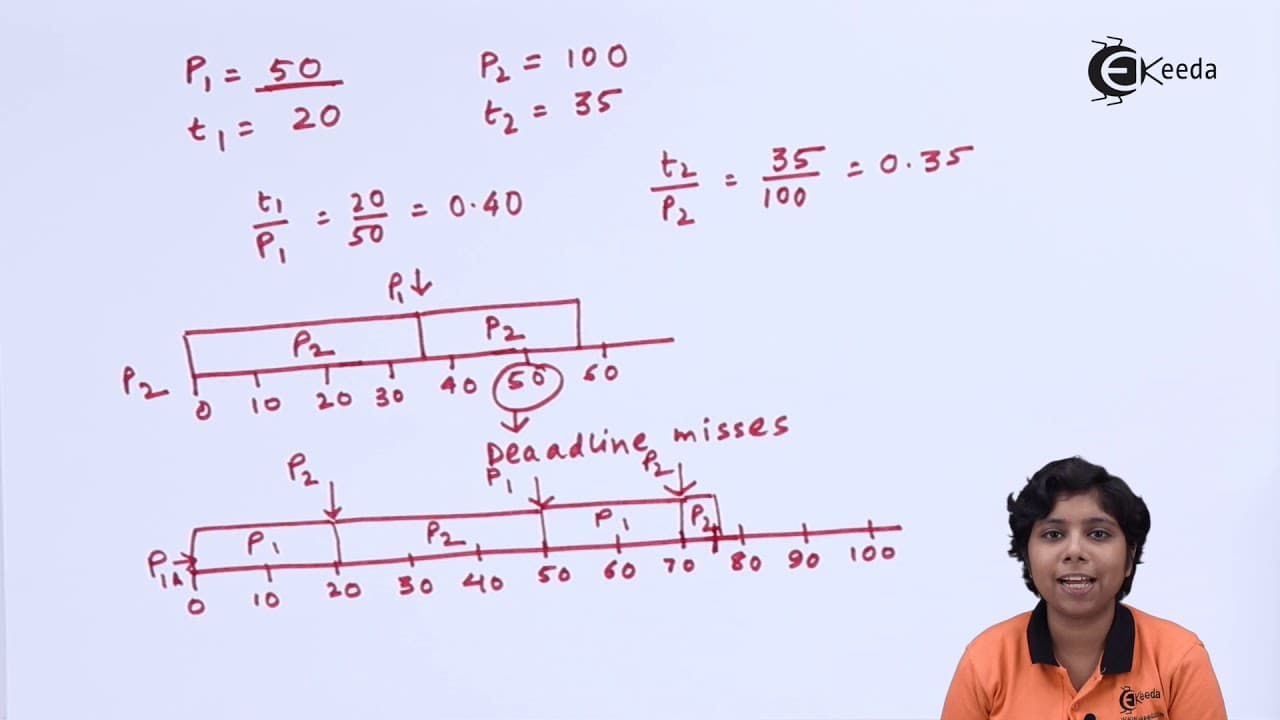
- 🎟️ The algorithm can result in both meeting and missing deadlines depending on the priority and deadline configuration.
- ☠️ CPU utilization in the rate monotonic algorithm is bounded, and no algorithm can utilize the maximum CPU resources fully.
- ☠️ The rate monotonic algorithm can sometimes fail to allocate all processes successfully due to priority and period limitations.
- ✋ With one process, the CPU utilization can reach 100%, but it reduces to 69% when the number of processes becomes infinite or significantly high.
- ☠️ The rate monotonic algorithm is considered optimal, but it has limitations in certain scenarios.
Install to Summarize YouTube Videos and Get Transcripts
Explore YouTube Video Summarizer or Get YouTube Transcript Extractor
Questions & Answers
Q: What is the basis for assigning priority in the rate monotonic algorithm?
The rate monotonic algorithm assigns priority based on deadline requirements, with shorter periods having higher priority and longer periods having lower priority.
Q: How does the rate monotonic algorithm handle process preemption?
The rate monotonic algorithm allows for process preemption, where a running lower priority process can be preempted by a higher priority process in the queue.
Q: Can the rate monotonic algorithm guarantee that all processes meet their deadlines?
No, the rate monotonic algorithm does not guarantee that all processes will meet their deadlines. Depending on the priority and deadline configuration, processes can still miss their deadlines.
Q: What is the CPU utilization for the example with two processes?
The CPU utilization for the example with two processes is calculated to be 75%, indicating that 75% of the CPU time can be allocated to execute these processes while leaving 25% available for the next cycles.
Q: Is the rate monotonic algorithm considered an optimal scheduling algorithm?
Yes, the rate monotonic algorithm is considered optimal because if no processes can be allocated using this algorithm, no other algorithm can easily allocate them either.
Summary & Key Takeaways
-
Rate Monotonic Scheduling is a type of real-time CPU scheduling that applies a priority-based algorithm with preemption and assigns priority based on deadline requirements.
-
It assumes that each process's processing time is equal to the CPU burst time and aims to execute processes consecutively with shorter burst times having higher priority.
-
An example is provided to illustrate how the rate monotonic algorithm can result in both meeting and missing deadlines.
Read in Other Languages (beta)
Share This Summary 📚
Summarize YouTube Videos and Get Video Transcripts with 1-Click
Try YouTube Summary with ChatGPT & Claude or YouTube Transcript Generator
Explore More Summaries from Ekeeda 📚






Summarize YouTube Videos and Get Video Transcripts with 1-Click
Try YouTube Summary with ChatGPT & Claude or YouTube Transcript Generator