First Law of Thermodynamics Applied to Steam Turbine, Pump and Heat Exchanger
TL;DR
This video discusses the application of the first law of thermodynamics to flow processes in steam turbines, pumps, and heat exchangers.
Transcript
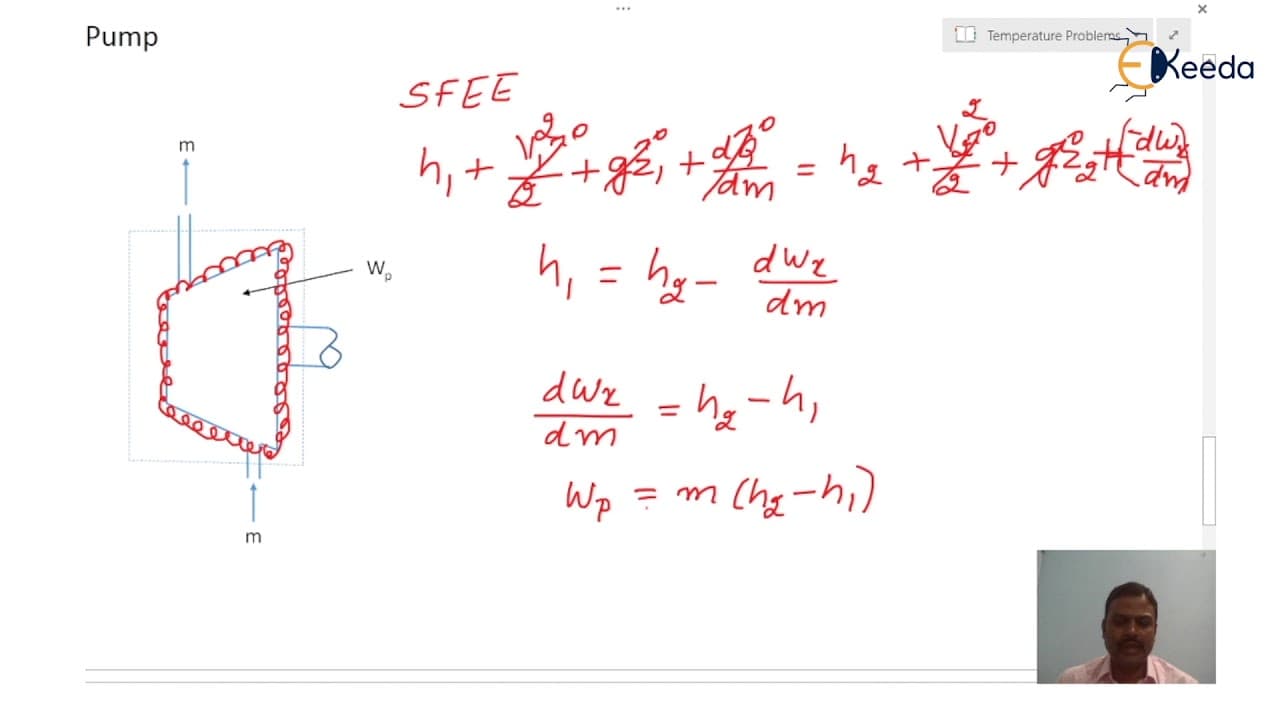
hello friends so in this video i am going to discuss first law of thermodynamics applied to flow process in case of steam turbine pump and heat exchanger uh turbine is a device which produces a positive power output at the expense of its enthalpy here let us consider a steam turbine which is insulated uh here there is a mkg per second of steam flow... Read More
Key Insights
- 💦 The first law of thermodynamics is fundamental in understanding energy transfer and work output in flow processes.
- 😤 In steam turbines, the enthalpy change of the steam corresponds to the turbine work produced.
- ⛽ Pumps consume power to increase the pressure of incompressible fluids, with the enthalpy change representing the pump work.
- 🥵 Heat exchangers facilitate heat transfer between fluids, with the first law of thermodynamics used to calculate the enthalpy change for each fluid.
- 💐 The energy balance equations are crucial for accurately analyzing flow processes in various devices.
- 💐 Neglecting kinetic energy and potential energy can simplify calculations in flow processes.
- 👻 The first law of thermodynamics allows engineers to optimize the performance and efficiency of flow process devices.
Install to Summarize YouTube Videos and Get Transcripts
Explore YouTube Video Summarizer or Get YouTube Transcript Extractor
Questions & Answers
Q: What is the first law of thermodynamics and how is it applied to flow processes?
The first law of thermodynamics states that energy cannot be created or destroyed, only transferred or transformed. In flow processes, it is applied to analyze the energy transfer and work output in devices like steam turbines, pumps, and heat exchangers.
Q: How is the first law of thermodynamics applied to steam turbines?
In a steam turbine, the first law of thermodynamics is used to relate the change in enthalpy of the steam to the turbine work produced. The equation is given by Wt = m(h1 - h2), where Wt is the turbine work, m is the mass flow rate, h1 is the enthalpy at inlet, and h2 is the enthalpy at exit.
Q: What is the role of pumps in flow processes and how is the first law of thermodynamics applied to them?
Pumps are devices that handle incompressible fluids and consume power to increase the fluid's pressure. The first law of thermodynamics is used to relate the increased enthalpy from inlet to outlet to the pump work supplied to the fluid. The equation is given by Wp = m(h2 - h1), where Wp is the pump work, m is the mass flow rate, h2 is the enthalpy at outlet, and h1 is the enthalpy at inlet.
Q: How is the first law of thermodynamics applied to heat exchangers?
In a heat exchanger, the first law of thermodynamics is used to analyze the heat transfer between two fluids. The energy balance equation is applied, relating the mass flow rate and enthalpy of the fluids at inlet and outlet. The equation allows us to determine the heat transfer and determine the change in enthalpy for each fluid.
Summary & Key Takeaways
-
The first law of thermodynamics is applied to steam turbines, pumps, and heat exchangers to analyze the energy transfer and work output.
-
In a steam turbine, the turbine work produced is equal to the change in enthalpy of the steam.
-
In a pump, the increased enthalpy from inlet to outlet represents the pump work supplied to the fluid.
-
In a heat exchanger, the energy balance equation is used to determine the heat transfer from steam to water.
Read in Other Languages (beta)
Share This Summary 📚
Summarize YouTube Videos and Get Video Transcripts with 1-Click
Try YouTube Summary with ChatGPT & Claude or YouTube Transcript Generator
Explore More Summaries from Ekeeda 📚



Summarize YouTube Videos and Get Video Transcripts with 1-Click
Try YouTube Summary with ChatGPT & Claude or YouTube Transcript Generator