Hydrohalogenation - Alkene Reaction Mechanism
TL;DR
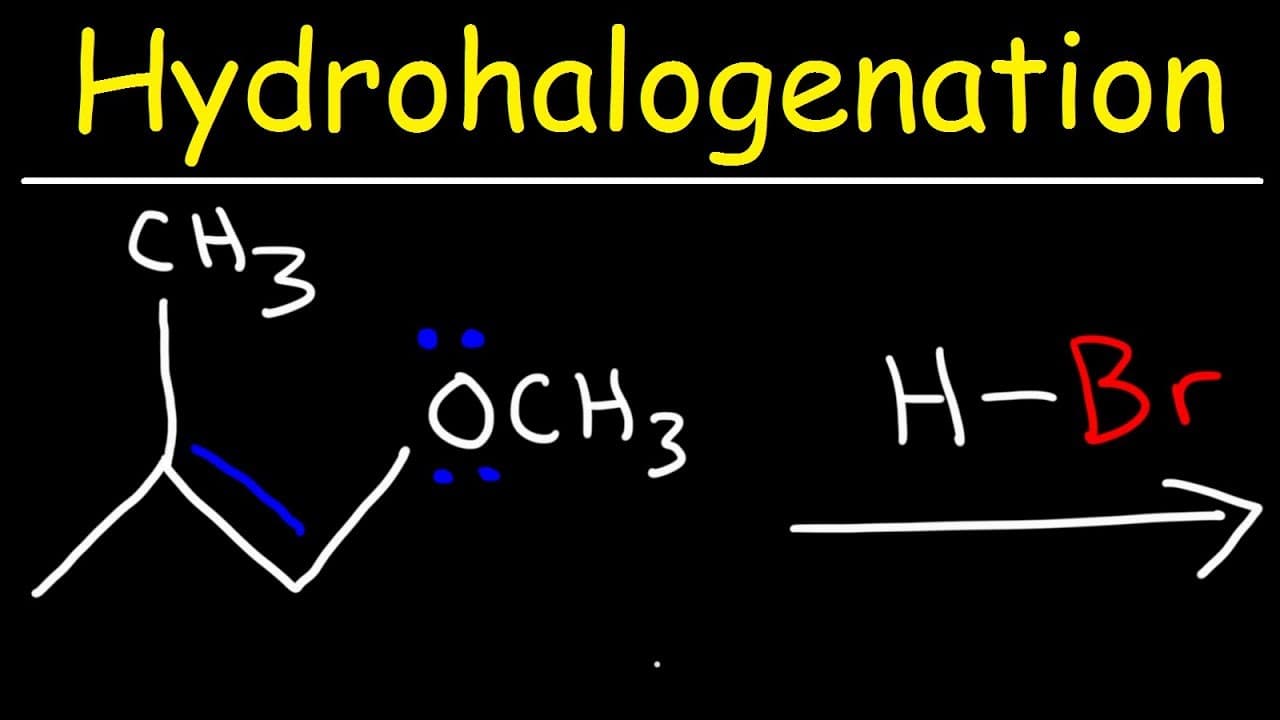
Hydrohalogenation reactions of alkenes are regioselective, with the bromine atom preferentially attacking the more stable secondary carbon to form the major product. Stereochemistry of the reaction can lead to two different products, depending on the position of the bromine atom. Resonance stabilization can determine the placement of the hydrogen atom in certain cases.
Transcript
in this video we're going to focus on the hydrohalogenation reaction of alkenes so let's start with 1 butene unless react it with hydrobromic acid what's going to be the major product in this reaction the double bond is nucleophilic it's electron rich and so it's going to be attracted to the hydrogen atom because the hydrogen atom there's a partial... Read More
Key Insights
- 🥺 Hydrohalogenation reactions of alkenes preferentially occur on the more stable secondary carbon, leading to the formation of the major product.
- 💨 Stereochemistry influences whether the bromine atom is attached on the wedge or the dash, resulting in different products.
- 🫀 Resonance stabilization can affect the placement of the hydrogen atom, with certain groups stabilizing the carbo cation and influencing the regioselectivity of the reaction.
- 🫀 Hydrohalogenation reactions with peroxides follow the anti-Markovnikov rule, with the hydrogen atom going to the less substituted carbon and the halogen atom attaching to the more substituted carbon.
Install to Summarize YouTube Videos and Get Transcripts
Explore YouTube Video Summarizer or Get YouTube Transcript Extractor
Questions & Answers
Q: What determines whether the hydrogen atom is placed on the primary or secondary carbon in the hydrohalogenation reaction of alkenes?
The more stable secondary carbon is preferred for the placement of the hydrogen atom. This results in the formation of the major product in the reaction. The stability of the carbo cation determines the regioselectivity of the reaction.
Q: How does the stereochemistry of the reaction in hydrohalogenation of alkenes lead to different products?
Depending on where the bromine atom attaches, the product can have two different stereochemical configurations: one with the bromine atom on the wedge (coming out of the page) and one with the bromine atom on the dash (going into the page). These different configurations result from the attack of the bromide ion on the empty p-orbital of the carbo cation.
Q: How does resonance stabilization affect the placement of the bromine atom in the hydrohalogenation reaction?
Resonance stabilization can determine the placement of the bromine atom. If there is a group, such as an oxygen atom, that can donate a pair of electrons and stabilize the positive charge of the carbo cation, the bromine atom will preferentially attach to the carbon adjacent to that group. This occurs because the resonance-stabilized carbo cation is more stable.
Q: Why do hydrohalogenation reactions with peroxides result in anti-Markovnikov product formation?
Hydrohalogenation reactions with peroxides, such as HBr with peroxides, follow the anti-Markovnikov rule. In this case, the hydrogen atom goes to the less substituted carbon, while the halogen atom attaches to the more substituted carbon. This is due to the formation of a radical intermediate that allows for the anti addition of the hydrogen and halogen atoms.
Summary & Key Takeaways
-
Hydrohalogenation reactions of alkenes involve the addition of a hydrogen atom and a halogen atom (such as bromine) to the double bond.
-
The reaction is regioselective, with the more stable secondary carbon being preferred for the addition of the halogen atom, resulting in the formation of the major product.
-
The stereochemistry of the reaction can lead to two different products, depending on whether the bromine atom attaches to the front or the back of the molecule.
-
Resonance stabilization can influence the placement of the hydrogen atom, with certain groups (such as oxygen) stabilizing the positive charge of the carbo cation.
Read in Other Languages (beta)
Share This Summary 📚
Summarize YouTube Videos and Get Video Transcripts with 1-Click
Try YouTube Summary with ChatGPT & Claude or YouTube Transcript Generator
Explore More Summaries from The Organic Chemistry Tutor 📚
Summarize YouTube Videos and Get Video Transcripts with 1-Click
Try YouTube Summary with ChatGPT & Claude or YouTube Transcript Generator