Problem 1 Based on Inverse Laplace Transform using Standard Results - Engineering Mathematics 3
TL;DR
Learn how to simplify and find the inverse Laplace transform of a complex function using standard results and formulas.
Transcript
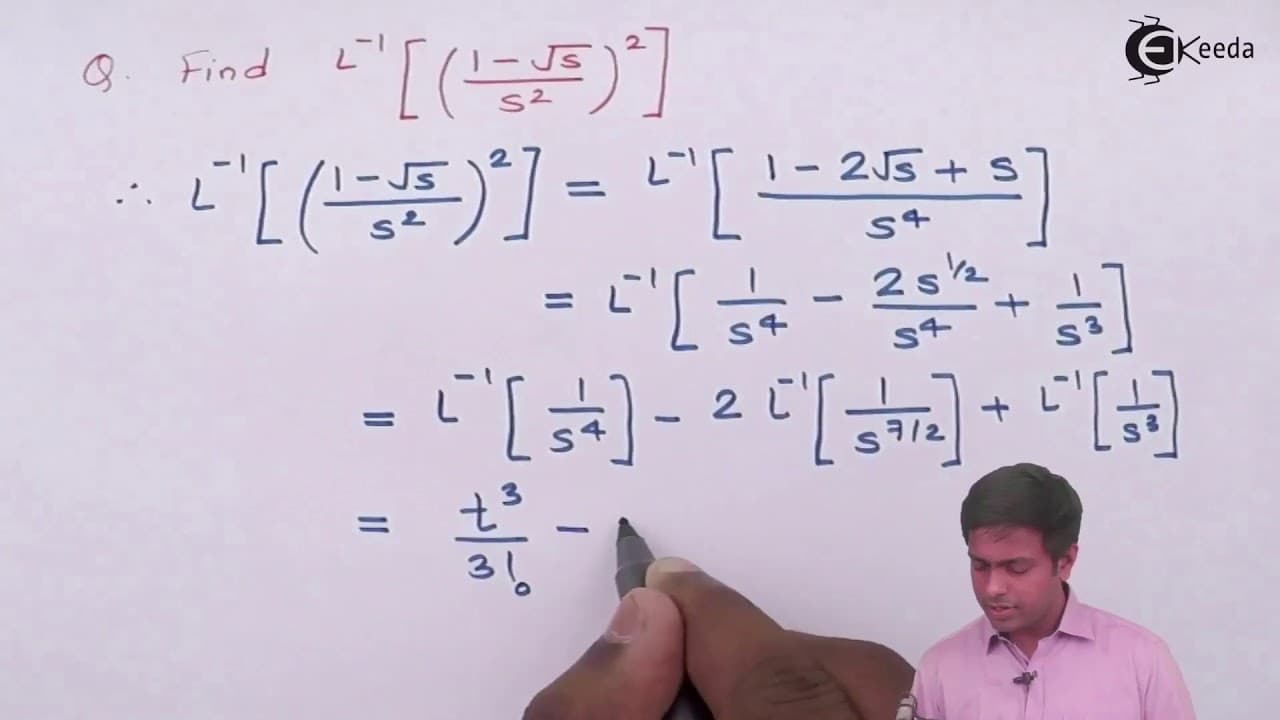
hello friends so after understanding the definition and the formula of inverse laplace transform we will start with the numerical in which i am going to use those standard results or the formulae of inverse laplace transform to get the answer so let's see here how to get the value of the question by using the standard results now here we have to fi... Read More
Key Insights
- 😃 Inverse Laplace transform involves finding the function of t corresponding to a given function of s.
- 💄 Simplifying the function by applying formulas and techniques makes it easier to find the inverse transform.
- 👻 The linearity property allows us to find the inverse transform of each term separately.
Install to Summarize YouTube Videos and Get Transcripts
Explore YouTube Video Summarizer or Get YouTube Transcript Extractor
Questions & Answers
Q: What is the first step in finding the inverse Laplace transform of a complex function?
The first step is to simplify the given function by applying appropriate formulas or techniques, such as expanding, factoring, or combining like terms.
Q: How is the linearity property used in finding the inverse Laplace transform?
The linearity property allows us to find the inverse transform of each individual term in the function separately. This is done by applying the inverse transform formula or referencing previous formulas for specific cases.
Q: Why is the gamma function used instead of the factorial in certain cases?
The gamma function is used instead of the factorial when the value of n in the inverse transform formula is not a whole number. The gamma function extends the factorial concept to include fractions or real numbers.
Q: What is the final answer for the inverse Laplace transform of the given complex function?
The final answer is a function of t, given as t^3/6 - 16/(15√π) × e^(√t/2) + t^2/2.
Summary & Key Takeaways
-
The content explains how to simplify a given function in order to apply standard results or formulas for finding the inverse Laplace transform.
-
The video demonstrates the step-by-step process of simplifying the function and applying the formulas, starting with expanding the numerator using a formula for (a - b)^2.
-
The linearity property of inverse Laplace transform is utilized to separately find the inverse transforms of each term in the simplified function.
-
The video provides references to previous videos and formulas for further understanding and application.
Read in Other Languages (beta)
Share This Summary 📚
Summarize YouTube Videos and Get Video Transcripts with 1-Click
Try YouTube Summary with ChatGPT & Claude or YouTube Transcript Generator
Explore More Summaries from Ekeeda 📚

Summarize YouTube Videos and Get Video Transcripts with 1-Click
Try YouTube Summary with ChatGPT & Claude or YouTube Transcript Generator