Existence theorems intro | Existence theorems | AP Calculus AB | Khan Academy
TL;DR
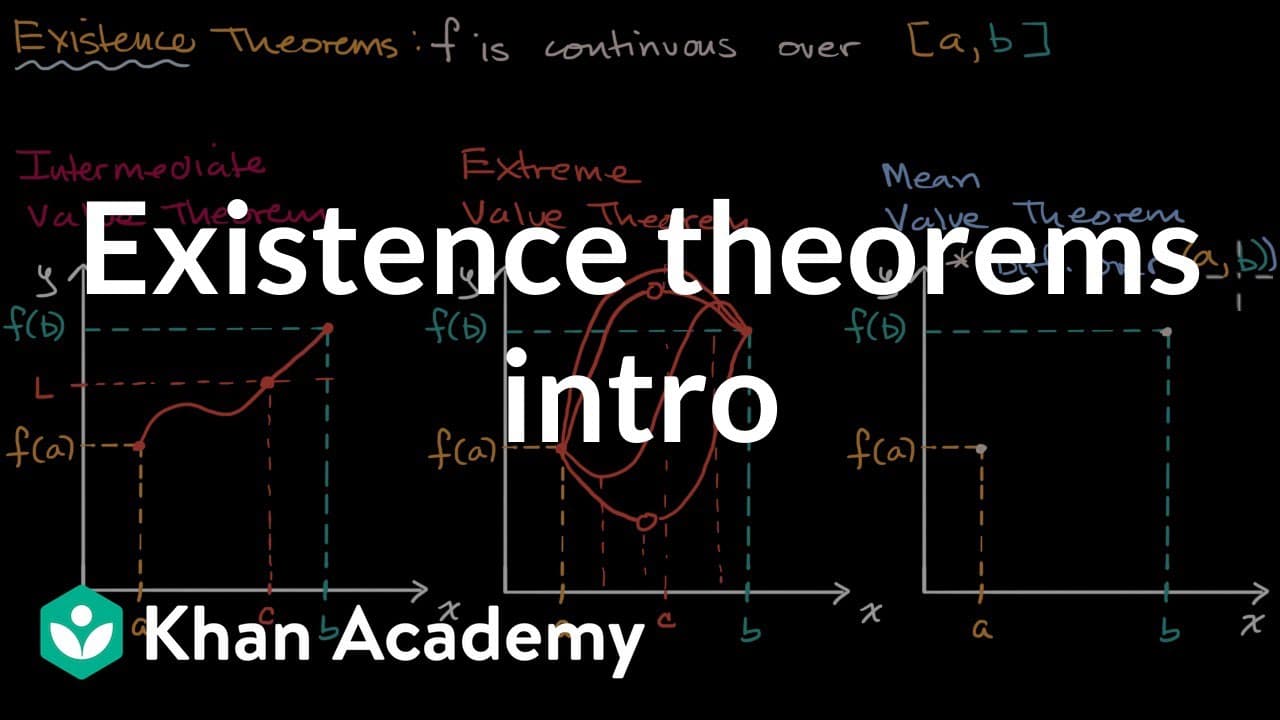
This video explains three existence theorems in calculus: the intermediate value theorem, the extreme value theorem, and the mean value theorem.
Transcript
- [Instructor] What we're going to talk about in this video are three theorems that are sometimes collectively known as existence theorems. So the first that we're going to talk about is the intermediate value theorem. And the common thread here, all of the existence theorems, say, hey, we're looking for something over an interval. There exists an ... Read More
Key Insights
- 😚 The intermediate value theorem guarantees that continuous functions on a closed interval will take on every value within a certain range.
- 😚 The extreme value theorem ensures that continuous functions on a closed interval will have both maximum and minimum values.
- 🫥 The mean value theorem connects the derivative of a function with its average rate of change, providing a link between the function's behavior and its tangent lines.
- 🥹 These theorems rely on the assumption of continuity in order to hold.
- ❓ Discontinuous functions can violate the conditions of the theorems and not exhibit the behavior described.
- 🔨 The existence theorems provide powerful tools for understanding and analyzing functions in calculus.
- ❓ The theorems highlight the relationship between continuity, differentiability, and the behavior of functions over specific intervals.
Install to Summarize YouTube Videos and Get Transcripts
Explore YouTube Video Summarizer or Get YouTube Transcript Extractor
Questions & Answers
Q: What is the intermediate value theorem?
The intermediate value theorem states that if a function is continuous over a closed interval, it must take on every value between its endpoints. This means that there exists a point within the interval where the function has a specific value.
Q: What does the extreme value theorem state?
The extreme value theorem states that if a function is continuous over a closed interval, it must have both a maximum and a minimum value within that interval. This means that the function reaches its highest and lowest points within the interval.
Q: What is the mean value theorem?
The mean value theorem states that if a function is continuous and differentiable over an interval, there exists a point within the interval where the derivative is equal to the average rate of change of the function. In other words, at that point, the slope of the tangent line is equal to the average rate of change of the function.
Q: Why is continuity important in these theorems?
Continuity is important because all the existence theorems assume that the function is continuous over the interval. If the function had any discontinuities within the interval, the theorems would not hold. Continuity guarantees that the function behaves smoothly and consistently.
Summary & Key Takeaways
-
The intermediate value theorem states that if a function is continuous over a closed interval, it must take on every value between its endpoints.
-
The extreme value theorem states that if a function is continuous over a closed interval, it must have both a maximum and a minimum value within that interval.
-
The mean value theorem states that if a function is continuous and differentiable over an interval, there exists a point within the interval where the derivative is equal to the average rate of change of the function.
Read in Other Languages (beta)
Share This Summary 📚
Summarize YouTube Videos and Get Video Transcripts with 1-Click
Try YouTube Summary with ChatGPT & Claude or YouTube Transcript Generator
Explore More Summaries from Khan Academy 📚



Summarize YouTube Videos and Get Video Transcripts with 1-Click
Try YouTube Summary with ChatGPT & Claude or YouTube Transcript Generator