Supply and demand curves in foreign exchange | AP Macroeconomics | Khan Academy
TL;DR
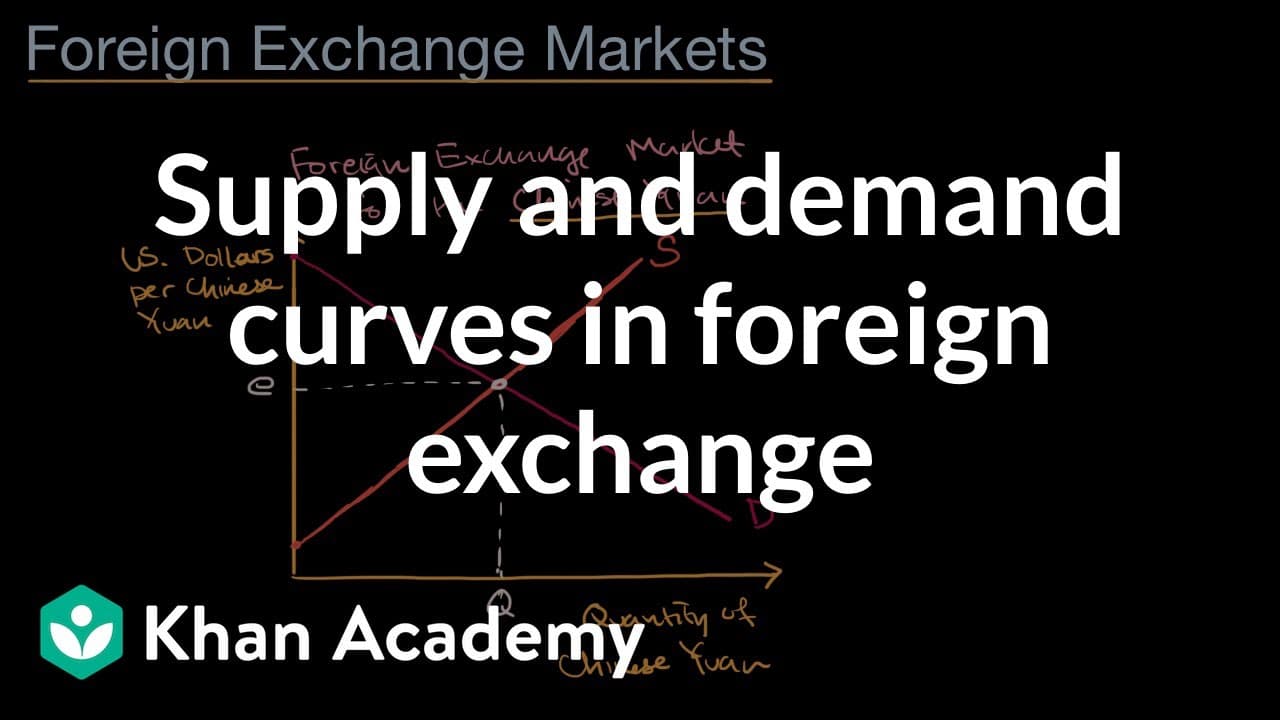
This video explains how the foreign exchange market works using supply and demand curves, focusing on the Chinese yuan and the US dollar.
Transcript
- [Instructor] In a previous video, we've given an intuition on what foreign exchange markets are all about. In particular, we talked about the foreign exchange market between the U.S. dollar and the Chinese yuan. What we're going to do in this video is think about the same idea, but think about it in terms of graphs and the types of economic model... Read More
Key Insights
- 💰 The quantity of Chinese yuan and the price of the yuan in US dollars are represented on the axes of the foreign exchange market graph.
- 🤪 The supply curve for yuan increases as the price in dollars goes up, while the demand curve for yuan decreases as the price in dollars goes down.
- 💱 The equilibrium point in the graph determines the exchange rate and quantity of yuan exchanged.
- 💱 Changes in demand or supply shift the supply and demand curves, leading to a new equilibrium with different exchange rates and quantities of yuan exchanged.
- 💱 Increased demand for yuan results in a higher exchange rate and quantity of yuan exchanged, while increased supply leads to a lower exchange rate and a higher quantity of yuan exchanged.
- 💱 The foreign exchange market can be understood using the principles of supply and demand, similar to other markets in macroeconomics.
Install to Summarize YouTube Videos and Get Transcripts
Explore YouTube Video Summarizer or Get YouTube Transcript Extractor
Questions & Answers
Q: Why is the horizontal axis representing the quantity of Chinese yuan and the vertical axis representing the price of the yuan in US dollars?
The chart represents the foreign exchange market for the Chinese yuan, so it focuses on the quantity of Chinese yuan being exchanged and the price of the yuan in terms of US dollars. This arrangement is based on the perspective of someone in the market for Chinese yuan.
Q: How does an increase in demand for yuan affect the exchange rate?
If the demand for yuan increases, and assuming the exchange rate remains constant, there will be a shortage of yuan. In response, the price of yuan in US dollars will rise until a new equilibrium is reached, with a higher exchange rate and quantity of yuan exchanged.
Q: Can you explain the concept of equilibrium in the foreign exchange market?
Equilibrium in the foreign exchange market refers to the point where the quantity of yuan demanded equals the quantity supplied. It determines the exchange rate and quantity of yuan exchanged. Changes in demand or supply cause shifts in the supply and demand curves, leading to a new equilibrium point.
Q: How do shifts in the supply and demand curves affect the exchange rate and quantity of yuan exchanged?
An increase in supply or a decrease in demand would lead to a lower exchange rate and a higher quantity of yuan exchanged. Conversely, a decrease in supply or an increase in demand would cause the exchange rate to rise and the quantity of yuan exchanged to decrease.
Summary & Key Takeaways
-
The video discusses the foreign exchange market for the Chinese yuan and explains how supply and demand curves affect the price of the yuan in terms of US dollars.
-
The supply for Chinese yuan increases as the price of yuan in dollars goes up, while the demand for yuan increases as the price in dollars goes down.
-
The equilibrium point determines the exchange rate and quantity of yuan exchanged, and changes in demand or supply shifts these curves, altering the exchange rate.
Read in Other Languages (beta)
Share This Summary 📚
Summarize YouTube Videos and Get Video Transcripts with 1-Click
Try YouTube Summary with ChatGPT & Claude or YouTube Transcript Generator
Explore More Summaries from Khan Academy 📚



Summarize YouTube Videos and Get Video Transcripts with 1-Click
Try YouTube Summary with ChatGPT & Claude or YouTube Transcript Generator