Products
Features
YouTube Video Summarizer
Summarize YouTube videos
Web & PDF Highlighter
Highlight web pages & PDFs
Chat with PDF
Ask any PDF questions with AI
Ask AI Clone
Chat with your highlights & memories
Audio Transcriber
Transcribe audio files to text
Glasp Reader
Read and highlight articles
Kindle Highlight Export
Export your Kindle highlights
Idea Hatch
Hatch ideas from your highlights
Integrations
Obsidian Plugin
Notion Integration
Pocket Integration
Instapaper Integration
Medium Integration
Readwise Integration
Snipd Integration
Hypothesis Integration
Apps & Extensions
Chrome Extension
Safari Extension
Edge Add-ons
Firefox Add-ons
iOS App
Android App
Discover
Discover
Ideas
Discover new ideas and insights
Articles
Curated articles and insights
Books
Book recommendations by great minds
Posts
Essays and notes from readers
Quotes
Inspiring quotes collection
Videos
Curated videos and summaries
Explore Glasp
Glasp Newsletter
Weekly insights and updates
Glasp Talk
Interview series with great minds
Glasp Blog
Latest news and articles
Glasp Use Cases
Learn how others use Glasp
Build & Support
Glasp API
Access Glasp's API for developers
MCP Connector
Connect Glasp to Claude & ChatGPT
Community
Glasp Reddit Community
Students
Student discount and benefits
FAQs
Frequently Asked Questions
AboutPricing
DashboardLog inSign up

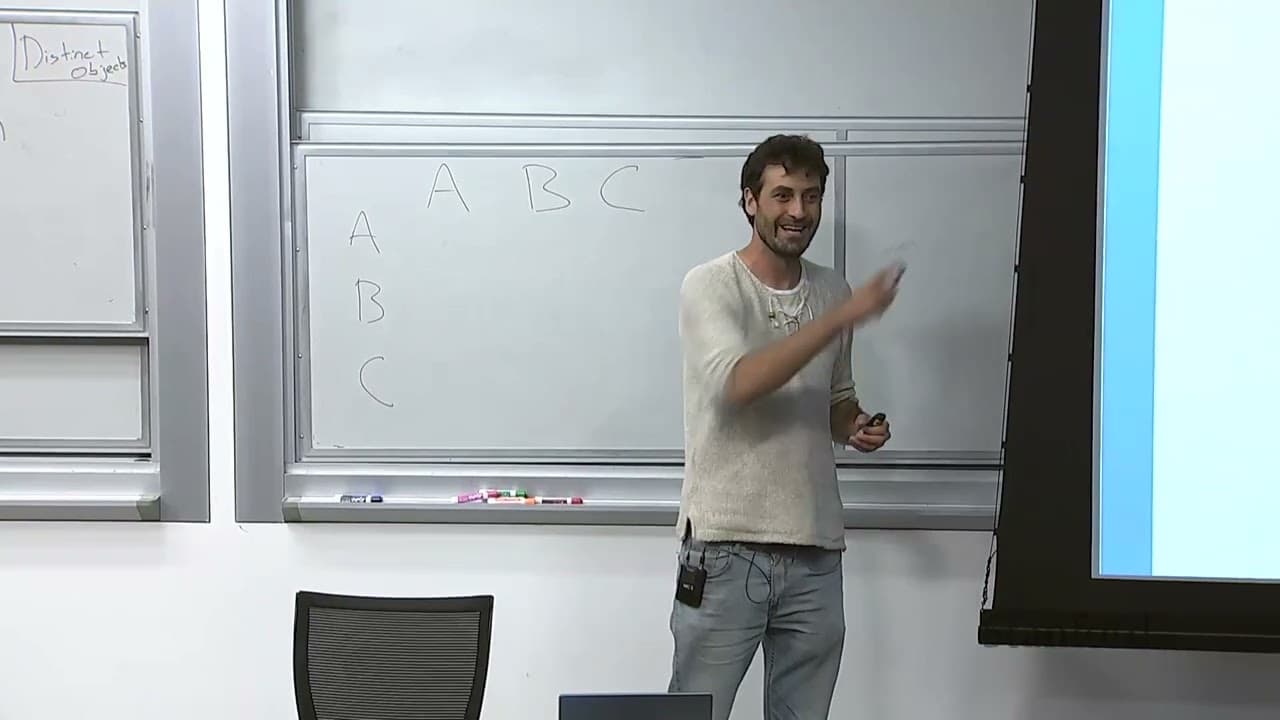
Stanford CS109 Probability for Computer Scientists I What is Probability? I 2022 I Lecture 3
October 9, 2023
by
Stanford Online
YouTube video player
Stanford CS109 Probability for Computer Scientists I What is Probability? I 2022 I Lecture 3

TL;DR

This content discusses the concept of probabilities and equally likely outcomes in the context of counting and probability theory.

Transcript

today is a very special place or class in cs109 because this is the first class where we're actually going to be talking about probabilities about time we're a class on probability for computer scientists so get excited we will get deep into what probability actually means today before we jump into anything though a couple announcements this is a f... Read More

Key Insights

  • #️⃣ Probabilities are numbers between 0 and 1 that reflect the likelihood of an event occurring.
  • 👾 Sample space represents all possible outcomes, while event space refers to a subset of the sample space that satisfies certain conditions.
  • ❓ Equally likely outcomes are crucial for accurate probability calculations, and distinct outcomes are often necessary to achieve equally likely outcomes.
  • 📏 Counting principles, such as the step rule and the or rule, can be used to count outcomes and determine probabilities.

Install to Summarize YouTube Videos and Get Transcripts

Explore YouTube Video Summarizer or Get YouTube Transcript Extractor

Questions & Answers

Q: What is a sample space and how does it relate to calculating probabilities?

A sample space refers to all the possible outcomes of an experiment. Calculating probabilities involves determining the likelihood of an event occurring within the sample space.

Q: How can you determine whether outcomes are equally likely?

Outcomes are considered equally likely if each outcome has an equal chance of occurring. This is often the case with flipping coins or rolling dice, where each outcome has an equal probability.

Q: What is the significance of distinct outcomes in calculating probabilities?

Distinct outcomes are crucial when aiming for equally likely outcomes. If outcomes are not distinct, an accurate calculation of probabilities cannot be obtained.

Q: Can counting principles be used to calculate probabilities in poker hands?

Yes, counting principles can be applied to calculate probabilities in poker hands. By constructing a sample space of all possible hands and considering the desired event (e.g., a straight), probabilities can be determined.

Summary & Key Takeaways

  • The content introduces the concept of probabilities and equally likely outcomes in the context of counting and probability theory.

  • It explains the importance of sample space and event space in calculating probabilities and highlights the need for outcomes to be equally likely for accurate calculations.

  • The content also explores different ways of constructing sample spaces and emphasizes the requirement for outcomes to be distinct when aiming for equally likely outcomes.

  • It provides examples and demonstrates how to apply counting principles in determining probabilities, using scenarios like flipping coins and rolling dice.


Read in Other Languages (beta)

English

Share This Summary 📚

Summarize YouTube Videos and Get Video Transcripts with 1-Click

Download browser extensions on:

Try YouTube Summary with ChatGPT & Claude or YouTube Transcript Generator

Explore More Summaries from Stanford Online 📚
Stanford AA228/CS238 Decision Making Under Uncertainty I Policy Gradient Estimation and Optimization thumbnail
Stanford AA228/CS238 Decision Making Under Uncertainty I Policy Gradient Estimation and Optimization
Stanford Online
Stanford CS229: Machine Learning | Summer 2019 | Lecture 20 - Variational Autoencoder thumbnail
Stanford CS229: Machine Learning | Summer 2019 | Lecture 20 - Variational Autoencoder
Stanford Online
Stanford CS224N NLP with Deep Learning | Winter 2021 | Lecture 16 - Social & Ethical Considerations thumbnail
Stanford CS224N NLP with Deep Learning | Winter 2021 | Lecture 16 - Social & Ethical Considerations
Stanford Online
Bayesian Networks 4 - Probabilistic Inference | Stanford CS221: AI (Autumn 2021) thumbnail
Bayesian Networks 4 - Probabilistic Inference | Stanford CS221: AI (Autumn 2021)
Stanford Online
Stanford Webinar - GPT-3 & Beyond thumbnail
Stanford Webinar - GPT-3 & Beyond
Stanford Online

Summarize YouTube Videos and Get Video Transcripts with 1-Click

Download browser extensions on:

Try YouTube Summary with ChatGPT & Claude or YouTube Transcript Generator

Apps & Extensions

  • Chrome Extension
  • Safari Extension
  • Edge Add-ons
  • Firefox Add-ons
  • iOS App
  • Android App

Key Features

  • YouTube Video Summarizer
  • Web & PDF Summarizer
  • Web & PDF Highlighter
  • Chat with PDF
  • Ask AI Clone
  • Audio Transcriber
  • Glasp Reader
  • Kindle Highlight Export
  • Idea Hatch

Integrations

  • Obsidian Plugin
  • Notion Integration
  • Pocket Integration
  • Instapaper Integration
  • Medium Integration
  • Readwise Integration
  • Snipd Integration
  • Hypothesis Integration

More Features

  • APIs
  • MCP Connector
  • Blog & Post
  • Embed Links
  • Image Highlight
  • Personality Test
  • Quote Shots

Company

  • About us
  • Blog
  • Community
  • FAQs
  • Job Board
  • Newsletter
  • Pricing
Terms

•

Privacy

•

Guidelines

© 2026 Glasp Inc. All rights reserved.