Solving Formulas For a Specified Variable - SAT Math Part 17
TL;DR
This content explains various physics equations and demonstrates how to isolate variables in order to solve for them.
Transcript
58 the gravitational potential energy of an object is directly proportional to the mass of an object as well as the gravitational acceleration of the planet and the height of the object above the ground the formula is shown below which of the following expressions correctly represents the height of the object above ground level now something that y... Read More
Key Insights
- 🧑🏭 Gravitational potential energy, mass, and gravitational acceleration are important factors in calculating the height of an object above ground.
- 🚙 Subtracting initial velocity from final velocity and dividing by time gives the acceleration of a moving vehicle.
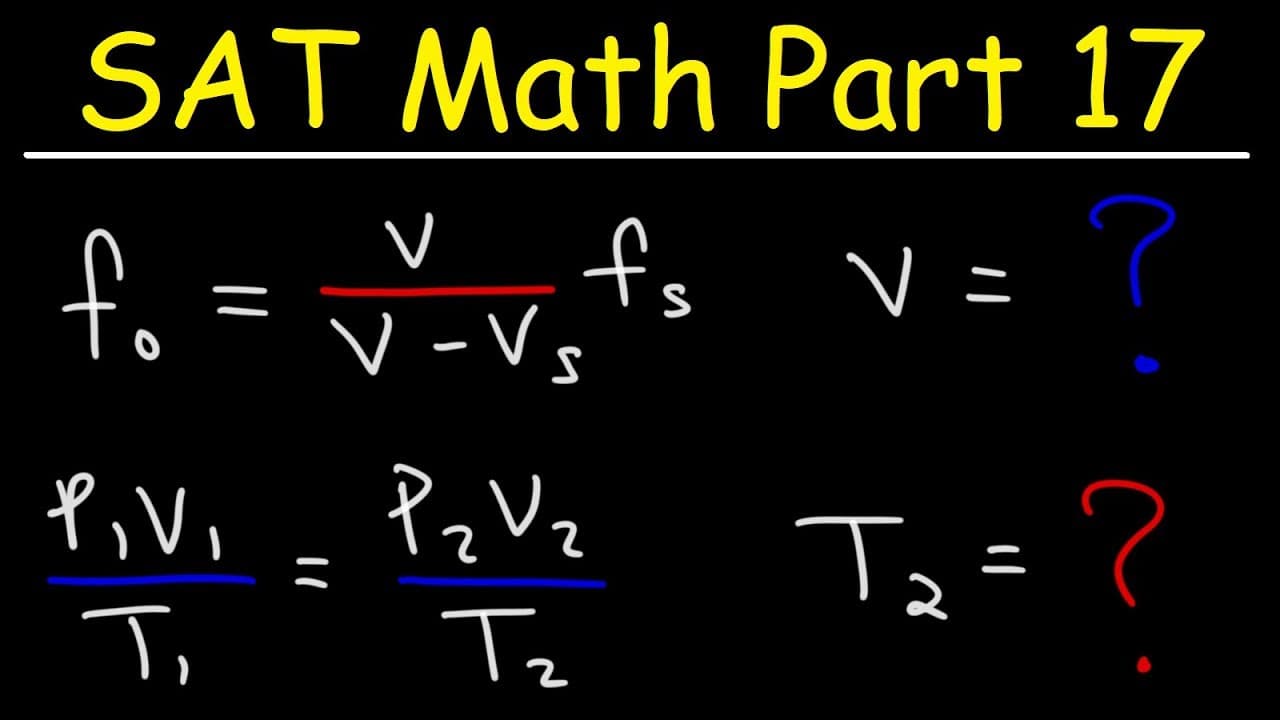
- 🫢 Cross-multiplying and dividing by P1V1 can isolate the variable T2 in the combined gas law equation.
- 🍉 Factorizing and dividing by appropriate terms can isolate variables in equations related to electric force, gravitational force, and fluid density.
Install to Summarize YouTube Videos and Get Transcripts
Explore YouTube Video Summarizer or Get YouTube Transcript Extractor
Questions & Answers
Q: What is the formula for calculating the height of an object above ground level?
The height (h) can be calculated using the formula: h = gravitational potential energy (U) divided by mass (m) and divided by gravitational acceleration (g).
Q: How can the acceleration of a moving vehicle be calculated?
The acceleration (a) can be calculated by subtracting the initial velocity (v initial) from the final velocity (v final) and dividing by time (t).
Q: How can T2 (Kelvin temperature) be calculated in the combined gas law equation?
T2 can be calculated by cross-multiplying the equation and dividing by P1V1. The formula is: T2 = (P2V2 * T1) / (P1V1).
Q: What is the formula for calculating the magnitude of the first charge (Q1) in the electric force equation?
The formula for calculating Q1 is: Q1 = F * R^2 divided by K and divided by Q2.
Q: How can the distance between two planets (R) be calculated in the gravitational force equation?
To calculate R, multiply both sides of the equation by R^2, then divide by F. Finally, take the square root of both sides to find the value of R.
Q: How can the density of a fluid be calculated in Bernoulli's equation?
First, factor out the density term (ρ) from the equation. Then, divide both sides by the remaining expression to calculate the density.
Q: How can the speed of sound in air be calculated using the Doppler effect formula?
To calculate the speed of sound (v), rearrange the formula, factor out the speed of sound variable, and divide both sides by (f0 - fs). The formula is: v = (vs * fo) / (fo - fs).
Summary & Key Takeaways
-
The height of an object above ground level can be calculated using the gravitational potential energy, mass, and gravitational acceleration of the planet.
-
The acceleration of a moving vehicle can be calculated by subtracting the initial velocity from the final velocity and dividing by time.
-
The formula for calculating T2 (Kelvin temperature) in the combined gas law equation involves cross-multiplication and dividing by P1V1.
-
The magnitude of the first charge (Q1) in the electric force equation can be calculated by multiplying F, R^2, and dividing by K and Q2.
-
The formula for calculating R (distance between two planets) in the gravitational force equation involves multiplying by R^2 and dividing by F.
-
The density of a fluid in Bernoulli's equation can be calculated by factoring out the density term and dividing by the remaining expression.
-
The speed of sound in air can be calculated by rearranging the simplified version of the Doppler effect formula and factoring out the speed of sound variable.
Read in Other Languages (beta)
Share This Summary 📚
Summarize YouTube Videos and Get Video Transcripts with 1-Click
Try YouTube Summary with ChatGPT & Claude or YouTube Transcript Generator
Explore More Summaries from The Organic Chemistry Tutor 📚




Summarize YouTube Videos and Get Video Transcripts with 1-Click
Try YouTube Summary with ChatGPT & Claude or YouTube Transcript Generator