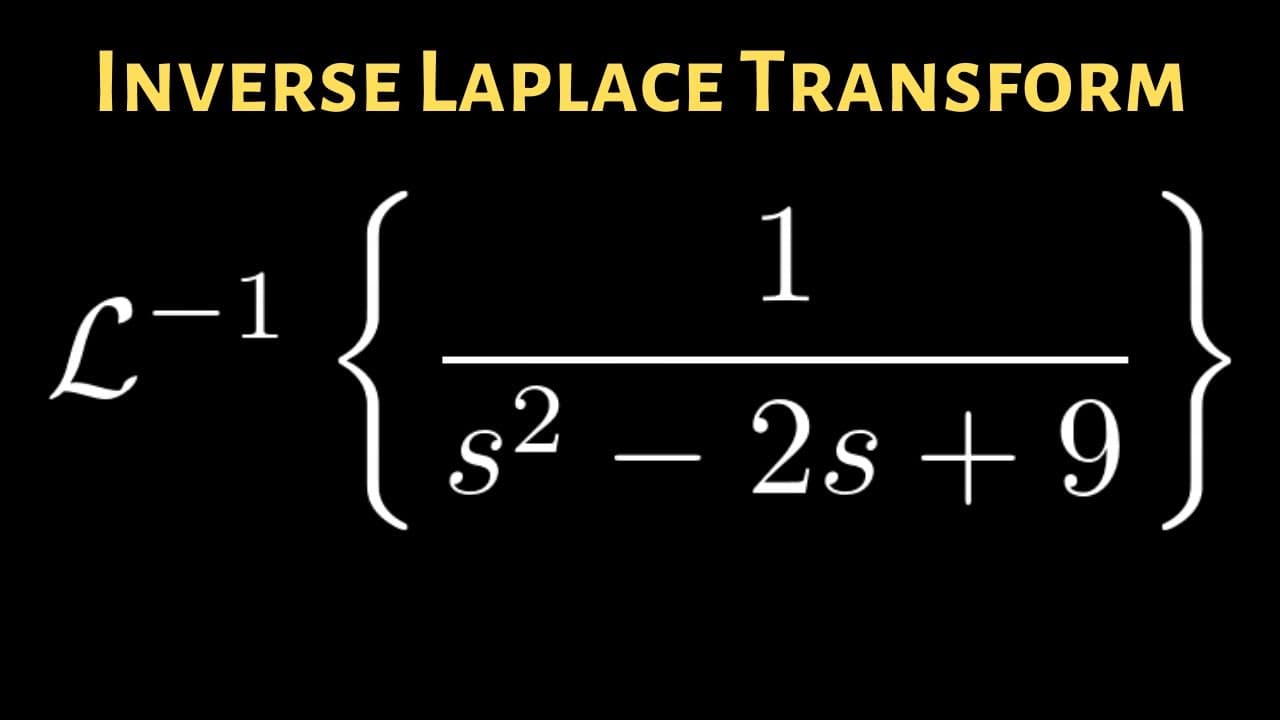
Inverse Laplace Transform of 1/(s^2 - 2s + 9)
TL;DR
This video explains how to find the inverse Laplace transform using square completion and a shift theorem.
Transcript
in this problem we have to find the inverse laplace transform of this function so um i don't see a nice way to factor this you know two numbers that multiply to nine but add to negative two it doesn't seem like it's that easy to do so let's try to complete the square so i'm going to do that over here so we have s squared minus 2s plus 9. so when we... Read More
Key Insights
- 😑 Completing the square simplifies the inverse Laplace transform expression.
- 😑 The first translation theorem allows for shifting the Laplace transform expression.
- ❎ The inverse Laplace transform of k over s squared plus k squared can be represented as the sine of kt.
- 🍉 Shifting the Laplace transform introduces an exponential term in the solution.
- 😑 Factorizing a quadratic expression into a perfect square trinomial helps in finding the inverse Laplace transform.
- ❎ Square completion involves taking half the coefficient of the linear term and squaring it.
- 😑 The shift theorem helps handle translations in the Laplace transform expression.
Install to Summarize YouTube Videos and Get Transcripts
Explore YouTube Video Summarizer or Get YouTube Transcript Extractor
Questions & Answers
Q: How does completing the square help in finding the inverse Laplace transform?
Completing the square allows us to simplify the expression and factor it into a perfect square trinomial, making it easier to apply the inverse Laplace transform formula.
Q: What is the first translation theorem in Laplace transforms?
The first translation theorem allows us to shift the Laplace transform expression by a constant, which introduces an exponential term in the inverse Laplace transform solution.
Q: What does the formula for the inverse Laplace transform of k over s squared plus k squared represent?
The formula represents a specific case where the inverse Laplace transform is equal to the sine of kt, with k being the constant value in the denominator.
Q: How does the shift theorem affect the inverse Laplace transform solution?
The shift theorem introduces an exponential term in the solution, with the exponent equal to the value of the shift constant times t.
Summary & Key Takeaways
-
The video demonstrates completing the square to simplify the expression for inverse Laplace transform.
-
Square completion allows factoring a quadratic expression into a perfect square trinomial.
-
The first translation theorem is applied to perform a shift in the Laplace transform expression.
-
The final solution includes an exponential term due to the shift.
Read in Other Languages (beta)
Share This Summary 📚
Summarize YouTube Videos and Get Video Transcripts with 1-Click
Try YouTube Summary with ChatGPT & Claude or YouTube Transcript Generator
Explore More Summaries from The Math Sorcerer 📚


Summarize YouTube Videos and Get Video Transcripts with 1-Click
Try YouTube Summary with ChatGPT & Claude or YouTube Transcript Generator