Matrix equations and systems | Matrices | Precalculus | Khan Academy
TL;DR
Learn how to solve systems of equations using matrix equations and inverse matrices.
Transcript
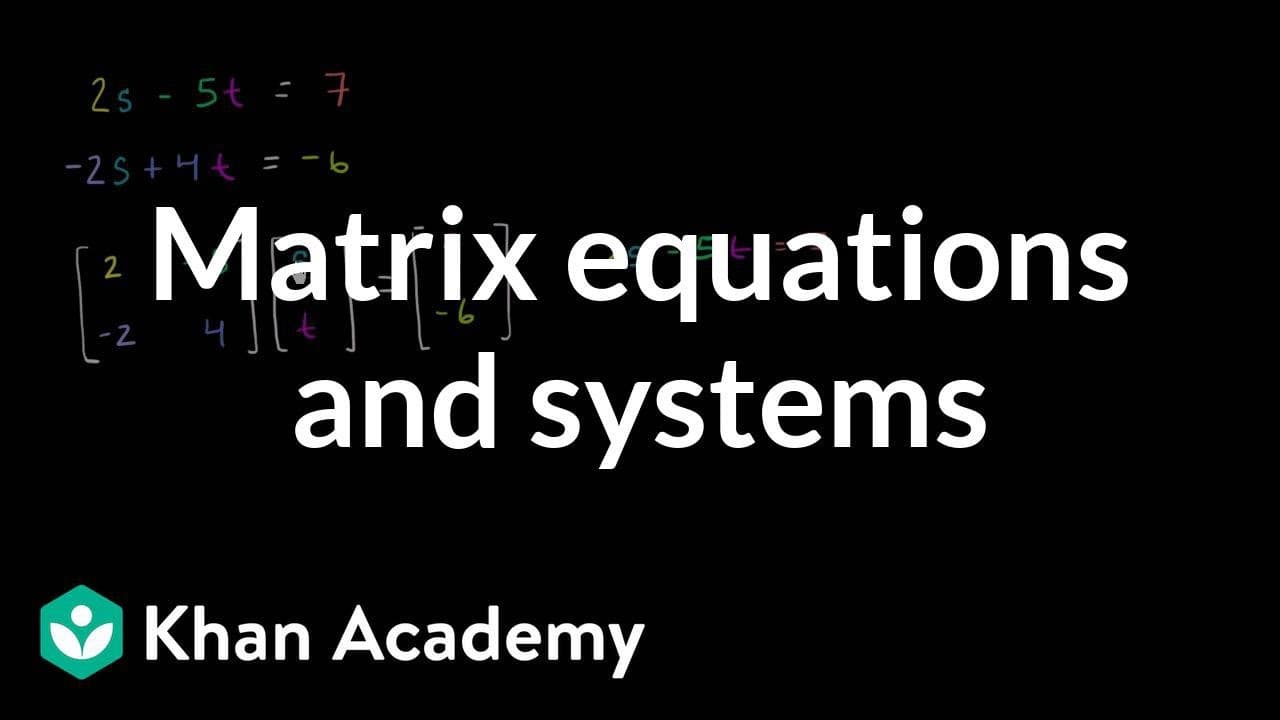
Voiceover:I have a system of 2 equations with 2 unknowns here. We've seen how to solve this, and there's multiple techniques we've used, substitution, elimination, and we could do that right over here. In fact, you could just add the two. The left sides of the equations and the right sides of the equations, the s's would cancel out. Actually, let's... Read More
Key Insights
- 👻 Systems of equations can be represented as matrix equations, allowing for a more compact and efficient representation.
- 🫱 Multiplying the inverse of the coefficient matrix with the column vector on the right-hand side gives the solution vector.
- 🫱 Matrix equations are particularly useful when dealing with repeated computations or changing right-hand side values.
Install to Summarize YouTube Videos and Get Transcripts
Explore YouTube Video Summarizer or Get YouTube Transcript Extractor
Questions & Answers
Q: How can a system of equations be represented as a matrix equation?
A system of equations can be represented as a matrix equation by composing a coefficient matrix and a column vector containing the unknowns. The matrix equation takes the form Ax = b, where A is the coefficient matrix, x is the column vector of unknowns, and b is the column vector on the right-hand side.
Q: How is the inverse matrix used to solve the system of equations?
The inverse matrix is multiplied with the column vector on the right-hand side to find the solution vector x. This multiplication is represented by x = A^(-1) * b. The inverse matrix allows for the efficient calculation of x when dealing with multiple sets of equations with the same coefficients but different right-hand side values.
Q: Why is solving systems of equations using matrix equations useful?
Solving systems of equations using matrix equations is useful when dealing with repeated computations or changing right-hand side values. By calculating the inverse matrix once, the solution vector can be easily obtained for different sets of equations, reducing computational time.
Q: How can matrix equations be applied in computer programming?
Matrix equations are often used in computer programming when dealing with mathematical problems or manipulating data. They provide a way to represent and solve problems efficiently, making them valuable in areas such as computer graphics or physics simulations.
Summary & Key Takeaways
-
The video explains how to represent a system of equations as a matrix equation.
-
By using coefficient matrices and column vectors, the system of equations can be solved using matrix operations.
-
Multiplying both sides of the equation by the inverse of the coefficient matrix allows for the calculation of the solution vector.
Read in Other Languages (beta)
Share This Summary 📚
Summarize YouTube Videos and Get Video Transcripts with 1-Click
Try YouTube Summary with ChatGPT & Claude or YouTube Transcript Generator
Explore More Summaries from Khan Academy 📚



Summarize YouTube Videos and Get Video Transcripts with 1-Click
Try YouTube Summary with ChatGPT & Claude or YouTube Transcript Generator