2 Stage Rocket Problem - Kinematics and Projectile Motion | Physics
TL;DR
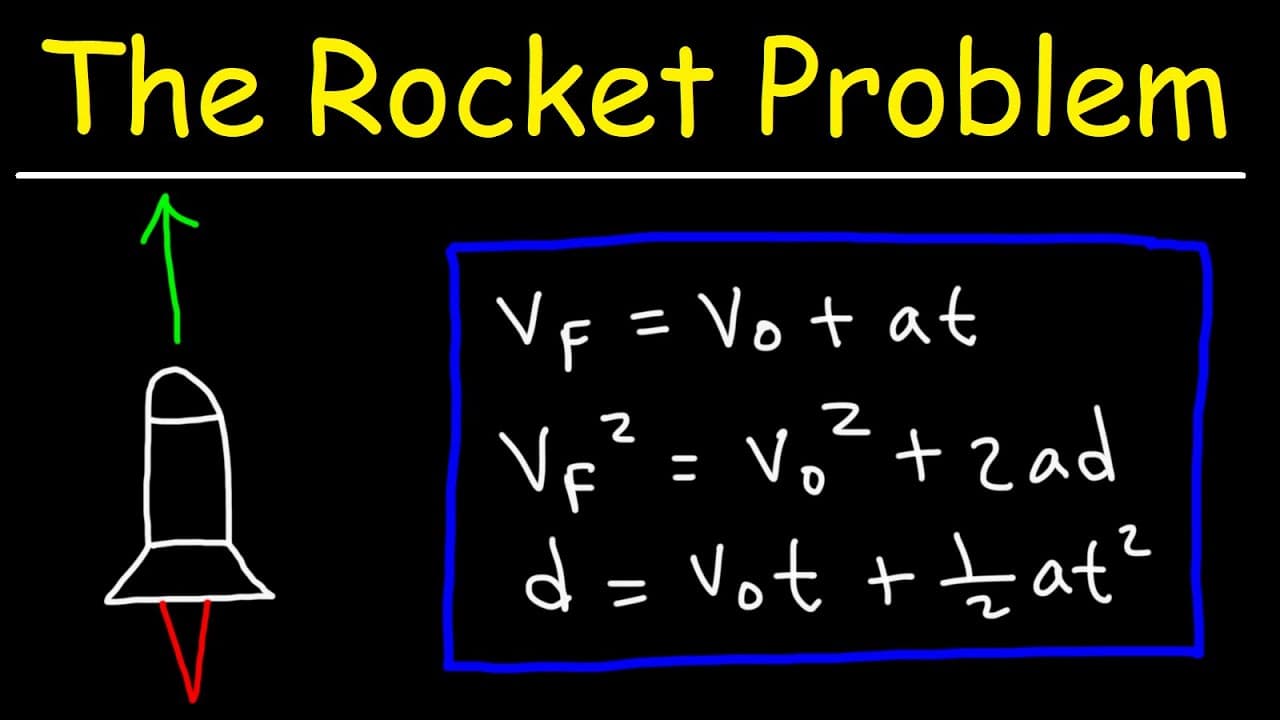
This video explains how to solve a two-stage rocket problem, calculating the maximum height the rocket will achieve and its total flight time.
Transcript
in this video we're going to focus on solving a two-stage rocket problem so let's begin a rocket accelerates Upward at 15 meters per second squared for 10 seconds starting from rest after 10 seconds the engine cuts off what is the maximum height the rocket will achieve and what is the Rocket's total flight time so let's draw a picture let's say thi... Read More
Key Insights
- 🚀 The rocket problem is divided into different segments, making it easier to solve.
- ❓ Kinematic equations are used to calculate displacement and velocity for each segment.
- 🥶 The rocket's acceleration changes from upward acceleration to negative acceleration during free fall.
- 🔙 The maximum height of the rocket is determined by adding the displacements between A and B and between B and C.
- ✈️ The total flight time is found by summing the times for each segment of the flight.
- 🐎 Final velocity or speed is determined based on whether the question asks for velocity or speed.
Install to Summarize YouTube Videos and Get Transcripts
Explore YouTube Video Summarizer or Get YouTube Transcript Extractor
Questions & Answers
Q: How is the displacement between points A and B calculated?
The displacement is calculated using the equation displacement = (initial velocity x time) + (0.5 x acceleration x time^2). In this case, the initial velocity is 0, the acceleration is 15 m/s^2, and the time is 10 seconds.
Q: How is the displacement from B to C determined?
The equation used is Vfinal^2 = Vinitial^2 + 2 x acceleration x displacement. Since the final velocity is 0, the initial velocity is 150 m/s, the acceleration is -9.8 m/s^2 (negative due to free fall), and the displacement is the maximum height of 1,148 m.
Q: What is the rocket's total flight time?
The rocket takes 10 seconds to go from A to B, 15.3 seconds from B to C, and 19.68 seconds from C to D. Therefore, the total flight time is approximately 45 seconds.
Q: What is the final velocity of the rocket before it hits the ground?
Using the equation Vfinal = Vinitial + acceleration x time, and considering Point C as the initial point and Point D as the final point, the final velocity is calculated to be -192.9 m/s. However, if the question asks for the final speed, it is 192.9 m/s.
Summary & Key Takeaways
-
The video begins by discussing the trajectory of the rocket, labeling key points A, B, C, and D representing different stages of the flight.
-
The first part focuses on calculating the vertical displacement between points A and B using kinematic equations.
-
The second part calculates the displacement from point B to C, taking into account the rocket's velocity and acceleration under free fall.
-
Finally, the video discusses finding the total flight time by adding up the time taken for each segment of the rocket's flight.
Read in Other Languages (beta)
Share This Summary 📚
Summarize YouTube Videos and Get Video Transcripts with 1-Click
Try YouTube Summary with ChatGPT & Claude or YouTube Transcript Generator
Explore More Summaries from The Organic Chemistry Tutor 📚



Summarize YouTube Videos and Get Video Transcripts with 1-Click
Try YouTube Summary with ChatGPT & Claude or YouTube Transcript Generator