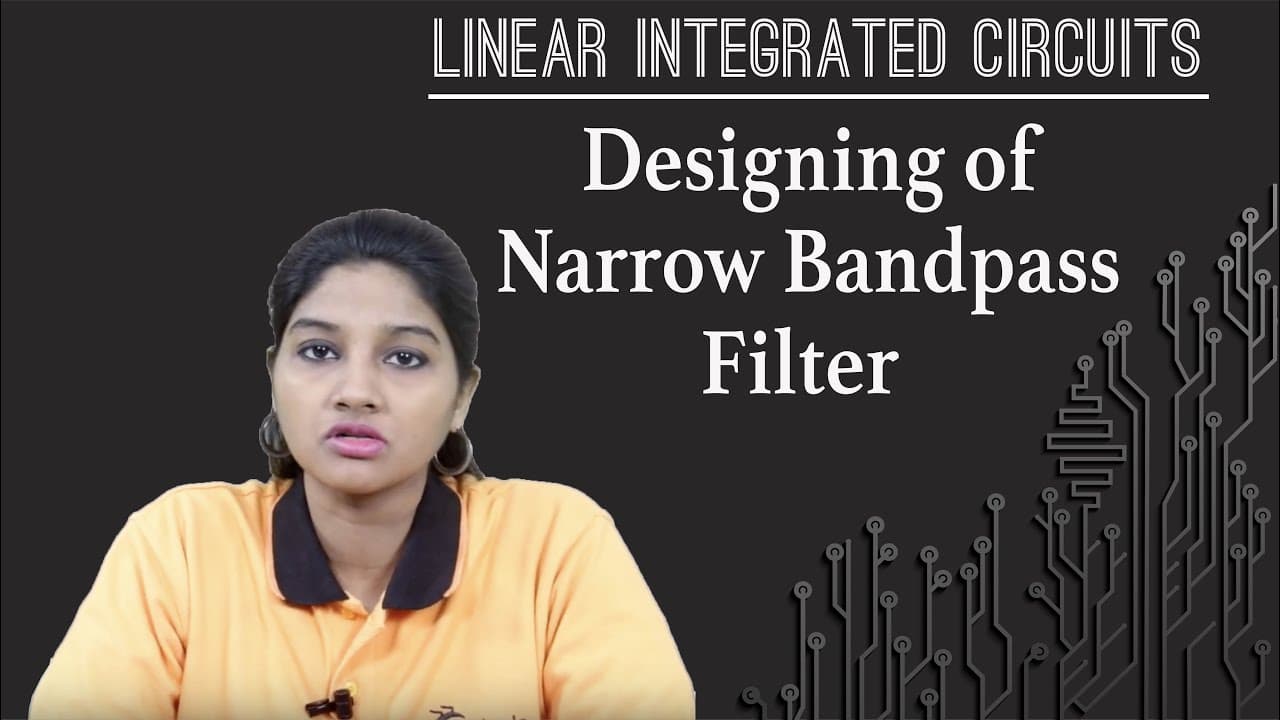
Designing of Narrow Bandpass Filter - Filters - Linear Integrated Circuits
TL;DR
Learn the process of designing a narrow band pass filter, which involves selecting the right components and calculating resistor values based on center frequency, Q factor, and gain.
Transcript
click the bell icon to get latest videos from Ikeda hello friends in today's video we are going to see the design process and few examples based on designing of narrow band pass filter so let's begin with the topic filter is basically a circuit which is used for frequency selection we can say filters are the frequency selective circuit filter allow... Read More
Key Insights
- 👻 Filters are circuits used for frequency selection, allowing certain frequencies to pass and blocking others.
- 🤕 The center frequency acts as a boundary between the pass band and stop band in a filter.
- 🤕 The Q factor determines the type of band pass filter to be used, with low Q values indicating a wide band pass filter and high Q values indicating a narrow band pass filter.
- 🤕 Narrow band pass filters have a sharp frequency response and are useful for frequency-selective applications.
- 🤕 Designing a narrow band pass filter involves selecting capacitor values and calculating resistor values based on the Q factor, gain, and center frequency.
- 🍾 The op-amp configuration in narrow band pass filters is inverting, and multiple feedback paths are used.
- 🉐 The gain of the filter should be less than 2Q^2 for proper filter operation.
Install to Summarize YouTube Videos and Get Transcripts
Explore YouTube Video Summarizer or Get YouTube Transcript Extractor
Questions & Answers
Q: What is the purpose of a filter?
A filter is used to select specific frequency bands and block unwanted frequencies in electronic circuits. It allows for frequency-based signal processing.
Q: What is the difference between pass band and stop band?
The pass band is the frequency range allowed by the filter, while the stop band is the range of frequencies that are attenuated or completely blocked by the filter.
Q: How is the center frequency determined in a bandpass filter?
The center frequency is the frequency that acts as a boundary between the pass band and stop band. It can be specified by defining the lower and higher frequencies of the allowed band.
Q: What is the Q factor in filter design?
The Q factor is the ratio of energy stored to energy dissipated by the filter in one cycle. It is an important parameter that determines the type of band pass filter to be used.
Q: What is the difference between wide and narrow band pass filters?
Wide band pass filters have a low Q factor, allowing a larger range of frequencies to pass. Narrow band pass filters have a high Q factor, allowing only a very narrow band of frequencies to pass.
Q: How does the op-amp configuration differ in a narrow band pass filter?
In narrow band pass filters, the op-amp is connected in an inverting configuration. Additionally, multiple feedback paths are used to achieve the desired frequency response.
Q: How can the center frequency be changed in a narrow band pass filter?
By adjusting the value of resistor R2, the center frequency of the filter can be shifted. The formula to calculate the new value of R2 is provided in the content.
Q: What is the condition for gain in a narrow band pass filter?
The gain of a narrow band pass filter should be less than 2Q^2 to ensure proper filter operation.
Summary & Key Takeaways
-
A filter is a circuit used for frequency selection, allowing certain frequency bands and blocking others.
-
In the case of a narrow band pass filter, only a small band of frequencies is allowed, resulting in a sharp frequency response.
-
The design process involves selecting capacitor values, calculating resistor values based on Q factor and gain, and ensuring the gain is less than 2Q^2.
Read in Other Languages (beta)
Share This Summary 📚
Summarize YouTube Videos and Get Video Transcripts with 1-Click
Try YouTube Summary with ChatGPT & Claude or YouTube Transcript Generator
Explore More Summaries from Ekeeda 📚



Summarize YouTube Videos and Get Video Transcripts with 1-Click
Try YouTube Summary with ChatGPT & Claude or YouTube Transcript Generator