Derivative of a position vector valued function | Multivariable Calculus | Khan Academy
TL;DR
The derivative of a vector-valued function measures the instantaneous rate of change of the function with respect to its parameter.
Transcript
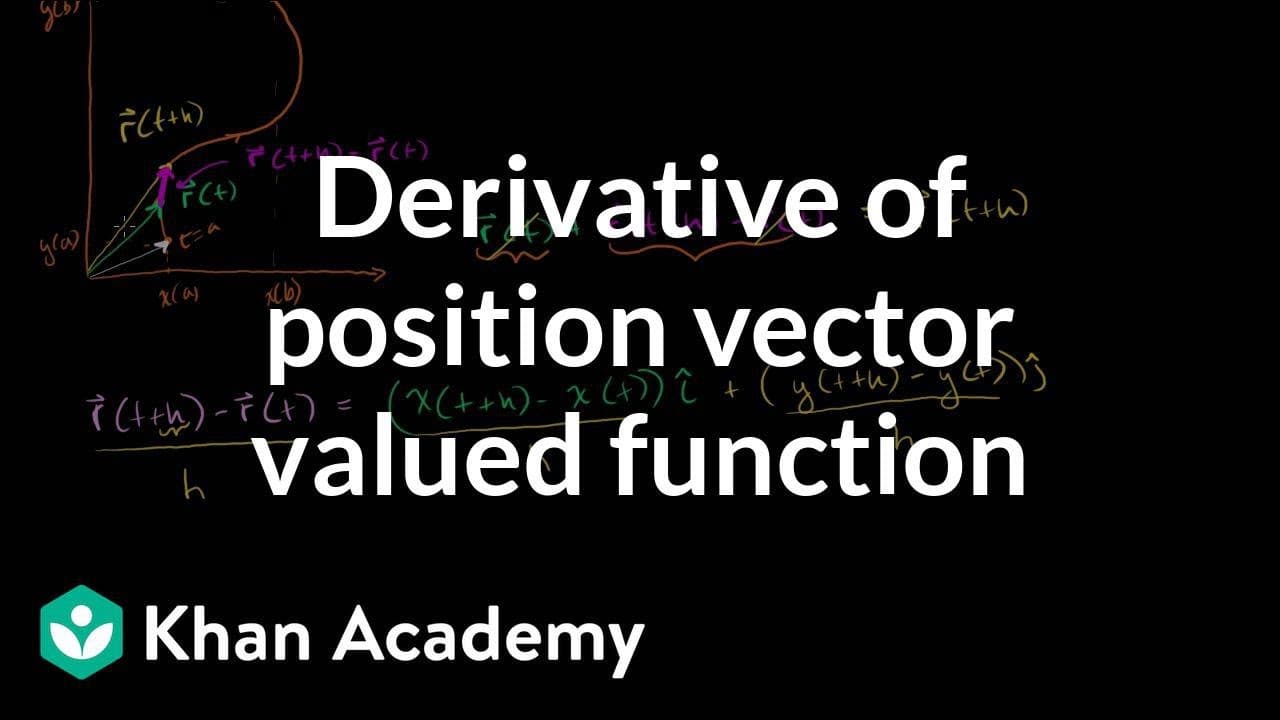
In the last video, we hopefully got ourselves a respectable understanding of how a vector-valued function works, or even better, a position vector-valued function, that is, in some ways, a replacement for traditional parameterization to describe a curve. And what I want to do in this video is just get a little bit of gut sense of what it means to t... Read More
Key Insights
- 🧘 A vector-valued function describes a curve using position vectors determined by parameters.
- 🧘 The difference between two position vectors gives a pure vector that represents the change between them.
- 🫡 The derivative of a vector-valued function is the instantaneous rate of change, or slope, of the function with respect to its parameter.
- 💱 Taking the limit as the parameter change approaches 0 allows us to find the instantaneous rate of change at a specific point on the curve.
- 😥 The derivative vector is tangential to the curve at a given point, representing the direction of the curve at that point.
- 💠 The magnitude of the derivative vector is dependent on the parameterization of the curve, but the direction is determined by the shape of the curve.
Install to Summarize YouTube Videos and Get Transcripts
Explore YouTube Video Summarizer or Get YouTube Transcript Extractor
Questions & Answers
Q: What does the derivative of a vector-valued function represent?
The derivative measures the rate of change of the vector-valued function with respect to its parameter, giving the instantaneous change in position vectors.
Q: How is the derivative of a vector-valued function calculated?
The derivative is calculated by taking the difference between two position vectors and dividing it by the change in the parameter. This gives the instantaneous change per unit change in the parameter.
Q: What is the significance of taking the limit as the parameter change approaches 0?
Taking the limit allows us to find the instantaneous rate of change, or slope, of the vector-valued function at a specific point on the curve.
Q: How does the derivative of a vector-valued function relate to the shape of the curve?
The derivative vector is tangent to the curve at a given point, representing the direction of the curve at that point. However, the magnitude of the derivative is dependent on the parameterization of the curve.
Summary & Key Takeaways
-
A vector-valued function describes a curve, with position vectors determined by parameters.
-
Taking the difference between two position vectors gives a pure vector that represents the change between them.
-
The derivative of a vector-valued function is the vector that describes the instantaneous change per unit change of the parameter.
Read in Other Languages (beta)
Share This Summary 📚
Summarize YouTube Videos and Get Video Transcripts with 1-Click
Try YouTube Summary with ChatGPT & Claude or YouTube Transcript Generator
Explore More Summaries from Khan Academy 📚



Summarize YouTube Videos and Get Video Transcripts with 1-Click
Try YouTube Summary with ChatGPT & Claude or YouTube Transcript Generator