Algebra 78 - Imaginary and Complex Numbers
TL;DR
Adding imaginary numbers to the number system allows for the representation of the square root of negative quantities, thus solving quadratic equations that have no real solutions.
Transcript
Hello. I'm Professor Von Schmohawk and welcome to Why U. In the previous lecture we introduced the "quadratic formula". Given any general-form quadratic equation "a x-squared, plus bx, plus c, equals zero" the values for the constants a, b, and c are entered into the formula that then produces the solutions to the equation. We also saw that an expr... Read More
Key Insights
- #️⃣ The quadratic formula relies on the discriminant to determine the number and type of solutions to a quadratic equation.
- ❎ Imaginary numbers, represented by the symbol "i", were introduced to extend the number system and allow for the representation of the square root of negative quantities.
- #️⃣ The inclusion of imaginary numbers enables the solution of quadratic equations that have no real solutions.
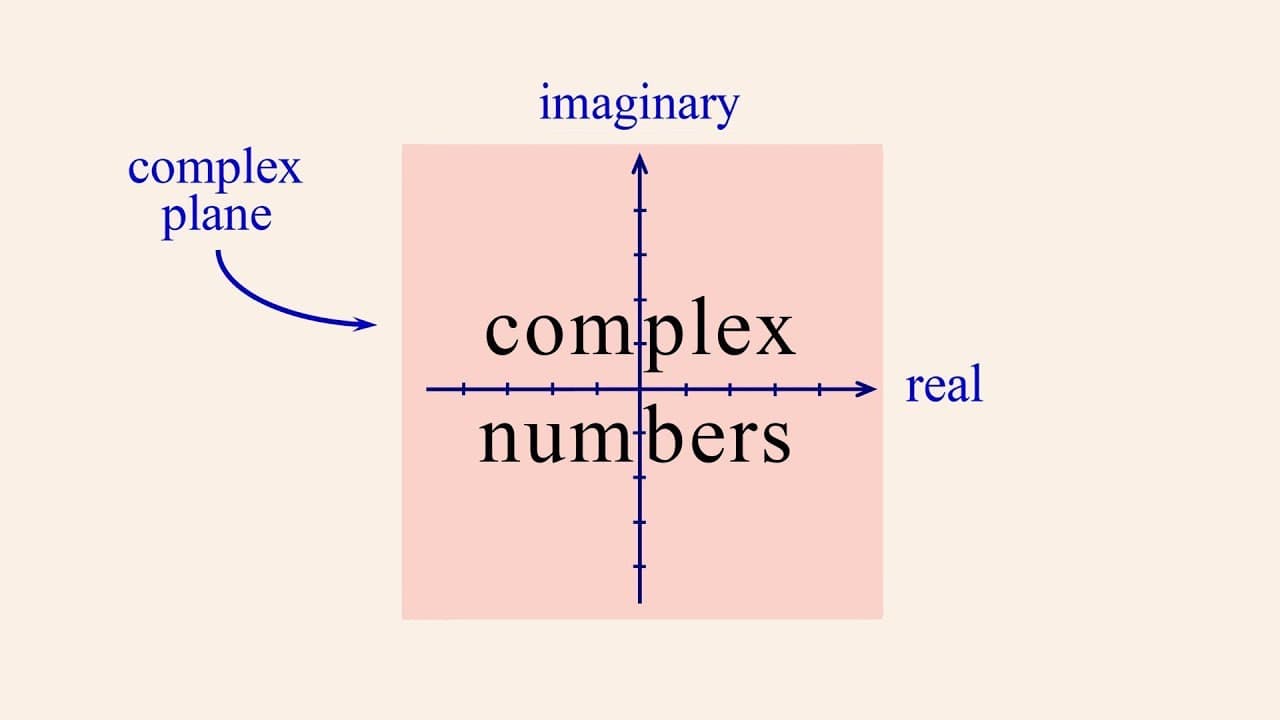
- ✈️ Complex numbers, consisting of a real part and an imaginary part, can be graphically represented on a complex plane.
Install to Summarize YouTube Videos and Get Transcripts
Explore YouTube Video Summarizer or Get YouTube Transcript Extractor
Questions & Answers
Q: What role does the discriminant play in determining the solutions of a quadratic equation?
The discriminant, calculated using the quadratic formula, indicates whether a quadratic equation has two distinct real solutions, one real solution, or no real solutions. A positive discriminant indicates two real solutions, zero discriminant indicates one real solution, and negative discriminant indicates no real solutions.
Q: How did mathematicians extend the number system to include negative numbers and zero?
Mathematicians extended the number system by adding negative numbers and zero to the set of natural numbers, resulting in the set of integers. This extension allowed for subtraction and the representation of negative quantities.
Q: What are complex numbers?
Complex numbers consist of a real part and an imaginary part, represented as "a + bi". They are used to represent the square root of negative quantities and are graphically represented on a complex plane.
Q: How can complex solutions to quadratic equations be verified?
Complex solutions can be verified by substituting the values of x back into the original equation and checking if it produces a true statement. If the equation holds true with the complex values, the solutions are correct.
Summary & Key Takeaways
-
The quadratic formula, used to find solutions for quadratic equations, relies on the discriminant to determine the type of solutions. If the discriminant is positive, there are two distinct real solutions. If the discriminant is zero, there is one real solution. If the discriminant is negative, there are no real solutions.
-
Mathematicians wondered if it was possible to extend the number system to include numbers that could represent the square root of negative quantities, which led to the concept of imaginary numbers.
-
The number "i" represents the square root of negative one, and the inclusion of imaginary numbers in the number system allows for the representation of solutions to quadratic equations with no real solutions.
-
Imaginary numbers can be graphically represented on a complex plane, with the real part represented on the horizontal axis and the imaginary part on the vertical axis.
Read in Other Languages (beta)
Share This Summary 📚
Summarize YouTube Videos and Get Video Transcripts with 1-Click
Try YouTube Summary with ChatGPT & Claude or YouTube Transcript Generator
Explore More Summaries from MyWhyU 📚


Summarize YouTube Videos and Get Video Transcripts with 1-Click
Try YouTube Summary with ChatGPT & Claude or YouTube Transcript Generator