What Is HMAC and How Does It Enhance Security?
TL;DR
HMAC, or Hash-based Message Authentication Code, enhances security by using a cryptographic hash function alongside a secret key for message integrity and authenticity. It is designed to be efficient in software, allowing for easy replacement of hash functions while maintaining performance. Common hash functions used include SHA and MD5, which help establish secure communication protocols.
Transcript
welcome back uh in this section we are going to study about a hash function based mac now okay last in last video we have seen the information about the mac there is a message authentication code now there are various functions that we can apply for encoding this particular uh mac uh mode here and uh there are certain ways in which we can see this ... Read More
Key Insights
- 💨 Cryptographic hash functions perform faster in software than symmetric block ciphers like DES.
- #️⃣ The availability of library code for hash functions increases the demand for hash function based MAC.
- #️⃣ HMAC has design objectives like using available hash functions, easy replacement of embedded hash functions, and preserving original performance.
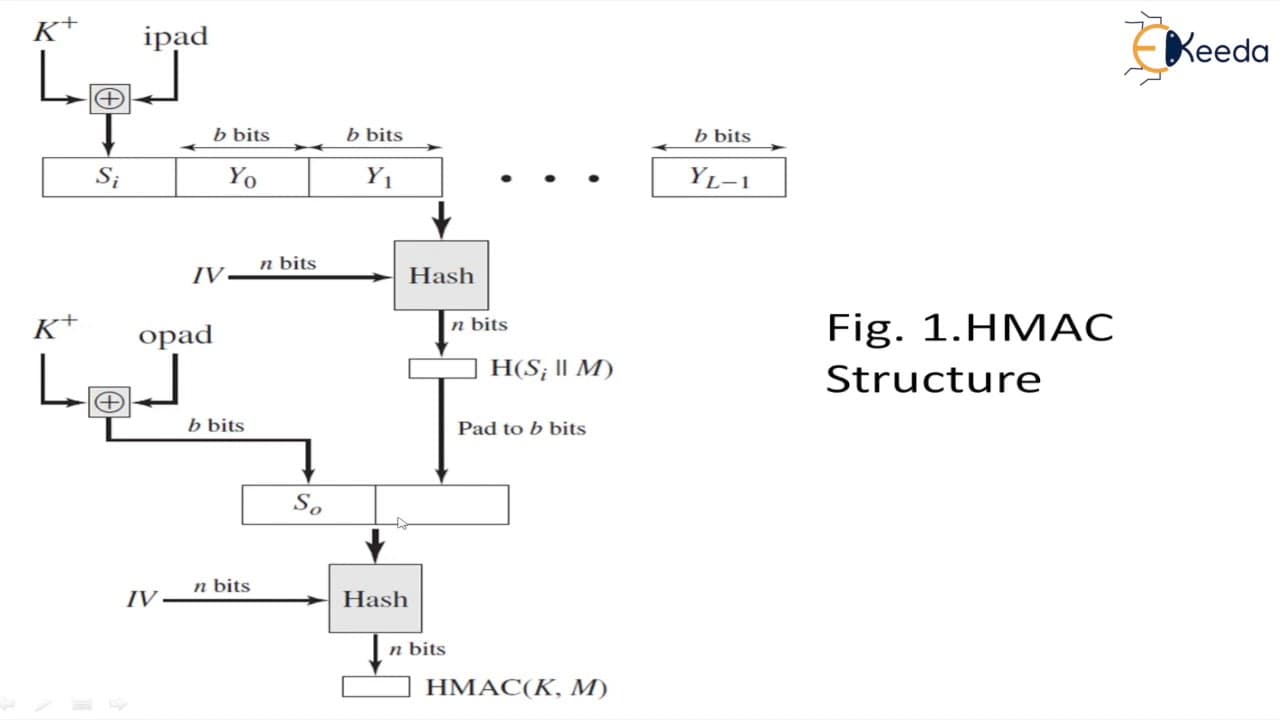
- 🤶 The HMAC algorithm involves the addition of IPad, K+, and M as inputs to the hash function to produce the MAC.
- 🤩 The key length and message length determine the structure and output of the HMAC algorithm.
- 🎅 There are variations of hash function based MAC, such as C-MAC and DAA.
- 😒 C-MAC uses block chaining mode of operation and AES or Triple DES for authentication.
- 🤩 The C-MAC algorithm divides the message into blocks and applies encryption and key operations to generate authentication code.
Install to Summarize YouTube Videos and Get Transcripts
Explore YouTube Video Summarizer or Get YouTube Transcript Extractor
Questions & Answers
Q: What are the advantages of using hash functions for MAC instead of block ciphers?
Hash functions like MD7, MD5, and SHA are faster in software execution compared to block ciphers like DES. They also have widely available library code, increasing their demand for MAC applications.
Q: What are the design objectives for HMAC?
The design objectives for HMAC include using available hash functions that perform well in software, allowing easy replacement of embedded hash functions, preserving original performance, simple key handling, and having cryptographic analysis of the authentication strength.
Q: How is the HMAC algorithm defined?
The HMAC algorithm consists of an embedded hash function (H), an initial value input (M), a message input (M), a number of blocks (L) in the message, a length of hash code (N), and a secret key input (K). The algorithm follows a specific structure where the hash function takes inputs, performs calculations, and produces the final authentication code.
Q: What is the structure of the HMAC algorithm?
The HMAC algorithm involves the addition of the initial value input (IPad) and the padded key (K+) to produce an output (SI). This output, along with the message input (M), is given as input to the hash function, which produces the authentication code (MAC).
Summary & Key Takeaways
-
Hash functions like MD7, MD5, and SHA perform faster in software compared to symmetric block ciphers like DES.
-
The availability of library code for cryptographic hash functions increases the demand for hash function based MAC.
-
The design objectives for HMAC include using available hash functions, easy replacement of hash functions, preserving performance, handling keys easily, and having cryptographic analysis.
Read in Other Languages (beta)
Share This Summary 📚
Summarize YouTube Videos and Get Video Transcripts with 1-Click
Try YouTube Summary with ChatGPT & Claude or YouTube Transcript Generator
Explore More Summaries from Ekeeda 📚


Summarize YouTube Videos and Get Video Transcripts with 1-Click
Try YouTube Summary with ChatGPT & Claude or YouTube Transcript Generator