Distant time and the hint of a multiverse - Sean Carroll
TL;DR
The universe is vast and expanding, with a hundred billion galaxies and stars. Understanding its low entropy and why it is accelerating is a challenge for cosmologists.
Transcript
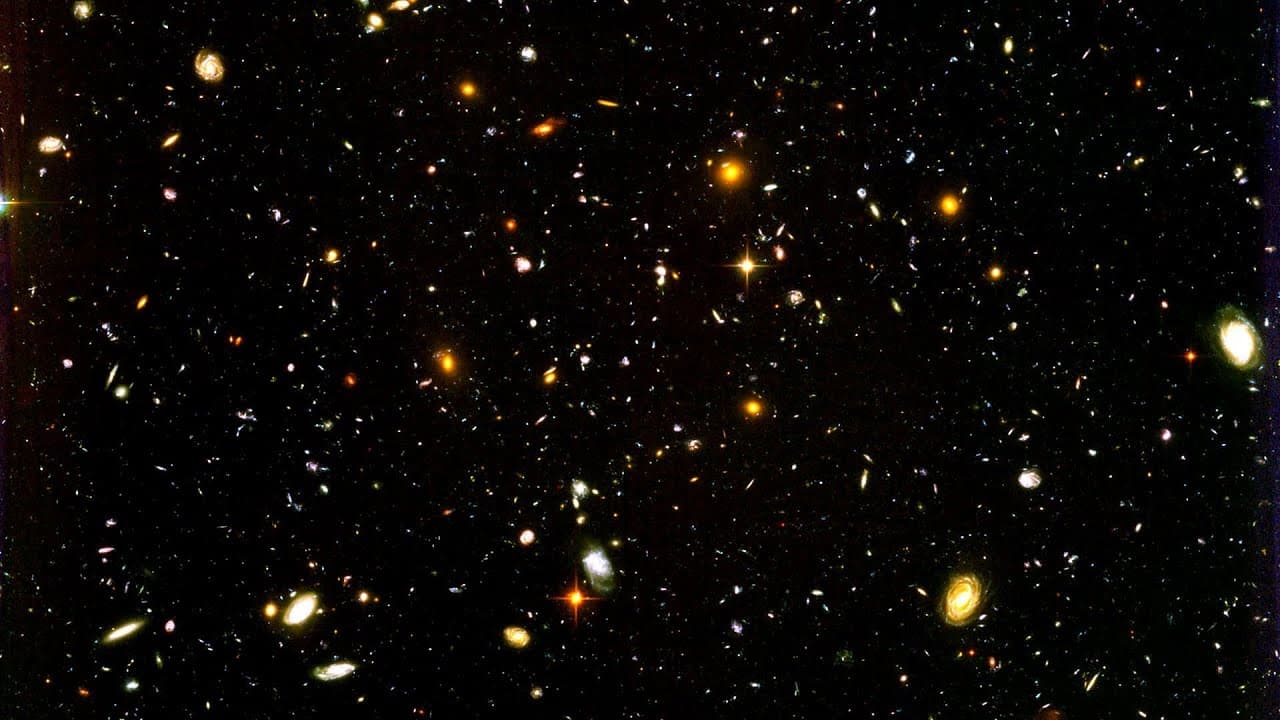
the universe is really big we live in a galaxy the Milky Way galaxy there about a hundred billion stars in the Milky Way galaxy and if you take a camera and you point it at a random part of the sky and you just keep the shutter open as long as your camera is attached to the Hubble Space Telescope it will see something like this every one of these l... Read More
Key Insights
- 🤩 The universe contains a hundred billion galaxies, each with a hundred billion stars.
- 😘 The early universe was highly smooth and low in entropy, posing a challenge for cosmologists to explain.
- 💘 The expansion of the universe and the increase of entropy are linked to the arrow of time.
- 👾 Dark energy, present in empty space, drives the universe's acceleration and eternal expansion.
- 👾 The future universe will consist mainly of black holes, followed by an era of empty space giving off thermal fluctuations.
- #️⃣ The number of things that can possibly happen in the universe is finite, occurring over 10 to the 10 to the 120 years.
- 👾 There is a mystery surrounding why we exist in the first 14 billion years and not in the empty space of the later universe.
Install to Summarize YouTube Videos and Get Transcripts
Explore YouTube Video Summarizer or Get YouTube Transcript Extractor
Questions & Answers
Q: Why is the universe expanding and moving away from us?
The velocity and distance of galaxies reveal that the universe is expanding. Further galaxies are moving away faster due to the expansion, suggesting that space itself is expanding.
Q: What made the early universe so smooth and low in entropy?
The conditions near the Big Bang were unique, with a hundred billion galaxies squeezed into a small region. Maintaining smoothness and low entropy required a delicate arrangement and an as-of-yet unknown explanation.
Q: What insights did Ludwig Boltzmann provide?
Boltzmann's formula helped quantify entropy, proving that there are many more high entropy configurations than low entropy ones. His work also raised questions about why the entropy of the universe was ever low in the first place.
Q: How does dark energy affect the universe?
Dark energy, present in empty space, contributes to the acceleration of the universe's expansion. Unlike matter or radiation, dark energy does not dilute as the universe expands, leading to an eternal expansion.
Summary & Key Takeaways
-
The universe consists of a hundred billion galaxies with a hundred billion stars each, all of which were densely packed in the past.
-
The universe's early smoothness and low entropy pose a puzzle for cosmologists.
-
Ludwig Boltzmann's theory of entropy helps explain why entropy increases and why the arrow of time moves from past to future.
Read in Other Languages (beta)
Share This Summary 📚
Summarize YouTube Videos and Get Video Transcripts with 1-Click
Try YouTube Summary with ChatGPT & Claude or YouTube Transcript Generator
Explore More Summaries from TED-Ed 📚






Summarize YouTube Videos and Get Video Transcripts with 1-Click
Try YouTube Summary with ChatGPT & Claude or YouTube Transcript Generator