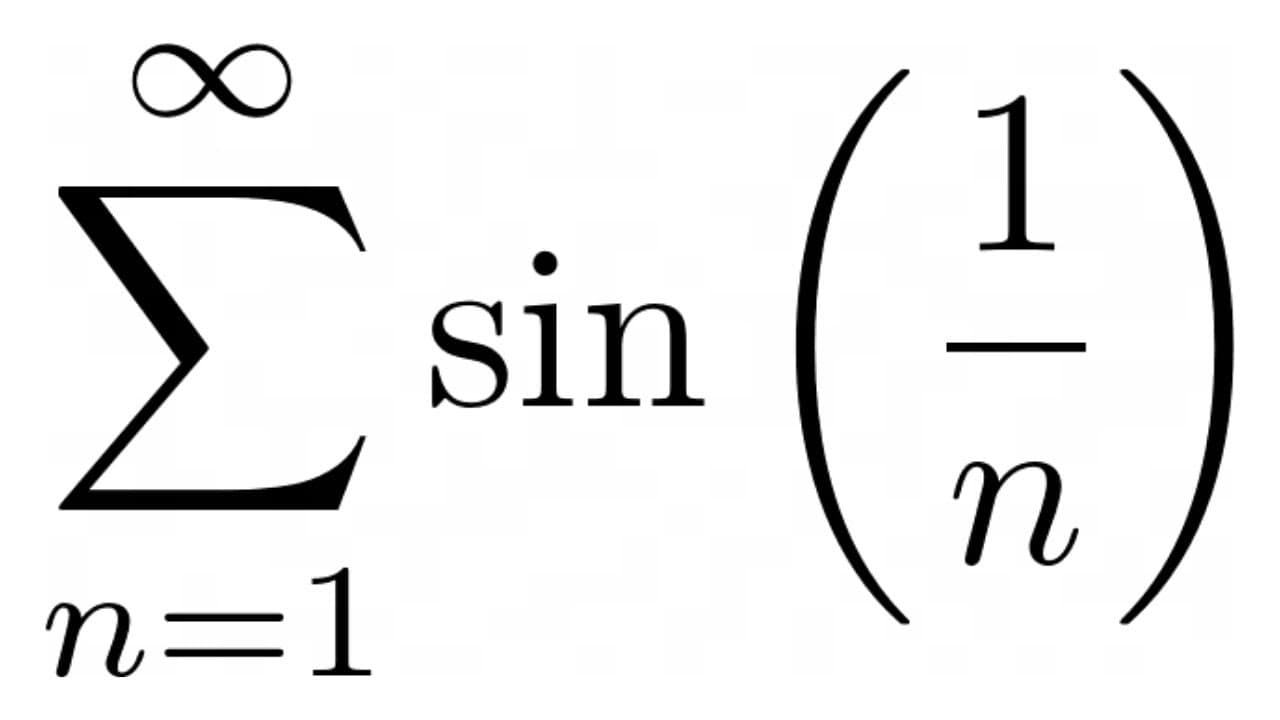
Limit Comparison Test Example with SUM(sin(1/n))
TL;DR
Use the limit comparison test to determine if the given infinite series converges or diverges.
Transcript
hi everyone in this problem we have an infinite sum and we're being asked to determine if it converges or diverges so this is an interesting problem so solution so number you're doing series you know the first test you should always at least mentally do is the nth term test so if you take the limit as n goes to infinity of whatever is here and you ... Read More
Key Insights
- 💭 The nth term test is not suitable for analyzing this series.
- 👻 The limit comparison test allows for a more effective analysis by comparing the given series to a simpler known series.
- 😚 Knowing that sine X is approximately equal to X when X is close to 0 simplifies the comparison process.
- 🏆 The limit comparison test is used to determine if the series behaves similarly to a known convergent or divergent series.
- 😀 The given series diverges, as it behaves similarly to the divergent p-series.
- ☠️ Understanding the growth rate of the terms in the series is crucial in selecting a suitable comparison series.
- ☠️ The sums of the A's and B's in the series should behave the same if their growth rates are similar.
Install to Summarize YouTube Videos and Get Transcripts
Explore YouTube Video Summarizer or Get YouTube Transcript Extractor
Questions & Answers
Q: What is the significance of the nth term test in determining the convergence or divergence of a series?
The nth term test helps determine convergence or divergence by taking the limit as n approaches infinity. If the limit is not equal to zero, the series diverges.
Q: How does the limit comparison test work in analyzing the given series?
The limit comparison test involves comparing the given series with a known series whose convergence or divergence is already established. The limit of the ratio between the terms of the two series is then taken to determine if they behave similarly.
Q: Why is it important to know that sine X is approximately equal to X when X is close to 0?
Knowing this fact simplifies the problem, as it allows us to consider sine of 1 over n as 1 over n for the purpose of comparison. This reduces the complexity and makes the analysis much easier.
Q: How does the limit comparison test help determine if the series converges or diverges?
If the limit of the ratio between the terms of the given series and a known convergent series is a positive finite number, it implies that the series behaves similarly. If the known series converges, so does the given series, and if the known series diverges, so does the given series.
Summary & Key Takeaways
-
The nth term test is not applicable in this case, so the limit comparison test is used to analyze the series.
-
It is important to know that sine X is approximately equal to X when X is close to 0 in order to solve the problem.
-
Applying the limit comparison test confirms that the series diverges, as it behaves similarly to the divergent p-series.
Read in Other Languages (beta)
Share This Summary 📚
Summarize YouTube Videos and Get Video Transcripts with 1-Click
Try YouTube Summary with ChatGPT & Claude or YouTube Transcript Generator
Explore More Summaries from The Math Sorcerer 📚


Summarize YouTube Videos and Get Video Transcripts with 1-Click
Try YouTube Summary with ChatGPT & Claude or YouTube Transcript Generator