Laplace as linear operator and Laplace of derivatives | Laplace transform | Khan Academy
TL;DR
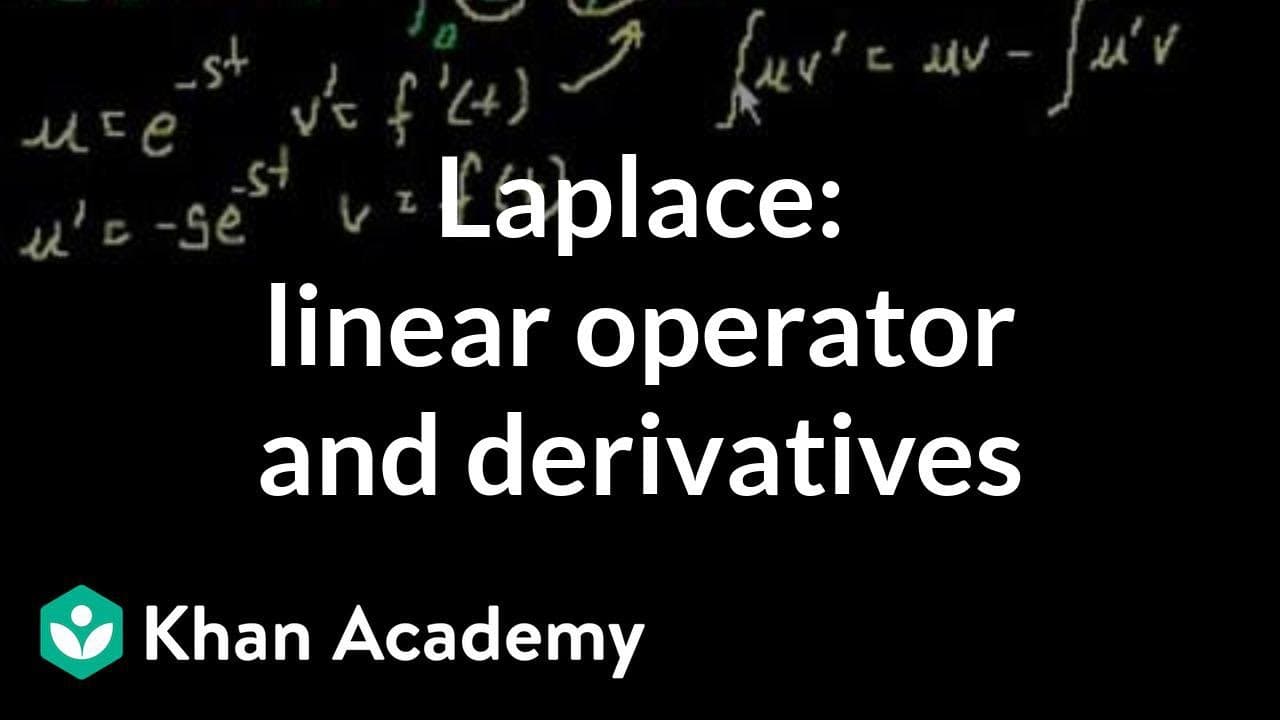
The Laplace transform is a linear operator and can be used to convert derivatives into multiplications by s.
Transcript
Well, now's as good a time as any to go over some interesting and very useful properties of the Laplace transform. And the first is to show that it is a linear operator. And what does that mean? Well, let's say I wanted to take the Laplace transform of the sum of the-- we call it the weighted sum of two functions. So say some constant, c1, times my... Read More
Key Insights
- 🍹 The Laplace transform is a linear operator, allowing for the transform of the sum of two functions to be calculated by taking the sum of their transformed counterparts.
- 🥳 Applying integration by parts can help find the Laplace transform of a function's derivative.
- 💄 The Laplace transform converts derivatives into multiplications by s, making it useful for solving differential equations.
Install to Summarize YouTube Videos and Get Transcripts
Explore YouTube Video Summarizer or Get YouTube Transcript Extractor
Questions & Answers
Q: What is a linear operator in the context of the Laplace transform?
A linear operator means that the Laplace transform can be applied to the sum of two functions by taking the transform of each function separately and then taking the sum of their transformed counterparts.
Q: How can the Laplace transform of a function's derivative be found?
The Laplace transform of a function's derivative can be found using integration by parts, where the function itself is differentiated and the exponential term from the Laplace transform is integrated.
Q: What is the relationship between the Laplace transform of a derivative and the Laplace transform of the original function?
The Laplace transform of a function's derivative is equal to the Laplace transform of the original function multiplied by s, where s is a constant.
Q: What is the pattern observed in the Laplace transform of higher derivatives?
The Laplace transform of the second derivative of a function follows a pattern where it becomes s squared times the Laplace transform of the function minus s times the initial value of the function minus the initial value of the derivative.
Summary & Key Takeaways
-
The Laplace transform is a linear operator, meaning that it can be applied to the sum of two functions by distributing the transform over each function and taking the sum of their transformed counterparts.
-
The Laplace transform of a function's derivative can be found using integration by parts, resulting in a relationship between the Laplace transform of the derivative and the Laplace transform of the original function.
-
The Laplace transform of the second derivative of a function follows a pattern where it becomes s squared times the Laplace transform of the function minus s times the initial value of the function minus the initial value of the derivative.
Read in Other Languages (beta)
Share This Summary 📚
Summarize YouTube Videos and Get Video Transcripts with 1-Click
Try YouTube Summary with ChatGPT & Claude or YouTube Transcript Generator
Explore More Summaries from Khan Academy 📚



Summarize YouTube Videos and Get Video Transcripts with 1-Click
Try YouTube Summary with ChatGPT & Claude or YouTube Transcript Generator