The Future of U.S.-China Relations
TL;DR
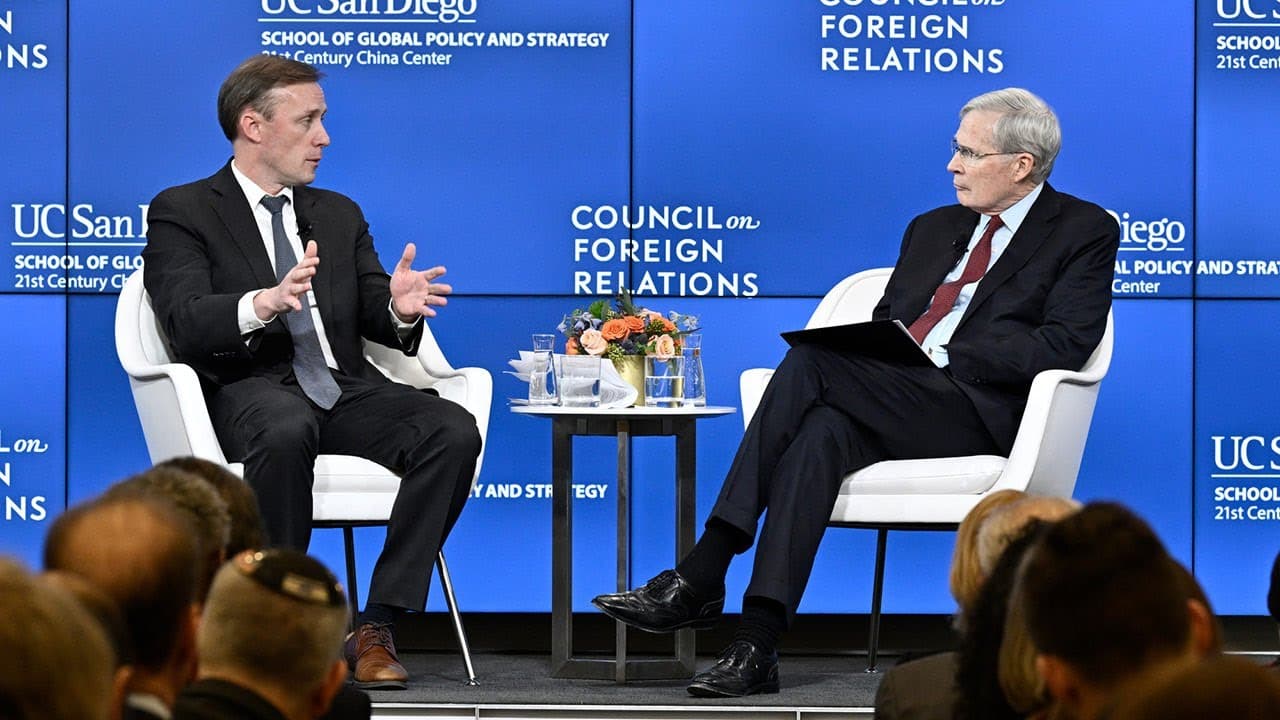
Jake Sullivan discusses U.S.-China relations and future policy directions.
Transcript
FROMAN: Good evening. My name is Mike Froman. I’m president of the Council on Foreign Relations. And it is a distinct honor to welcome you here tonight for the opening of a very important two-day meeting on U.S.-China relations organized by the UC San Diego Forum on U.S.-China Relations, which has become no doubt the premier forum of experts ... Read More
Key Insights
- The U.S. approach to China involves managing competition while avoiding conflict, focusing on strategic stability and cooperation where possible.
- Diplomatic efforts have been intensified to stabilize U.S.-China relations, with high-level meetings and dialogues on key issues like AI and military communication.
- The U.S. strategy includes significant investments in domestic industrial and technological capacities to strengthen competitive positions globally.
- China's perception of the U.S. as in decline is a critical factor in bilateral relations, influencing China's strategic decisions and interactions.
- The U.S. aims to diversify supply chains and maintain technological leadership to mitigate risks associated with economic dependencies on China.
- Human rights issues remain a significant point of contention, with the U.S. committed to addressing abuses while engaging diplomatically with China.
- The trilateral relationship with Japan and South Korea is crucial for regional stability, focusing on security, economic cooperation, and global issues.
- The Biden administration continues to balance competition with collaboration in areas like climate change and global health, recognizing shared interests.
Install to Summarize YouTube Videos and Get Transcripts
Explore YouTube Video Summarizer or Get YouTube Transcript Extractor
Questions & Answers
Q: What were the main outcomes of Jake Sullivan's recent meeting with Wang Yi?
In the recent meeting with Wang Yi, Jake Sullivan focused on launching a dialogue on AI risk management, discussing cross-strait issues, and addressing current global events. Both parties agreed on the importance of leader-to-leader communication, with plans for a future call between President Biden and President Xi.
Q: How does the U.S. view the recent elections in Taiwan?
The U.S. maintained a neutral stance during Taiwan's elections, congratulating the winner and emphasizing the importance of Taiwan's democratic process. The U.S. continues to uphold the 'One China' policy while expressing concerns about China's military activities around Taiwan, advocating for peace and stability in the region.
Q: What is the U.S. strategy regarding China's economic challenges?
The U.S. acknowledges the complexity of China's economic situation and focuses on strengthening its own industrial base and innovation capacity. The strategy involves rejecting narratives of inevitable decline and rise, instead emphasizing choices and adaptability in economic policies.
Q: How does the U.S. approach technology and national security in relation to China?
The U.S. aims to protect national security by implementing export controls and regulating outbound investments in critical technologies. The strategy is not to hinder China's economic growth but to ensure that American technology is not used to undermine U.S. and allied security.
Q: What is the U.S. position on AI governance and international treaties?
The U.S. supports AI governance that upholds fundamental rights and democratic values. While engaged in international treaty negotiations, the U.S. seeks to ensure that AI development supports open and pluralistic societies, balancing national interests with global ethical standards.
Q: How is the U.S. addressing China's influence in Africa?
The U.S. focuses on offering a better value proposition in Africa by mobilizing capital for infrastructure, clean energy, and digital investments. The strategy emphasizes development partnerships rather than viewing Africa as a battleground for U.S.-China competition.
Q: What role does the trilateral relationship with Japan and South Korea play?
The trilateral relationship with Japan and South Korea is pivotal for regional security, economic cooperation, and addressing global challenges. It involves enhanced defense collaboration, joint deterrence, and a shared vision for global stability, extending beyond regional concerns.
Q: How does the U.S. plan to address human rights issues with China?
The U.S. remains committed to speaking out against human rights abuses in China, including issues in Xinjiang and Tibet. The approach involves direct diplomacy, legislative actions like the Uyghur Forced Labor Protection Act, and collaboration with international partners to uphold human rights standards.
Summary & Key Takeaways
-
Jake Sullivan outlined the Biden administration's strategy for managing U.S.-China relations, emphasizing the need for stability and cooperation amidst competition. The approach involves strengthening alliances, investing in domestic capabilities, and maintaining open diplomatic channels.
-
The U.S. is focused on addressing China's economic and military ambitions while ensuring national security. This involves diversifying supply chains and implementing export controls on critical technologies. Diplomatic engagements aim to manage tensions and explore areas of mutual interest.
-
Human rights, regional security, and economic policies are key areas of U.S.-China engagement. The U.S. continues to advocate for human rights and seeks to work with allies to counterbalance China's influence, while also exploring opportunities for cooperation on global challenges.
Read in Other Languages (beta)
Share This Summary 📚
Summarize YouTube Videos and Get Video Transcripts with 1-Click
Try YouTube Summary with ChatGPT & Claude or YouTube Transcript Generator
Explore More Summaries from Council on Foreign Relations 📚


Summarize YouTube Videos and Get Video Transcripts with 1-Click
Try YouTube Summary with ChatGPT & Claude or YouTube Transcript Generator