How Do Supermassive Black Holes Form?
TL;DR
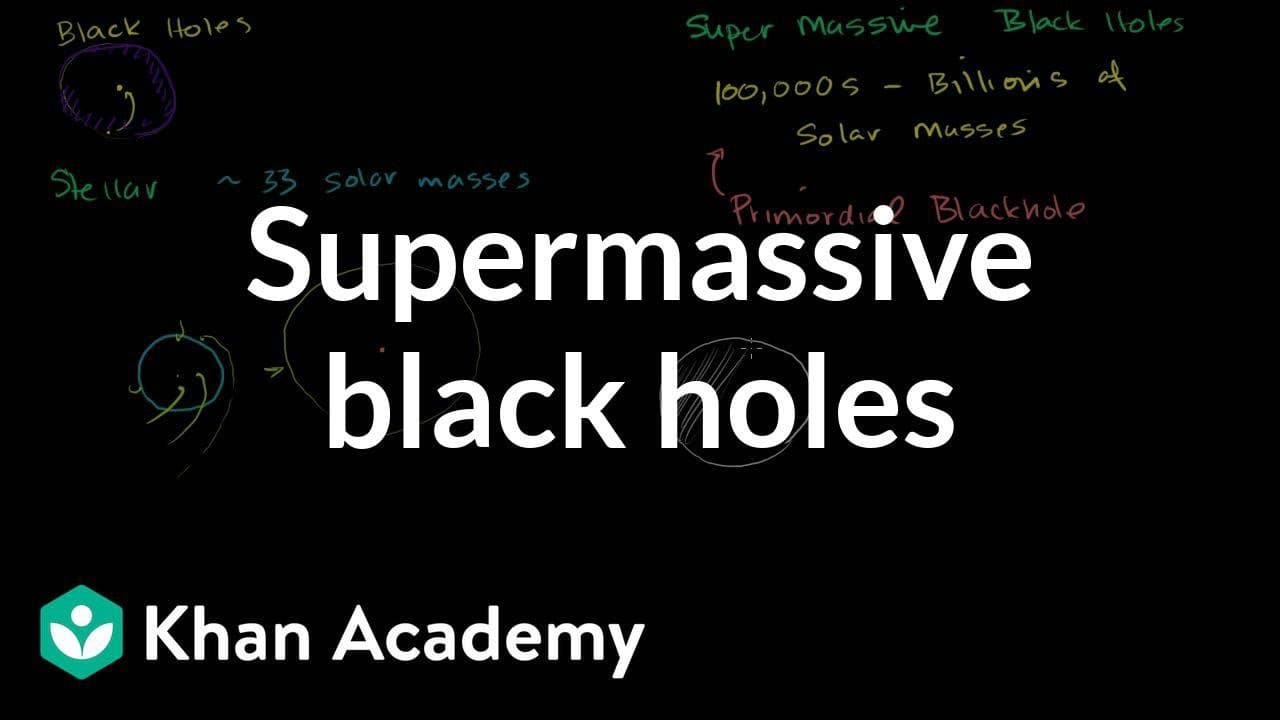
Supermassive black holes form either from the rapid accumulation of mass around stellar black holes or as primordial black holes that emerged shortly after the Big Bang. With masses ranging from hundreds of thousands to billions of solar masses, they are primarily located at the centers of galaxies, and their formation remains a key mystery in cosmology.
Transcript
In the videos on massive stars and on black holes, we learned that if the remnant of a star, of a massive star, is massive enough, the gravitational contraction, the gravitational force, will be stronger than even the electron degeneracy pressure, even stronger than the neutron degeneracy pressure, even stronger than the quark degeneracy pressure. ... Read More
Key Insights
- ✴️ Black holes form when the gravitational force overcomes degeneracy pressures, causing matter to collapse into an infinitely dense point called a singularity.
- ✴️ Stellar black holes are formed from collapsing massive stars and can have a mass of up to 33 solar masses.
- ⬛ Supermassive black holes are much larger and are found in the centers of galaxies, with masses ranging from hundreds of thousands to billions of solar masses.
- 🖤 The formation of supermassive black holes is still not fully understood, with two theories suggesting they either grow from regular stellar black holes or they are primordial black holes formed shortly after the Big Bang.
- 🖤 It is unclear why there are no observed black holes between stellar and supermassive sizes, but it raises questions about the formation and evolution of black holes.
- 🖤 The supermassive black hole at the center of the Milky Way is estimated to be around 4 million times the mass of the Sun.
- 💁 Supermassive black holes could have played a role in the formation of galaxies by attracting mass and causing orbiting objects to form around them.
- 🖤 Quasars are believed to be powered by supermassive black holes, generating immense amounts of radiation.
Install to Summarize YouTube Videos and Get Transcripts
Explore YouTube Video Summarizer or Get YouTube Transcript Extractor
Questions & Answers
Q: How are stellar black holes formed?
Stellar black holes form from the collapse of massive stars. If the remnant of a star is massive enough, gravitational forces overcome degeneracy pressures, causing the star to collapse into a point, resulting in a black hole.
Q: What is the difference between stellar black holes and supermassive black holes?
Stellar black holes have a mass of up to 33 solar masses and are formed from collapsing massive stars. Supermassive black holes, on the other hand, are much larger, ranging from hundreds of thousands to billions of solar masses, and are found in the centers of galaxies.
Q: How do supermassive black holes form if not from collapsing stars?
The formation of supermassive black holes is still not fully understood. One theory suggests that they grow from regular stellar black holes by accreting more mass, while another theory suggests they are primordial black holes that formed shortly after the Big Bang.
Q: Why haven't we observed black holes in between stellar black holes and supermassive black holes?
The lack of observed black holes between stellar and supermassive black holes is still a mystery. It is possible that there are intermediate-sized black holes, but they have not yet been detected.
Summary & Key Takeaways
-
Stellar black holes are formed from the collapse of massive stars and can have a mass of up to 33 solar masses.
-
Supermassive black holes are much larger, ranging from hundreds of thousands to billions of solar masses, and are found primarily in the centers of galaxies.
-
The formation of supermassive black holes is still not fully understood, but two theories suggest they either grow from regular stellar black holes by accreting more mass, or they are primordial black holes that formed shortly after the Big Bang.
Read in Other Languages (beta)
Share This Summary 📚
Summarize YouTube Videos and Get Video Transcripts with 1-Click
Try YouTube Summary with ChatGPT & Claude or YouTube Transcript Generator
Explore More Summaries from Khan Academy 📚



Summarize YouTube Videos and Get Video Transcripts with 1-Click
Try YouTube Summary with ChatGPT & Claude or YouTube Transcript Generator