2.4 Drag Force - The Nature of Code
TL;DR
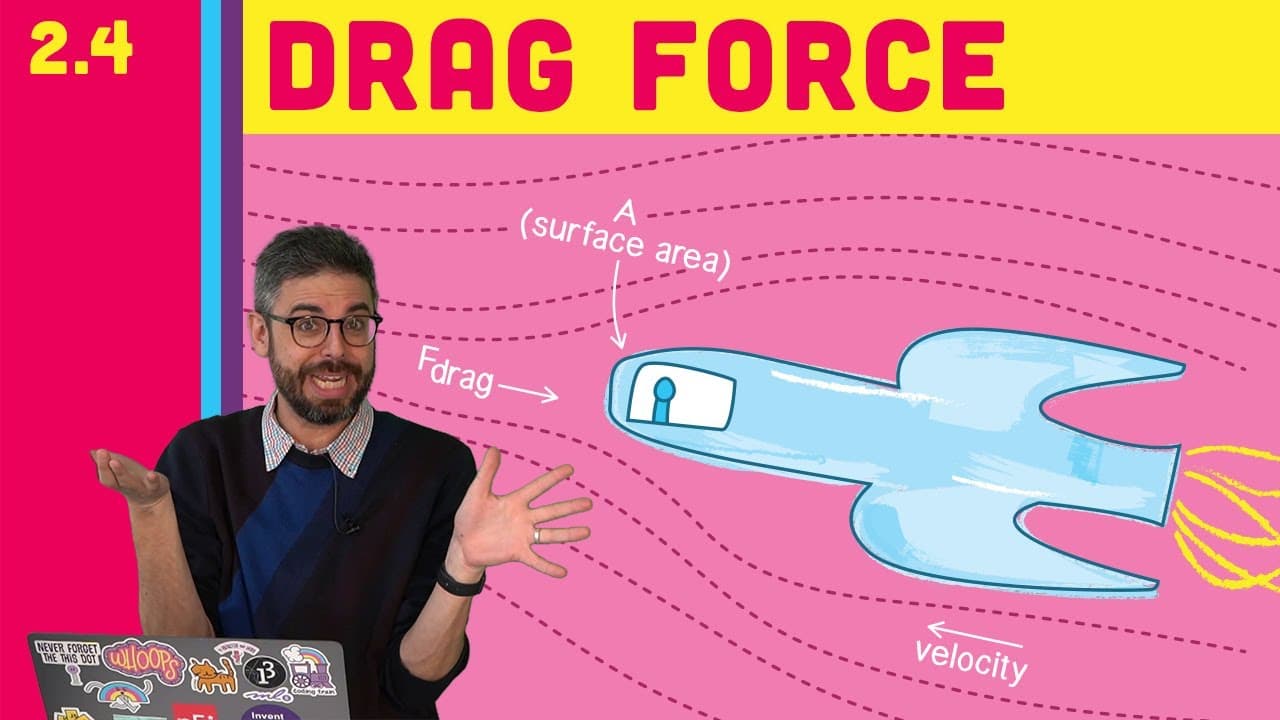
This video explores the concept of drag force and how to implement it in code.
Transcript
hello and welcome back to another video in Chapter two the nature of code about forces so the last video I look at it friction and modeling friction and in this video I want to look at a drag force which is quite similar to friction but also different isn't that that's why I'm looking at it but what I'm really doing here in these in these four wrap... Read More
Key Insights
- 🐲 Drag force is a type of friction experienced by objects moving through a fluid.
- 🐲 The drag force formula considers factors such as density, surface area, and coefficient of drag.
- 🐲 Drag force is directly proportional to the square of the object's velocity.
- 👨💻 Implementing drag force in code requires adjusting various parameters and considering the characteristics of the simulated environment.
- 🐲 Advanced simulations can involve modeling different fluids with varying coefficients of drag and surface areas.
- 🐲 Considerations should be made for the size and shape of objects to accurately calculate drag force in simulations.
- 😫 Constraints may need to be set to ensure realistic behavior when implementing drag force in code.
Install to Summarize YouTube Videos and Get Transcripts
Explore YouTube Video Summarizer or Get YouTube Transcript Extractor
Questions & Answers
Q: What is drag force and how does it differ from friction?
Drag force, also known as air resistance, is a type of friction experienced by objects moving through a fluid. While friction occurs between two solid surfaces, drag force occurs between an object and a fluid, such as air or water.
Q: What factors determine the magnitude of drag force?
The magnitude of drag force depends on factors such as density of the fluid, surface area of the object, and the coefficient of drag. Additionally, the speed of the object plays a crucial role, as drag force is directly proportional to the square of the object's velocity.
Q: How can drag force be implemented in code?
Drag force can be implemented in code by using the drag force formula, which takes into account the negative direction of velocity, density, surface area, coefficient of drag, and the magnitude of the velocity vector squared. These values can be adjusted to simulate different scenarios and behaviors.
Q: Are there any considerations when implementing drag force in code?
Some considerations when implementing drag force in code include determining the appropriate values for the density, surface area, and coefficient of drag. It may also be necessary to set constraints to prevent unrealistic behavior, such as objects being pushed back up when the drag force is too strong.
Summary & Key Takeaways
-
The video discusses drag force, a type of friction, and its role in fluid dynamics and simulation.
-
The drag force formula is broken down and simplified for implementation in a two-dimensional p5 canvas.
-
The video also explores the factors involved in calculating drag force, such as density, surface area, and coefficient of drag.
Read in Other Languages (beta)
Share This Summary 📚
Summarize YouTube Videos and Get Video Transcripts with 1-Click
Try YouTube Summary with ChatGPT & Claude or YouTube Transcript Generator
Explore More Summaries from The Coding Train 📚






Summarize YouTube Videos and Get Video Transcripts with 1-Click
Try YouTube Summary with ChatGPT & Claude or YouTube Transcript Generator