Leaching of Alumina from Bauxite
TL;DR
This video discusses the process of leaching aluminum from bauxite using two methods: Bayers process and Hall's process.
Transcript
click the bell icon to get latest videos from equator and friends in the previous section we have discussed about the first rotation process and now in this topic we are going to talk about leaching of aluminum from bauxite so in this topic we are going to talk about that is how basically the alumina is extracted from the box head and by removing t... Read More
Key Insights
- ❓ Leaching is an essential chemical method used to concentrate alumina from bauxite.
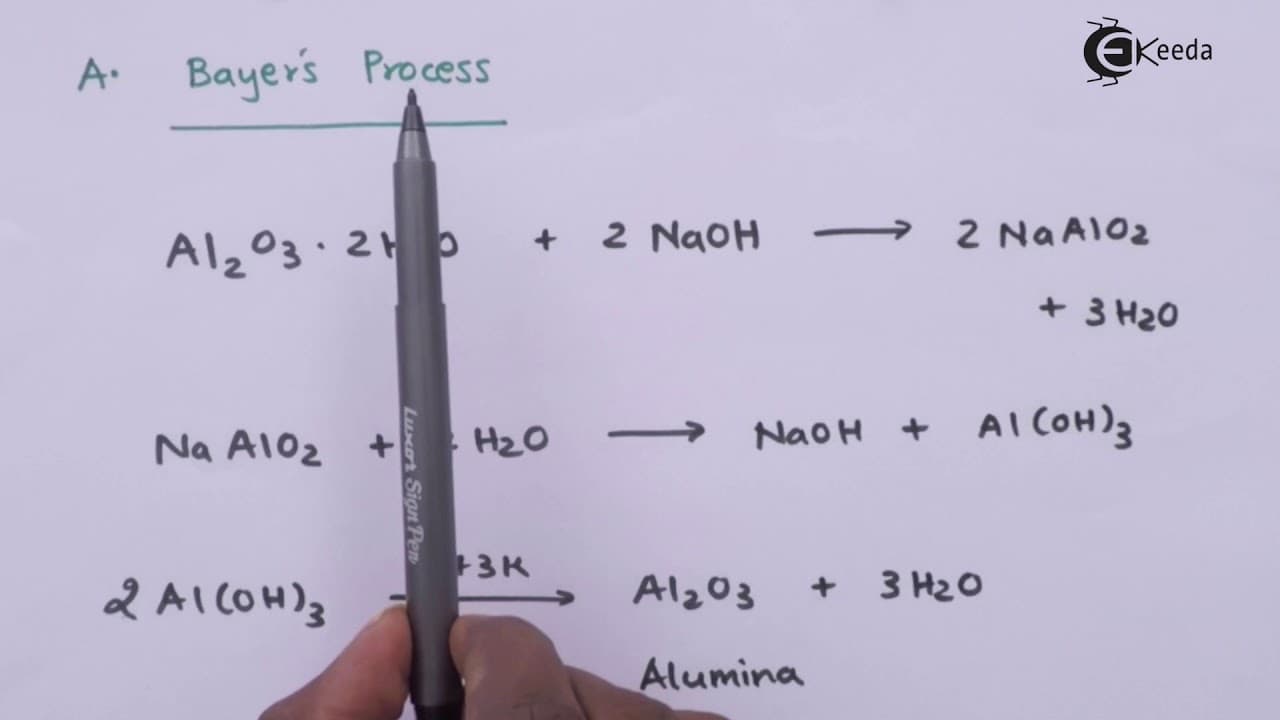
- ❓ The Bayers process involves treating bauxite with NaOH to obtain sodium aluminate, which undergoes further reactions to yield alumina.
- 😒 Hall's process uses Na2CO3 instead of NaOH to achieve the same result.
- ❓ Both processes involve heating aluminum hydroxide to obtain alumina.
- 🤘 Leaching is crucial in obtaining a pure and usable form of alumina for the production of aluminum metal.
- ✋ The extraction of alumina from bauxite involves eliminating impurities to obtain a high-quality product.
- ❓ Sodium hydroxide and sodium aluminate are intermediates in the leaching process.
Install to Summarize YouTube Videos and Get Transcripts
Explore YouTube Video Summarizer or Get YouTube Transcript Extractor
Questions & Answers
Q: What is leaching, and why is it important in the extraction of aluminum from bauxite?
Leaching is the process of dissolving a soluble material from an insoluble solid using a suitable solvent. In the case of aluminum extraction from bauxite, leaching helps eliminate impurities and obtain a high quantity of alumina, a precursor to aluminum metal.
Q: What is the Bayers process, and how does it extract alumina from bauxite?
In the Bayers process, bauxite is treated with NaOH to obtain sodium aluminate, which is then treated with water to produce sodium hydroxide and aluminum hydroxide. Heating aluminum hydroxide further yields alumina, which is the final product.
Q: How does Hall's process differ from the Bayers process?
Hall's process treats bauxite with Na2CO3 instead of NaOH. The resulting sodium aluminate is then treated with CO2 and water to obtain aluminum hydroxide. The subsequent steps of heating aluminum hydroxide and obtaining alumina are the same as in the Bayers process.
Q: Why is aluminum hydroxide heated to obtain alumina?
Heating aluminum hydroxide dehydrates it, resulting in the formation of alumina (aluminum oxide) and water as by-products. Alumina is the desired product in the extraction of aluminum from bauxite.
Summary & Key Takeaways
-
Leaching is the process of extracting a soluble material from an insoluble solid by dissolving it in a suitable solvent.
-
Bayers process involves treating bauxite with NaOH to obtain sodium aluminate, which is then treated with water to get sodium hydroxide and aluminum hydroxide. Heating aluminum hydroxide results in alumina and water.
-
Hall's process treats bauxite with Na2CO3 to obtain sodium aluminate, which is then treated with CO2 and water to get aluminum hydroxide. Heating aluminum hydroxide results in alumina and water.
Read in Other Languages (beta)
Share This Summary 📚
Summarize YouTube Videos and Get Video Transcripts with 1-Click
Try YouTube Summary with ChatGPT & Claude or YouTube Transcript Generator
Explore More Summaries from Ekeeda 📚






Summarize YouTube Videos and Get Video Transcripts with 1-Click
Try YouTube Summary with ChatGPT & Claude or YouTube Transcript Generator