Graphing logarithmic functions | Exponential and logarithmic functions | Algebra II | Khan Academy
TL;DR
This video explains how to graph a logarithmic function and discusses the relationship between exponential and logarithmic equations.
Transcript
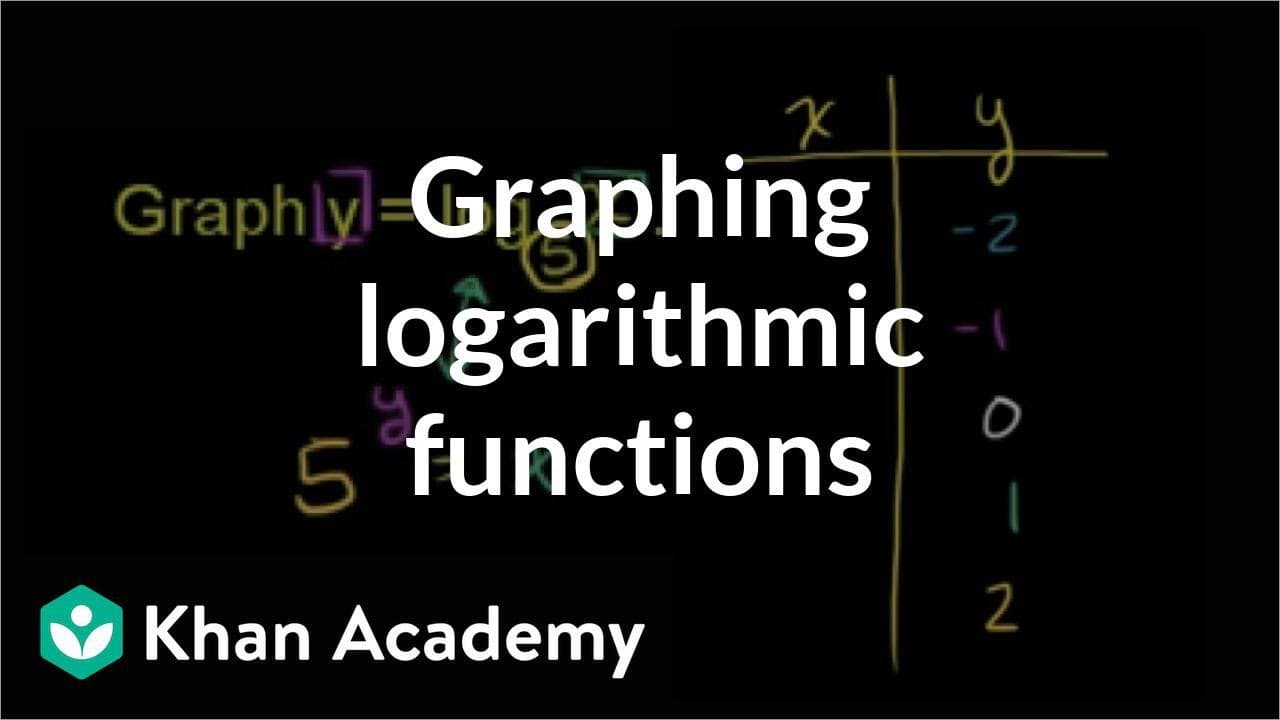
We're asked to graph, y is equal to log base 5 of x. And just to remind us what this is saying, this is saying that y is equal to the power that I have to raise 5 to to get to x. Or if I were to write this logarithmic equation as an exponential equation, 5 is my base, y is the exponent that I have to raise my base to, and then x is what I get when ... Read More
Key Insights
- 🤨 Logarithmic functions with base 5 can be written as y = log base 5 of x, where y represents the power to which 5 is raised to get x.
- 🤨 Graphing a logarithmic function involves finding y-values by raising the base to the power of the chosen x-values.
- 💁 The relationship between exponential and logarithmic equations is that they express the same information in different forms.
- ✊ The domain of a logarithmic function is x > 0, as there are no powers that can be raised to 5 to get negative or zero values.
- 📫 As x approaches infinity, the graph of a logarithmic function gets closer to the x-axis but never touches it.
Install to Summarize YouTube Videos and Get Transcripts
Explore YouTube Video Summarizer or Get YouTube Transcript Extractor
Questions & Answers
Q: How does graphing a logarithmic function differ from graphing an exponential function?
Graphing a logarithmic function involves finding the y-values by raising the base to the power of the chosen x-values, while graphing an exponential function involves finding the x-values by raising the base to the power of the chosen y-values.
Q: What is the domain of the logarithmic function y = log base 5 of x?
The domain of this logarithmic function is x > 0 because there are no powers that can be raised to 5 to get negative or zero values.
Q: How does the graph of a logarithmic function behave as x approaches infinity?
As x gets larger and larger, the graph of a logarithmic function gets closer and closer to the x-axis, but it never touches it.
Q: What happens to the graph of a logarithmic function as x approaches zero?
As x gets smaller and approaches zero, the graph of a logarithmic function becomes steeper and approaches negative infinity in the y-direction.
Summary & Key Takeaways
-
The video explains that a logarithmic function with base 5 can be written as y = log base 5 of x, which means y is the power to which 5 is raised to get x.
-
By converting the logarithmic equation into an exponential equation (5^y = x), it becomes clear that logarithmic and exponential equations convey the same information.
-
The video demonstrates how to create a table of values using nice, round numbers for x and calculate the corresponding y-values by raising 5 to the power of the chosen numbers.
Read in Other Languages (beta)
Share This Summary 📚
Summarize YouTube Videos and Get Video Transcripts with 1-Click
Try YouTube Summary with ChatGPT & Claude or YouTube Transcript Generator
Explore More Summaries from Khan Academy 📚



Summarize YouTube Videos and Get Video Transcripts with 1-Click
Try YouTube Summary with ChatGPT & Claude or YouTube Transcript Generator