Python Regular Expressions - Computerphile
TL;DR
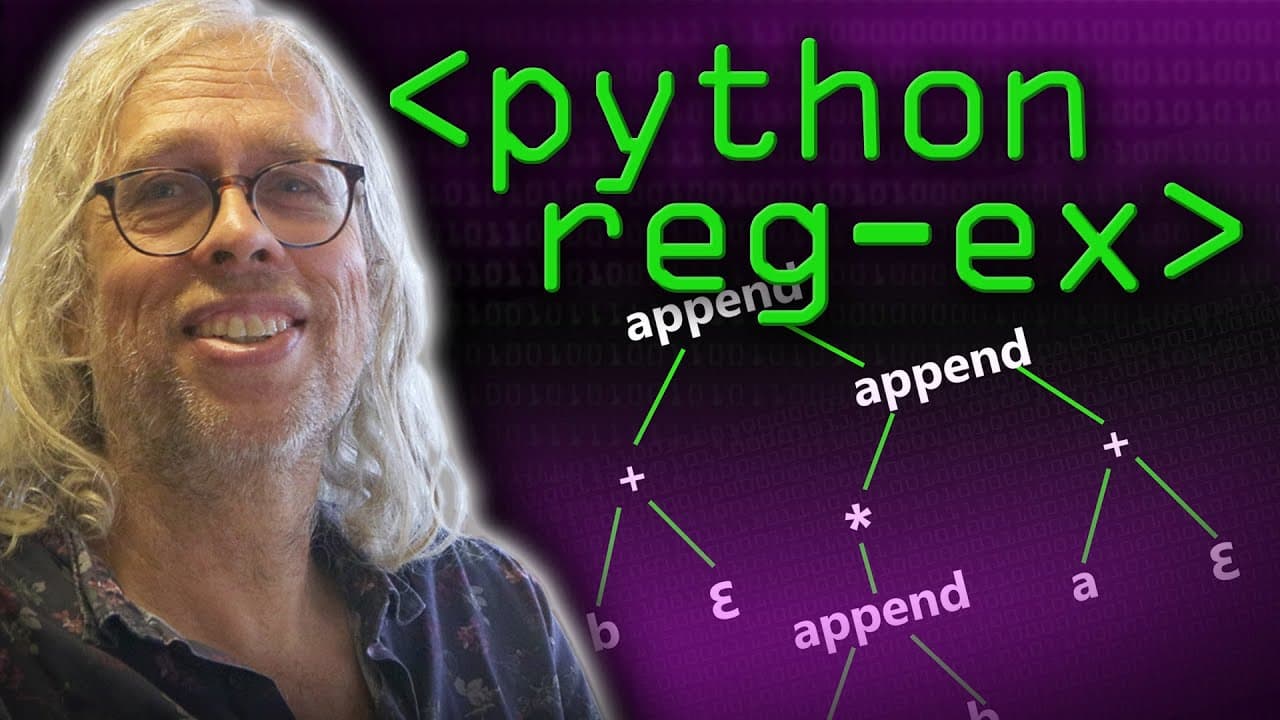
Learn how to represent and run regular expressions in Python, using a tree-like structure to represent the expressions and implementing a run function to check if a word is in the language defined by the regular expression.
Transcript
so yeah we have done uh this autometer we have done in in Python and now we have this ambitious project to do regular expressions in Python which is quite a useful little exercise because running regular expression is actually like grab the the unit command which we have mentioned uh is is sort of a useful application we have done deterministic fin... Read More
Key Insights
- 😑 Regular expressions can be represented as a tree-like structure in Python for easier manipulation and evaluation.
- 😑 The translation from regular expressions to non-deterministic finite automata allows for efficient evaluation of whether a word is in the language defined by the regular expression.
- 😑 Different operations can be applied to regular expressions, such as union, concatenation, and closure, by manipulating the corresponding automaton structures.
- 😑 Representing regular expressions as objects in Python enables the creation of useful methods, such as printing the expression or running a word on the expression.
Install to Summarize YouTube Videos and Get Transcripts
Explore YouTube Video Summarizer or Get YouTube Transcript Extractor
Questions & Answers
Q: What is the purpose of representing regular expressions as a tree-like structure?
Representing regular expressions as a tree helps in visualizing the structure and components of the expression. It allows for easier translation into a Python object and facilitates operations on the regular expression.
Q: How does the factory for the "plus" regular expression work?
The factory for the "plus" regular expression takes two automatons and combines them. It adds initial states from the first automaton and final states from the second automaton. Additionally, it creates epsilon transitions from final states of the first automaton to initial states of the second automaton.
Q: What is the significance of the run function in regular expressions?
The run function is used to check whether a given word is in the language defined by the regular expression. It takes a word and returns true if the word is in the language and false otherwise. It utilizes the translation from regular expressions to non-deterministic finite automata (NFA) and leverages the run function for NFAs.
Q: How is the language of a regular expression determined?
The language of a regular expression is determined by evaluating the regular expression tree-like structure. By running different words through the regular expression, we can observe which words are recognized (resulting in true) and which are not (resulting in false). The language consists of all the words that give a true result.
Summary & Key Takeaways
-
The content discusses the representation of regular expressions as a tree-like structure and how to convert it into a Python object.
-
It explains the concept of regular expressions and provides an example of a regular expression that represents a sequence of A's and B's.
-
The content introduces Python classes for different types of regular expressions and demonstrates the implementation of a run function to check if a word is in the language defined by the regular expression.
Read in Other Languages (beta)
Share This Summary 📚
Summarize YouTube Videos and Get Video Transcripts with 1-Click
Try YouTube Summary with ChatGPT & Claude or YouTube Transcript Generator
Explore More Summaries from Computerphile 📚




Summarize YouTube Videos and Get Video Transcripts with 1-Click
Try YouTube Summary with ChatGPT & Claude or YouTube Transcript Generator