Types of Bearing - Rolling Contact Bearing - Machine Design -2
TL;DR
Rolling contact bearings consist of inner and outer races, rolling elements, and a cage. They can be classified into different categories based on their design and load capacity.
Transcript
hello friends let's talk about types of rolling contact bearing a rolling contact bearing consists of four parts inner and outer races a rolling element like ball roller or needle and a cage which holds the ruling elements together and spaces them evenly around the periphery of the shop depending upon the type of the roller bearing the bearing are ... Read More
Key Insights
- 🤣 Rolling contact bearings consist of four main parts: inner and outer races, rolling elements, and a cage.
- 💬 Different types of rolling contact bearings include deep groove ball bearings, cylindrical roller bearings, angular contact bearings, self-aligning bearings, tapered roller bearings, and thrust ball bearings.
- 🅰️ Each type of bearing has its own advantages and disadvantages, such as load carrying capacity, rigidity, alignment tolerance, and noise generation.
- 💬 Deep groove ball bearings have high load carrying capacity, can take loads in both radial and axial directions, and generate less noise.
- 🌸 Cylindrical roller bearings have high radial load carrying capacity, more rigidity than ball bearings, and lower frictional loss.
- 🖐️ Angular contact bearings can take both radial and axial loads, but require precise mounting without axial play.
- ✋ Self-aligning bearings can adjust to angular misalignment and have the advantage of carrying high radial and thrust loads.
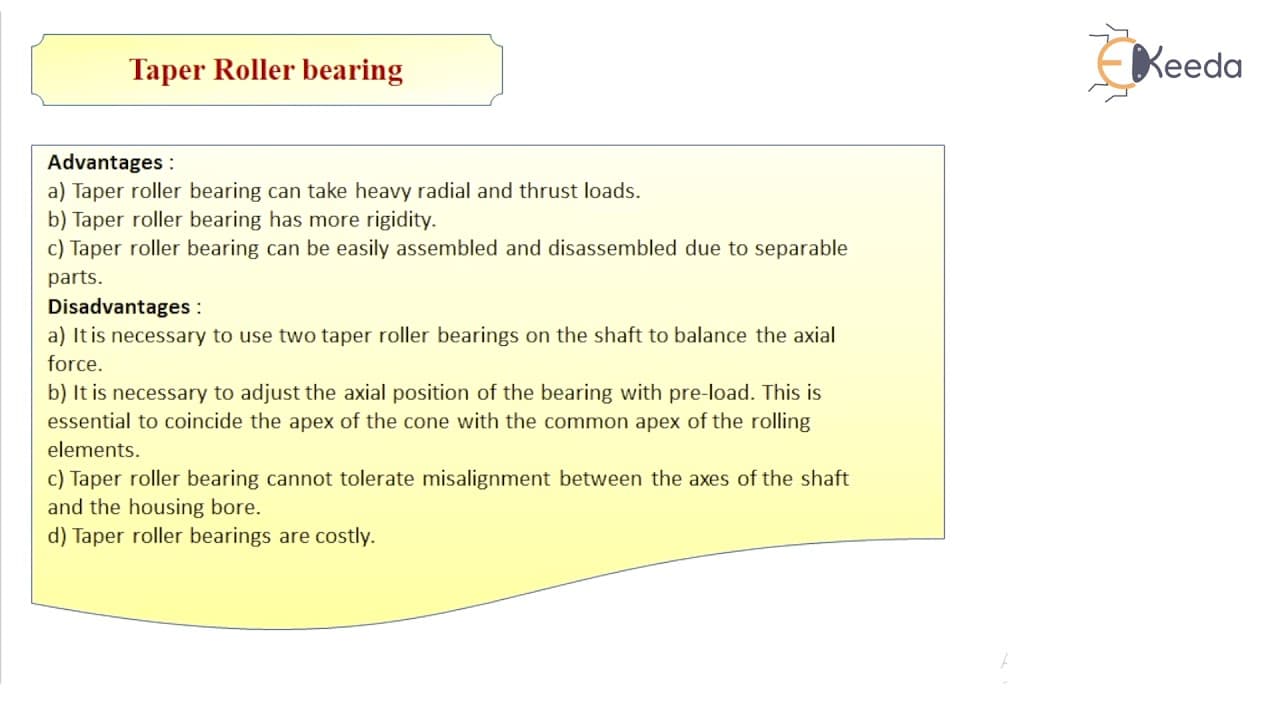
- 👷 Tapered roller bearings can carry both radial and axial loads, have separable construction for easy assembly and disassembly, but require precise alignment and are costly.
Install to Summarize YouTube Videos and Get Transcripts
Explore YouTube Video Summarizer or Get YouTube Transcript Extractor
Questions & Answers
Q: What are the four main components of a rolling contact bearing?
The four main components of a rolling contact bearing are inner and outer races, rolling elements (such as balls, rollers, or needles), and a cage that holds the rolling elements in place.
Q: How are rolling contact bearings classified?
Rolling contact bearings can be classified into different types, including deep groove ball bearings, cylindrical roller bearings, angular contact bearings, self-aligning bearings, tapered roller bearings, and thrust ball bearings.
Q: What are the advantages of deep groove ball bearings?
Deep groove ball bearings have advantages such as high load carrying capacity, the ability to take loads in both radial and axial directions, and less noise generation due to point contact between the balls and races.
Q: What are the disadvantages of tapered roller bearings?
Tapered roller bearings have disadvantages such as the need to use two bearings to balance the thrust component, the requirement of axial preload for proper functioning, and the inability to tolerate misalignment between the shaft and housing.
Summary & Key Takeaways
-
Rolling contact bearings are made up of inner and outer races, rolling elements, and a cage.
-
They can be classified into deep groove ball bearings, cylindrical roller bearings, angular contact bearings, self-aligning bearings, tapered roller bearings, and thrust ball bearings.
-
Each type of bearing has its own advantages and disadvantages in terms of load carrying capacity, rigidity, alignment tolerance, and noise generation.
Read in Other Languages (beta)
Share This Summary 📚
Summarize YouTube Videos and Get Video Transcripts with 1-Click
Try YouTube Summary with ChatGPT & Claude or YouTube Transcript Generator
Explore More Summaries from Ekeeda 📚






Summarize YouTube Videos and Get Video Transcripts with 1-Click
Try YouTube Summary with ChatGPT & Claude or YouTube Transcript Generator