Derivative of Logarithmic Functions
TL;DR
The video explains how to find the derivative of logarithmic functions using the formula u'/u and provides examples for natural log functions and logarithmic functions with different bases.
Transcript
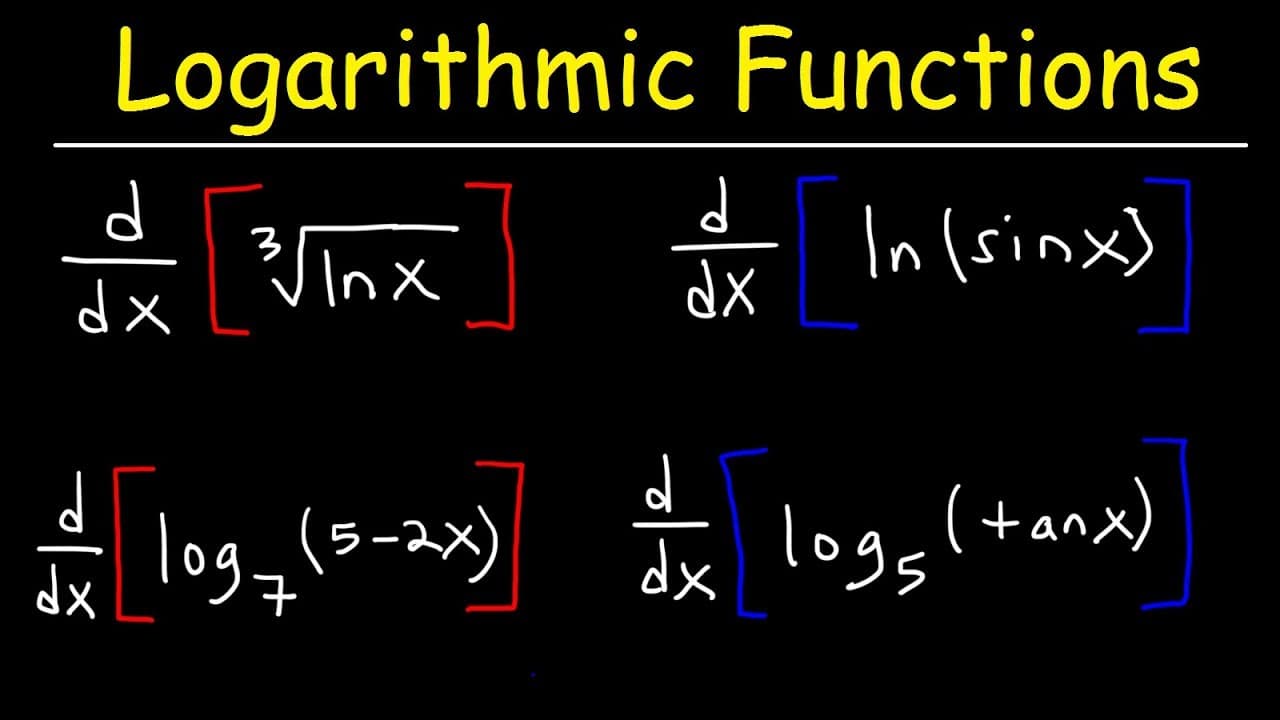
in this video we're going to focus on finding the derivative of a logarithmic function but let's start with natural log functions first so what is the derivative of ln x now there's a formula that you need to know the derivative of ln u is equal to u prime divided by u so in this example u is x and the derivative of x is one so therefore the deriva... Read More
Key Insights
- ❓ Derivative of ln(x) is 1/x.
- 🗂️ Derivatives of ln(x^n) take the exponent as the multiplier and divide by x.
- ❓ Moving constants or exponents to the front before differentiation is possible.
- 📏 Differentiating composite functions involves applying the chain rule.
Install to Summarize YouTube Videos and Get Transcripts
Explore YouTube Video Summarizer or Get YouTube Transcript Extractor
Questions & Answers
Q: What is the formula to find the derivative of natural log functions?
The formula is u'/u, where u is the inside function. For ln(x), the derivative is 1/x.
Q: How do we find the derivative of ln(x^2)?
We apply the formula u'/u. Since u is x^2, its derivative is 2x. The derivative is 2/x.
Q: Can we simplify ln(x^2) before finding its derivative?
Yes, we can simplify it as 2ln(x). The derivative of ln(x) is 1/x, so the answer remains 2/x.
Q: What is the derivative of ln(x^3)?
The derivative is 3/x. We can rewrite ln(x^3) as 3 ln(x) and apply the formula for ln(x).
Q: How do we find the derivative of ln(x + 5)?
Using the formula u'/u, where u is x + 5, the derivative is 1/(x + 5).
Q: How can we find the derivative of ln(sin(x))?
The derivative is cot(x), as the derivative of sin(x) is cos(x). We apply the formula u'/u, where u is sin(x).
Q: What is the derivative of ln(7√x)?
By rewriting it as x^(1/7), the derivative is 1/(7x).
Q: How do we find the derivative of the cube root of ln(x)?
We apply the chain rule, finding the derivative of the outside function and multiplying it by the derivative of ln(x), which is 1/x.
Summary & Key Takeaways
-
The derivative of ln(x) is 1/x, based on the formula u'/u where u is the inside function, which in this case is x.
-
For ln(x^2), the derivative is 2/x because u is x^2 and its derivative, u', is 2x.
-
The derivative of ln(x^3) is 3/x, as we can rewrite it as 3 ln(x) and apply the formula for ln(x).
-
To find the derivative of ln(x + 5), we use the formula u'/u where u is x + 5, giving us 1/(x + 5).
Read in Other Languages (beta)
Share This Summary 📚
Summarize YouTube Videos and Get Video Transcripts with 1-Click
Try YouTube Summary with ChatGPT & Claude or YouTube Transcript Generator
Explore More Summaries from The Organic Chemistry Tutor 📚



Summarize YouTube Videos and Get Video Transcripts with 1-Click
Try YouTube Summary with ChatGPT & Claude or YouTube Transcript Generator