Electrolysis & Electroplating Practice Problems - Electrochemistry
TL;DR
Calculate the mass of nickel metal that can be plated onto a cathode using a given current and time; determine the current needed to plate a certain amount of copper metal; find the time required to plate a specific amount of iron metal; identify the unknown metal based on its molar mass; calculate the volume of oxygen gas produced during electrolysis.
Transcript
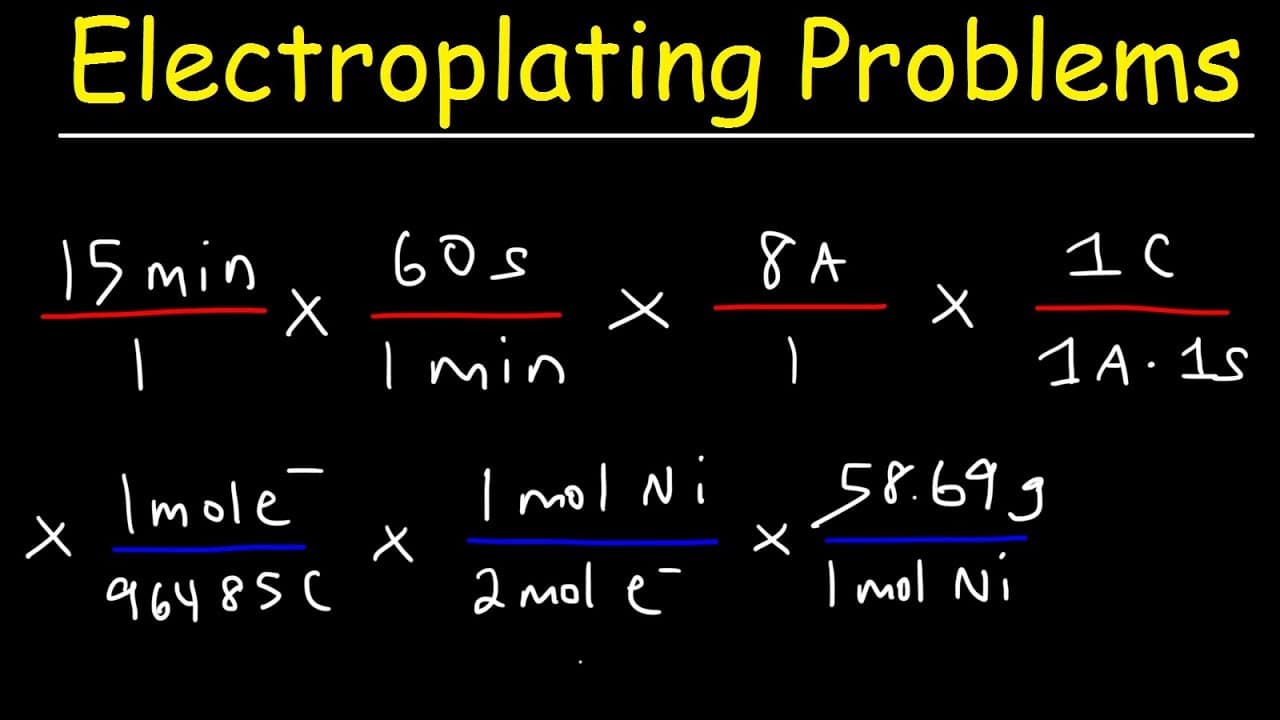
in this tutorial we're going to work on some quantitative problems associated with electroplatin and electrolysis now what mass of nickel metal can be plated on to the cathode from a nickel sulfate solution using a current of 8 amps for 15 minutes so how can we find the answer well first let's write the half reaction that occurs at the cathode so n... Read More
Key Insights
- 💆 The mass of a metal plated onto a cathode can be determined by considering the current, time, and conversion factors, such as molar mass and stoichiometry.
- 💆 The current needed to plate a certain mass of metal can be calculated by converting the mass to moles, utilizing stoichiometry, and converting the coulombs to amps.
- 💆 The time required to plate a specific mass of metal can be found by converting the mass to moles, using the stoichiometry, converting the coulombs to hours, and dividing by the current.
- 💆 The identity of an unknown metal can be determined by calculating its molar mass based on the given mass and comparing it to the molar masses of known substances.
Install to Summarize YouTube Videos and Get Transcripts
Explore YouTube Video Summarizer or Get YouTube Transcript Extractor
Questions & Answers
Q: How can the mass of nickel metal plated onto a cathode be calculated?
The mass of nickel metal can be calculated by multiplying the time, current, and other conversion factors to obtain the charge in coulombs. From there, the charge can be converted to moles of electrons and then to moles of nickel. Finally, the molar mass of nickel is used to find the mass of plated nickel metal.
Q: What current is needed to plate five grams of copper metal onto a cathode?
To calculate the current required, convert the mass of copper to moles, use the ratio of moles of electrons to moles of copper, and then convert the coulombs to amps. Finally, convert the time to seconds and divide the charge by the time to obtain the current in amps.
Q: How long will it take to plate 10 grams of iron metal using a current of 5 amps?
Start with the mass of iron metal and convert it to moles. Then convert moles of iron to moles of electrons using the stoichiometry. Convert coulombs of charge to hours and divide it by the current to get the time in hours.
Q: How can the unknown metal be identified based on the mass and other information given?
Calculate the moles of the metal by converting the given mass to moles using the molar mass. Then compare the molar mass of the substance to the given options to determine the identity of the metal. In this case, the molar mass of zinc matches the calculated molar mass.
Q: What volume of oxygen gas is produced during electrolysis of a sodium hydroxide solution?
Multiply the time, current, and conversion factors to obtain the charge in coulombs. Convert the coulombs to moles of electrons and use the stoichiometry to find moles of oxygen gas. Finally, convert moles of oxygen gas to liters using the molar volume of a gas and then to milliliters.
Summary & Key Takeaways
-
This tutorial explains how to calculate the mass of nickel metal that can be plated onto a cathode based on the current and time.
-
It also demonstrates how to determine the amount of current needed to plate a specific mass of copper metal.
-
The tutorial further covers how to calculate the time required to plate a given amount of iron metal.
-
It explains how to identify an unknown metal based on its molar mass.
-
Lastly, it shows how to calculate the volume of oxygen gas produced during electrolysis of a sodium hydroxide solution.
Read in Other Languages (beta)
Share This Summary 📚
Summarize YouTube Videos and Get Video Transcripts with 1-Click
Try YouTube Summary with ChatGPT & Claude or YouTube Transcript Generator
Explore More Summaries from The Organic Chemistry Tutor 📚




Summarize YouTube Videos and Get Video Transcripts with 1-Click
Try YouTube Summary with ChatGPT & Claude or YouTube Transcript Generator