Maximum Likelihood For the Normal Distribution, step-by-step!!!
TL;DR
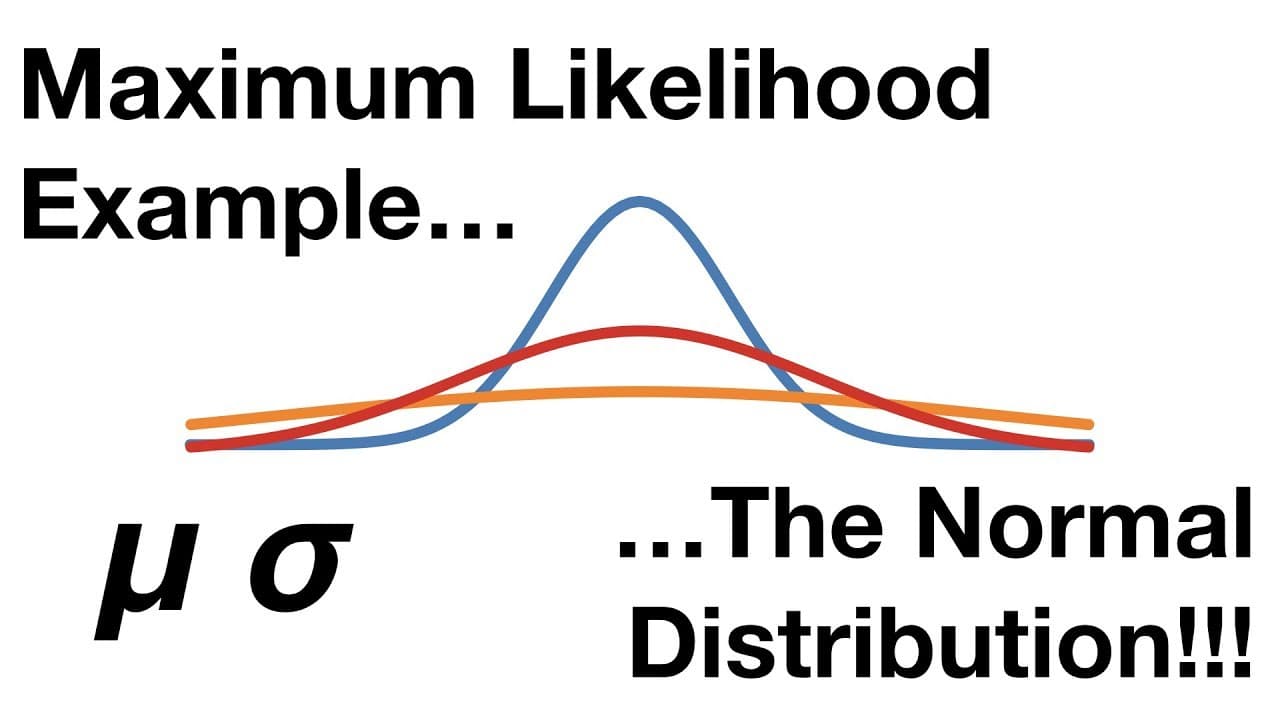
This StatQuest video explains how to determine the maximum likelihood estimates for the mean and standard deviation of a normal distribution using mathematical calculations.
Transcript
We're gonna do a lot of math step by step by step by step by step StatQuest!!! Hello, I'm Josh Starmer and welcome to StatQuest Today we're going to talk about maximum likelihood for the normal distribution and it's gonna be clearly explained Not: This StatQuest follows up on the StatQuest "Maximum Likelihood Clearly Explained" as well as the StatQ... Read More
Key Insights
- ❓ The normal distribution is characterized by two parameters: mean (μ) and standard deviation (σ).
- 🔌 The likelihood of the data given a normal distribution can be calculated by plugging the data values into the likelihood function.
- 😫 The maximum likelihood estimates for μ and σ can be determined by taking derivatives of the log-likelihood function and setting them equal to zero.
- ❓ The maximum likelihood estimate for μ is the mean of the data, while the maximum likelihood estimate for σ is the standard deviation of the data.
- 🥡 Taking the log of the likelihood function simplifies the process of taking derivatives.
- 🙊 The log-likelihood function and the likelihood function peak at the same values for μ and σ.
Install to Summarize YouTube Videos and Get Transcripts
Explore YouTube Video Summarizer or Get YouTube Transcript Extractor
Questions & Answers
Q: What are the two parameters that characterize the normal distribution?
The two parameters are the mean (μ) and the standard deviation (σ). The mean determines the location of the distribution's peak, while the standard deviation determines its width.
Q: How can the likelihood of the data given a normal distribution be calculated?
The likelihood can be found by plugging the data values into the likelihood function, which involves the normal distribution equation. The resulting value represents the probability of observing the given data.
Q: How can the maximum likelihood estimate for μ be determined?
To find the maximum likelihood estimate for μ, we treat σ as a constant and calculate the derivative of the log-likelihood function with respect to μ. We set the derivative equal to zero and solve for μ to find the optimal value.
Q: What is the purpose of taking the log of the likelihood function?
Taking the log of the likelihood function simplifies the process of taking derivatives. It transforms multiplications into additions and exponentials into logarithms, making the calculations easier.
Summary & Key Takeaways
-
The normal distribution is characterized by two parameters: mean (μ) and standard deviation (σ).
-
The likelihood of the data given a specific normal distribution can be calculated by plugging in the values into the likelihood function.
-
The maximum likelihood estimates for μ and σ can be found by taking derivatives of the log-likelihood function and setting them equal to zero.
Read in Other Languages (beta)
Share This Summary 📚
Summarize YouTube Videos and Get Video Transcripts with 1-Click
Try YouTube Summary with ChatGPT & Claude or YouTube Transcript Generator
Explore More Summaries from StatQuest with Josh Starmer 📚



Summarize YouTube Videos and Get Video Transcripts with 1-Click
Try YouTube Summary with ChatGPT & Claude or YouTube Transcript Generator