Partial Derivatives Using Jacobians Formula ekeeda
TL;DR
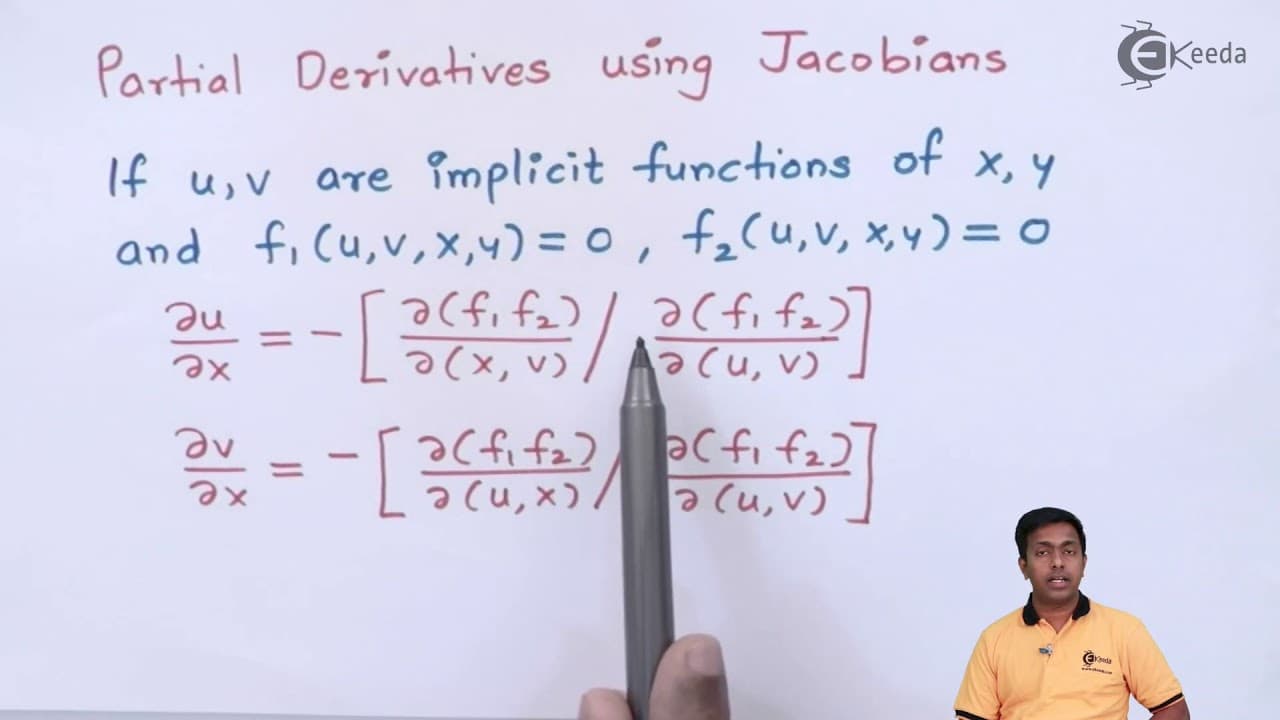
This video explains how to find partial derivatives using the Jacobian and discusses the formula and method for obtaining the answer.
Transcript
click the bell icon to get latest videos from akira hello students so in this video we are going to understand how to find out the partial derivative with the help of Jacobian so to get the partial derivative will be taking the help of Jacobian and then we'll get the answer so here I'll cover the formula which we'll be using in the next video to so... Read More
Key Insights
- 🟰 Implicit functions in partial differentiation are treated as equal to zero.
- ❓ The Jacobian formula is used to find partial derivatives.
- ⁉️ The numerator in the formula involves replacing the variable in question with the desired variable.
- ❓ The denominator in the formula remains the same and is determined by the Jacobian of the given implicit functions.
- ❓ The Jacobian formula provides a systematic approach to finding partial derivatives.
- 💱 Different partial derivatives can be found by changing the variables in the numerator of the formula.
- 🎮 The video promises to cover a numerical example in the next video.
Install to Summarize YouTube Videos and Get Transcripts
Explore YouTube Video Summarizer or Get YouTube Transcript Extractor
Questions & Answers
Q: What is an implicit function and how does it relate to partial differentiation?
An implicit function is a function where the dependent variable is not explicitly expressed in terms of the independent variable. In partial differentiation, such functions are treated as equal to zero.
Q: How is the Jacobian used to find partial derivatives?
The Jacobian formula for finding partial derivatives involves taking the partial derivative of the given implicit functions with respect to the desired variables, and dividing this by the Jacobian of the implicit functions with respect to the variables in which the derivative is being calculated.
Q: Does the denominator of the Jacobian formula change based on the variables involved?
No, the denominator remains the same regardless of the variables. It is determined by taking the Jacobian of the given implicit functions with respect to the variables in which the partial derivatives are being calculated.
Q: Can you provide an example of using the Jacobian formula to find partial derivatives?
Let's say we want to find ∂u/∂x. We replace U with X in the numerator of the Jacobian formula and keep the denominator the same to obtain the partial derivative.
Summary & Key Takeaways
-
The video introduces the concept of implicit functions and explains how they relate to partial differentiation.
-
The formula for finding partial derivatives using the Jacobian is presented.
-
The numerator in the formula involves replacing certain variables with the variables for which the partial derivatives are being calculated, while the denominator remains the same.
Read in Other Languages (beta)
Share This Summary 📚
Summarize YouTube Videos and Get Video Transcripts with 1-Click
Try YouTube Summary with ChatGPT & Claude or YouTube Transcript Generator
Explore More Summaries from Ekeeda 📚




Summarize YouTube Videos and Get Video Transcripts with 1-Click
Try YouTube Summary with ChatGPT & Claude or YouTube Transcript Generator