How I Use Deep Work as a Computer Science PhD Student | Bullet Journal Spreads for Productivity
TL;DR
Deep work is essential for productive PhD work, and implementing strategies like scheduling uninterrupted focus time and minimizing distractions can lead to high-quality output.
Transcript
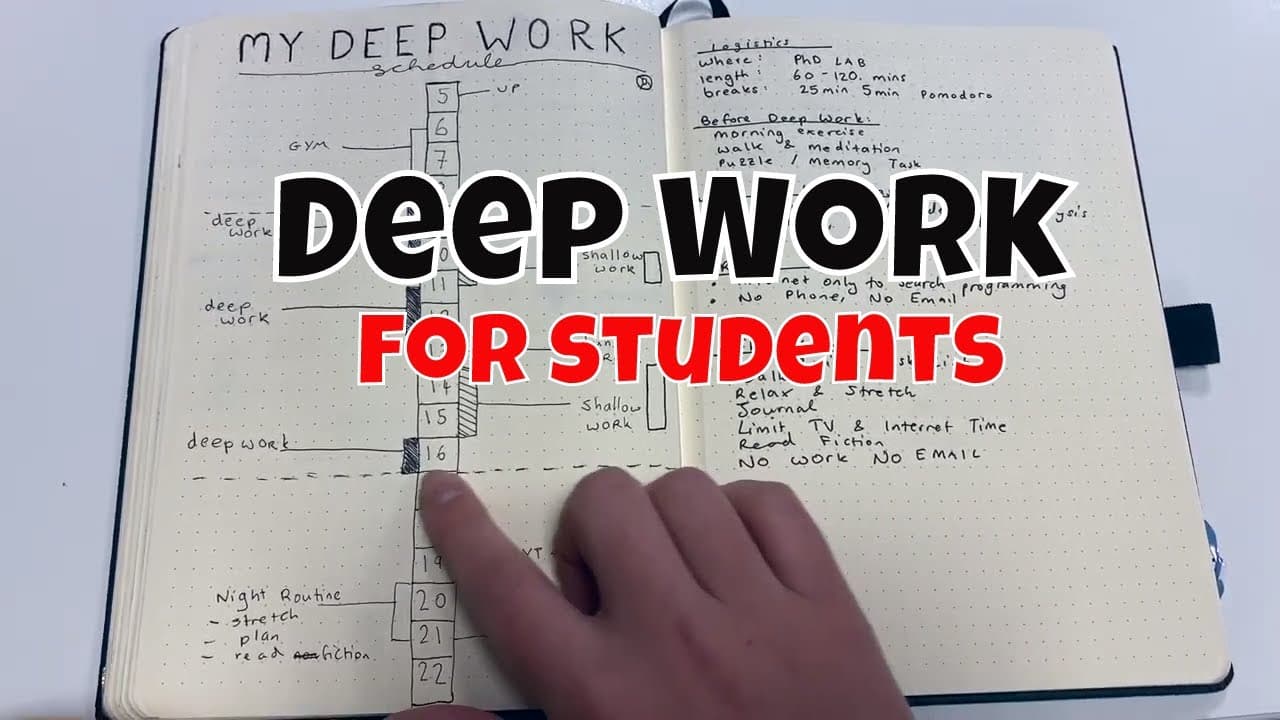
hello everyone and welcome back to pH D on productivity today we are going to be talking about the book deep work and how I use it in my daily PhD life so deep work is a book written by Cal Newport which I've recently read on audible in the book he says there are three types of people who will survive and prosper in today's world one is people who ... Read More
Key Insights
- 💦 Deep work is necessary for producing high-quality work efficiently, but distractions make it increasingly challenging.
- 💦 Scheduling uninterrupted focus time and minimizing distractions are crucial for implementing deep work.
- ❓ Different scheduling approaches, such as monastic, bimodal, rhythmic, and journalistic, can be tailored to fit individual preferences and constraints.
- 😣 Rest and relaxation are essential for productivity and allowing the brain to recharge and generate new insights.
- 💦 Deep work requires practice and building habits and routines around it.
- 🥺 The 4DX framework (focus on the wildly important, lead and lag measures, compelling scoreboard, cadence of accountability) can help track and improve deep work habits.
- 💦 PhD students can benefit from deep work by prioritizing their most important tasks and allocating dedicated deep work time.
Install to Summarize YouTube Videos and Get Transcripts
Explore YouTube Video Summarizer or Get YouTube Transcript Extractor
Questions & Answers
Q: What are the three types of people who thrive in today's world according to Cal Newport's book "Deep Work"?
Cal Newport suggests that people who have capital to invest, those who can work with intelligent technologies and machines, and superstars in their own field are the ones who will thrive.
Q: How does deep work differ from shallow work?
Deep work refers to professional activities performed with distraction-free concentration, pushing cognitive capabilities to their limit and creating new value. Shallow work, on the other hand, involves non-cognitive logistical tasks performed while distracted and doesn't create new value.
Q: How can PhD students implement deep work into their daily routine?
PhD students can implement deep work by scheduling long stretches of uninterrupted focus time, identifying deep work tasks, minimizing distractions, and building habits and rituals around deep work.
Q: Why is rest important for productivity?
Rest is crucial because it allows the subconscious mind to solve problems and come up with new insights. It also gives the brain time to recharge and perform at its best.
Summary & Key Takeaways
-
Deep work is a method outlined in the book "Deep Work" by Cal Newport, which focuses on mastering difficult tasks and producing valuable knowledge at an elite level.
-
The need for deep work is increasing as distractions become more prevalent, making it difficult to produce high-quality work efficiently.
-
Different approaches to scheduling deep work include monastic (complete isolation), bimodal (dividing time between deep and shallow work), rhythmic (setting a consistent deep work schedule), and journalistic (alternating between deep and shallow tasks).
Read in Other Languages (beta)
Share This Summary 📚
Summarize YouTube Videos and Get Video Transcripts with 1-Click
Try YouTube Summary with ChatGPT & Claude or YouTube Transcript Generator
Explore More Summaries from PhD and Productivity 📚





Summarize YouTube Videos and Get Video Transcripts with 1-Click
Try YouTube Summary with ChatGPT & Claude or YouTube Transcript Generator