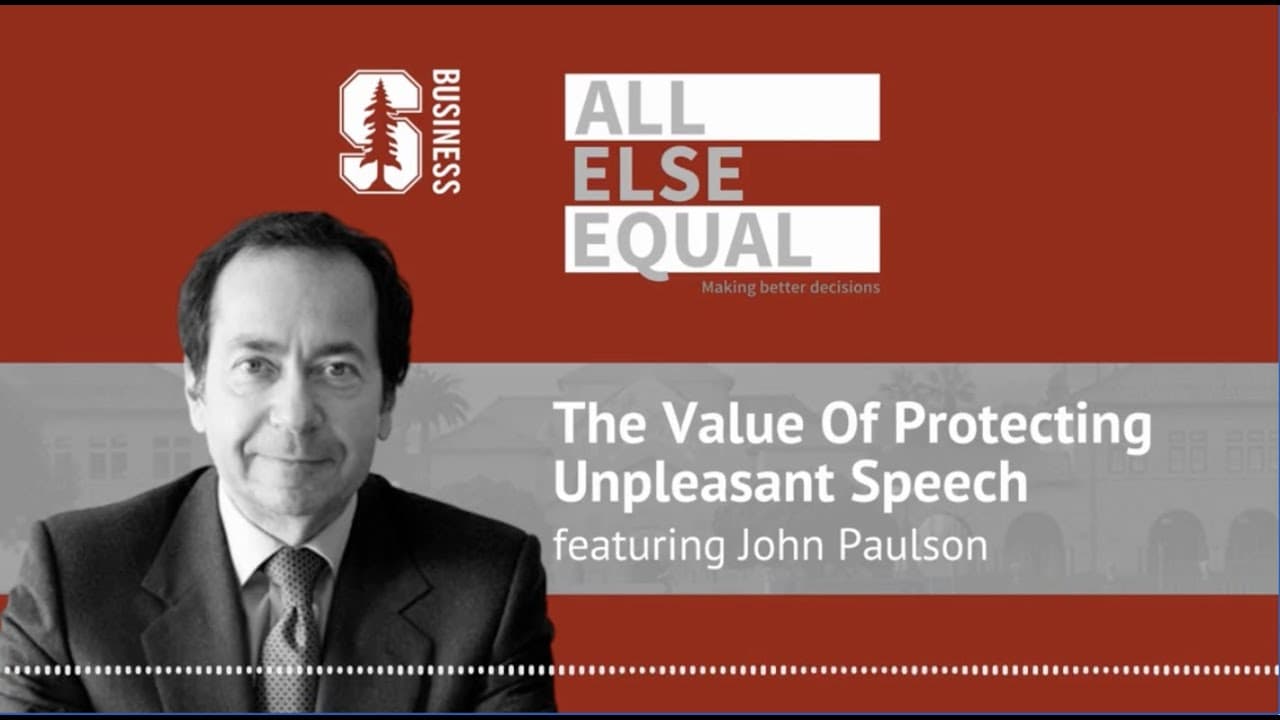
Ep16 “The Value Of Protecting Unpleasant Speech” with John Paulson
TL;DR
Freedom of expression is crucial for both academia and corporations, and the decline of this freedom can hinder competitiveness and innovation.
Transcript
[MUSIC] Hi, I'm Jonathan Berg, Professor of Finance at the Graduate School of Business at Stanford University. >> And I'm Jules Phan Ginsberg, I'm a Finance Professor to Wharton School at the University of Pennsylvania. >> And this is the all else equal podcast [MUSIC] Welcome back everybody today we're going to talk about what IV Is probably the m... Read More
Key Insights
- 😑 Freedom of expression is crucial for both academia and organizations, allowing for innovation and improvement.
- 😑 The decline of freedom of expression can lead to self-censorship and a lack of creative discussions.
- 😯 Protecting unpleasant speech and embracing critical analysis is essential for companies to remain competitive.
- 🙈 Groupthink and a reluctance to consider alternative viewpoints can blind individuals and organizations to potential risks and missed opportunities.
- 🤗 Incentives or institutional support for differing opinions can encourage open dialogue and prevent the silencing of alternative viewpoints.
- 🤗 The fear of ostracization can hinder open discussion and prevent the exploration of different ideas.
- 😑 The decline of freedom of expression can have negative consequences for both individuals and society as a whole.
Install to Summarize YouTube Videos and Get Transcripts
Explore YouTube Video Summarizer or Get YouTube Transcript Extractor
Questions & Answers
Q: Why is freedom of expression important within an organization?
Freedom of expression allows for the open exchange of ideas and critical analysis, leading to innovation and improvement. Without it, organizations can become stagnant and lose their competitive advantage.
Q: How can the decline of freedom of expression be detrimental to a company?
When people are unable to freely express new ideas and criticism, companies risk missing opportunities for growth and improvement. Censoring speech can lead to an environment where alternative viewpoints are silenced, hindering innovation.
Q: What are the motivations behind censoring speech?
People often censor speech out of discomfort or fear of criticism. However, this can lead to a perception of dishonesty and hinder organizational progress. Embracing criticism and allowing for open dialogue can lead to a stronger and more successful company.
Q: How did John Paulson profit from the decline in the housing market?
John Paulson observed the groupthink and lack of consideration for potential risks in the housing market. He shorted mortgage-backed securities, expecting a decline in home prices and an increase in mortgage defaults, which ultimately led to large profits.
Summary & Key Takeaways
-
Freedom of expression is under pressure in academia, and many executives from various companies feel the same way within their organizations.
-
Self-censorship and a decline in creative discussions have become more prevalent in the last five years.
-
Protecting unpleasant speech and allowing unfettered critical analysis is essential for organizations to improve and remain competitive.
Read in Other Languages (beta)
Share This Summary 📚
Summarize YouTube Videos and Get Video Transcripts with 1-Click
Try YouTube Summary with ChatGPT & Claude or YouTube Transcript Generator
Explore More Summaries from Stanford Graduate School of Business 📚



Summarize YouTube Videos and Get Video Transcripts with 1-Click
Try YouTube Summary with ChatGPT & Claude or YouTube Transcript Generator