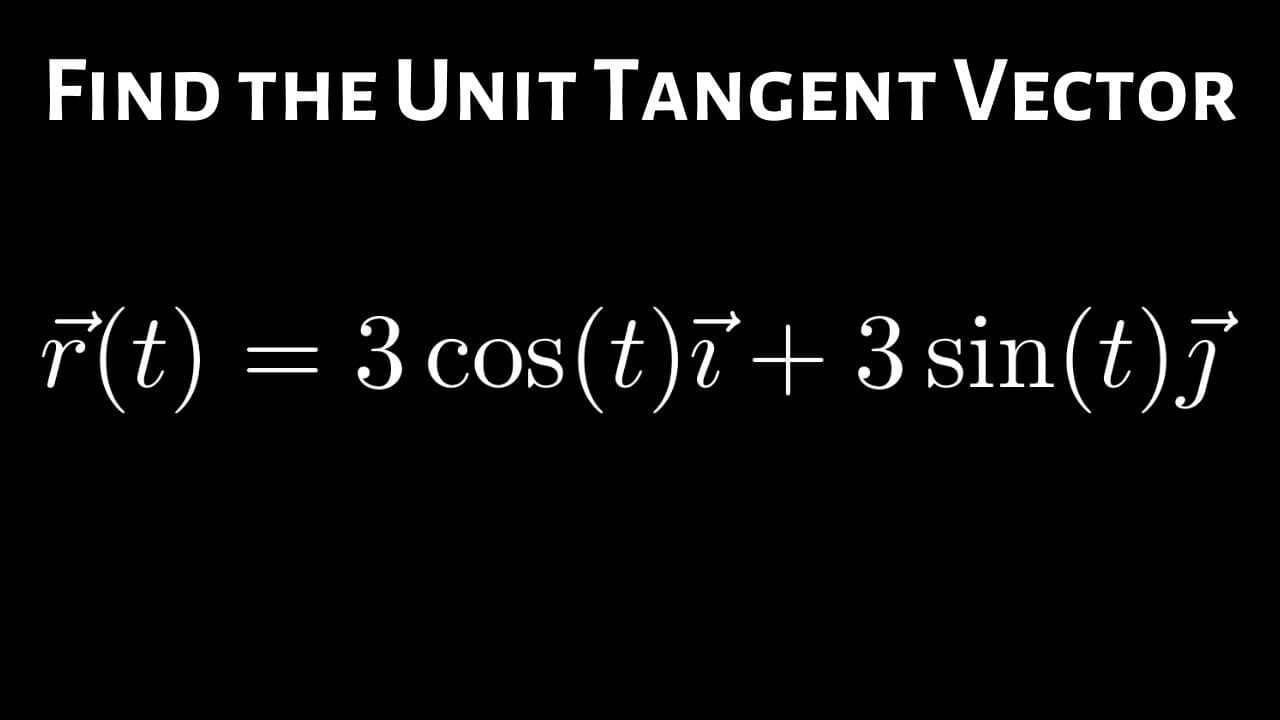
Find the Unit Tangent Vector for r(t) = 3cos(t)i + 3sin(t)j
TL;DR
The unit tangent vector is found by taking the derivative of the vector value function and dividing it by its magnitude.
Transcript
this problem we're going to find the unit tangent vector given this vector value function R and we're going to evaluate it at T equals PI over 4 so the formula for the unit tangent vector is Big T of little T and it's equal to the derivative of R divided by the magnitude of the derivative of R from a physical perspective if you think of R as your p... Read More
Key Insights
- 🗂️ The unit tangent vector is derived from the derivative of the vector value function divided by its magnitude.
- 🗂️ Normalization is the process of turning a vector into a unit vector by dividing it by its magnitude.
- 😥 The unit tangent vector represents the direction of motion at a given point on a vector value function.
- 🪜 The magnitude of a vector can be found by squaring and adding its components.
- 🗂️ Calculating the unit tangent vector involves differentiation, finding magnitudes, and dividing components by the magnitude.
- 🇦🇪 The unit tangent vector can be used to study velocity and acceleration in physics and engineering.
- 🇦🇪 The example demonstrates the step-by-step process of finding the unit tangent vector with a specific value of T.
Install to Summarize YouTube Videos and Get Transcripts
Explore YouTube Video Summarizer or Get YouTube Transcript Extractor
Questions & Answers
Q: What is the formula for the unit tangent vector?
The formula for the unit tangent vector is Big T of little T, which is equal to the derivative of the vector value function divided by the magnitude of the derivative of the vector value function. It is used to find the direction of motion at a given point.
Q: What does normalization mean in the context of vector values?
Normalization refers to the process of taking a vector and turning it into a unit vector by dividing it by its magnitude. In this case, the unit tangent vector is obtained by dividing the velocity vector (derivative of the vector value function) by its magnitude.
Q: How is the unit tangent vector calculated in the example?
In the example, the vector value function is differentiated to find the velocity vector. The derivative of cosine is -3 sin(T) i-hat, and the derivative of sine is 3 cosine(T) j-hat. Then, the magnitude of the velocity vector is calculated by squaring and adding the components. Finally, the components are divided by the magnitude to obtain the unit tangent vector.
Q: What is the significance of finding the unit tangent vector?
The unit tangent vector gives the direction of motion at a specific point along the vector value function. It is useful in applications such as physics and engineering to understand the velocity and acceleration of objects.
Summary & Key Takeaways
-
The unit tangent vector is derived by taking the derivative of the vector value function and dividing it by its magnitude.
-
The process of turning a vector into a unit vector by dividing it by its magnitude is called normalization.
-
The example in the video calculates the unit tangent vector at T equals PI over 4.
Read in Other Languages (beta)
Share This Summary 📚
Summarize YouTube Videos and Get Video Transcripts with 1-Click
Try YouTube Summary with ChatGPT & Claude or YouTube Transcript Generator
Explore More Summaries from The Math Sorcerer 📚


Summarize YouTube Videos and Get Video Transcripts with 1-Click
Try YouTube Summary with ChatGPT & Claude or YouTube Transcript Generator