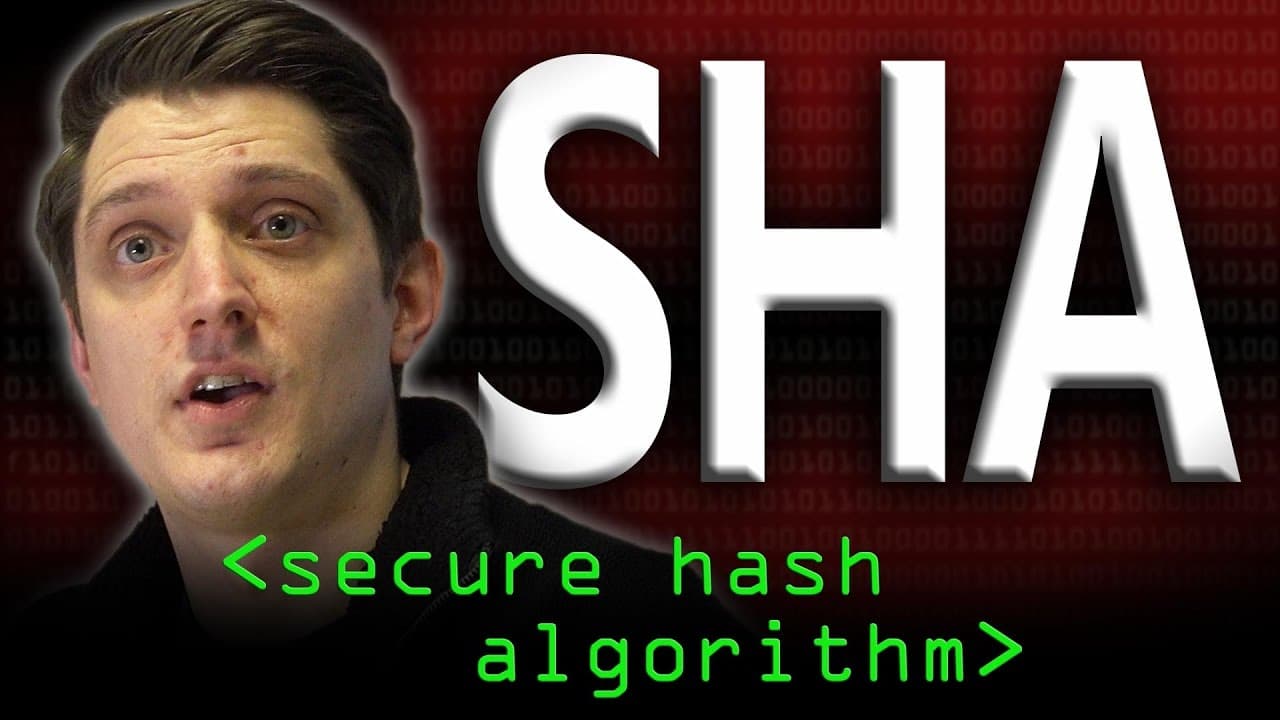
SHA: Secure Hashing Algorithm - Computerphile
TL;DR
SHA-1 is a widely used hash function in cryptography, but it has vulnerabilities. This analysis explains how hash functions work and delves into the inner workings of SHA-1.
Transcript
SHA stands for the secure hash algorithm. Which is interesting given that it has just kind of been broken But I'm not going to talk specifically about the attack on SHA today that's for a different video, but What I wanted to do was talk in a little bit more detail about hash functions and what they are And how SHA in particular works so you can ge... Read More
Key Insights
- #️⃣ Hash functions are essential in cryptography for various purposes, such as message authentication and digital signatures.
- 🔐 The key property of a hash function is the appearance of randomness, which ensures the security and integrity of data.
- 🤨 SHA-1 is a widely used hash function, but its vulnerabilities have raised concerns about its security.
- #️⃣ The internal state of SHA-1, represented by the variables H0 to H4, is updated by a compression function, resulting in the final hash.
- 🚫 SHA-1 operates on blocks of 512 bits, and if the message is not a multiple of 512 bits, padding is used to ensure compatibility.
- 👋 The repetitive updating of the internal state using a compression function is known as the Merkle-Damgård construction, ensuring good pseudo-random properties in the hash function.
- 🚨 SHA-1 was developed by the NSA and served its purpose well until more serious concerns about its security emerged.
Install to Summarize YouTube Videos and Get Transcripts
Explore YouTube Video Summarizer or Get YouTube Transcript Extractor
Questions & Answers
Q: What is the purpose of a hash function in cryptography?
Hash functions are used for tasks like message authentication and digital signatures. They ensure the integrity of data and verify that it hasn't been tampered with.
Q: How does SHA-1 produce a hash from a given input?
SHA-1 takes a string of any length and processes it in blocks of 512 bits. These blocks are sequentially processed and mixed with the internal state of the hash function, resulting in a final hash.
Q: Why is randomness important in a hash function?
The appearance of randomness in a hash function ensures that even minor changes in the input lead to drastically different hash values. This property is crucial for security and data integrity.
Q: Is SHA-1 secure against attacks?
SHA-1 has vulnerabilities, and attacks have reduced its security. While initially considered robust, more recent concerns have led to the transition to stronger hash functions like SHA-256.
Summary & Key Takeaways
-
Hash functions are used in cryptography for tasks such as message authentication and digital signatures.
-
The main property of a hash function is that it appears random, even though it is deterministically derived from the input.
-
SHA-1 is a specific hash function that takes a variable-length string and produces a fixed-length (160-bit) hash.
Read in Other Languages (beta)
Share This Summary 📚
Summarize YouTube Videos and Get Video Transcripts with 1-Click
Try YouTube Summary with ChatGPT & Claude or YouTube Transcript Generator
Explore More Summaries from Computerphile 📚





Summarize YouTube Videos and Get Video Transcripts with 1-Click
Try YouTube Summary with ChatGPT & Claude or YouTube Transcript Generator