Products
Features
YouTube Video Summarizer
Summarize YouTube videos
Web & PDF Highlighter
Highlight web pages & PDFs
Chat with PDF
Ask any PDF questions with AI
Ask AI Clone
Chat with your highlights & memories
Audio Transcriber
Transcribe audio files to text
Glasp Reader
Read and highlight articles
Kindle Highlight Export
Export your Kindle highlights
Idea Hatch
Hatch ideas from your highlights
Integrations
Obsidian Plugin
Notion Integration
Pocket Integration
Instapaper Integration
Medium Integration
Readwise Integration
Snipd Integration
Hypothesis Integration
Apps & Extensions
Chrome Extension
Safari Extension
Edge Add-ons
Firefox Add-ons
iOS App
Android App
Discover
Discover
Ideas
Discover new ideas and insights
Articles
Curated articles and insights
Books
Book recommendations by great minds
Posts
Essays and notes from readers
Quotes
Inspiring quotes collection
Videos
Curated videos and summaries
Explore Glasp
Glasp Newsletter
Weekly insights and updates
Glasp Talk
Interview series with great minds
Glasp Blog
Latest news and articles
Glasp Use Cases
Learn how others use Glasp
Build & Support
Glasp API
Access Glasp's API for developers
MCP Connector
Connect Glasp to Claude & ChatGPT
Community
Glasp Reddit Community
Students
Student discount and benefits
FAQs
Frequently Asked Questions
AboutPricing
DashboardLog inSign up

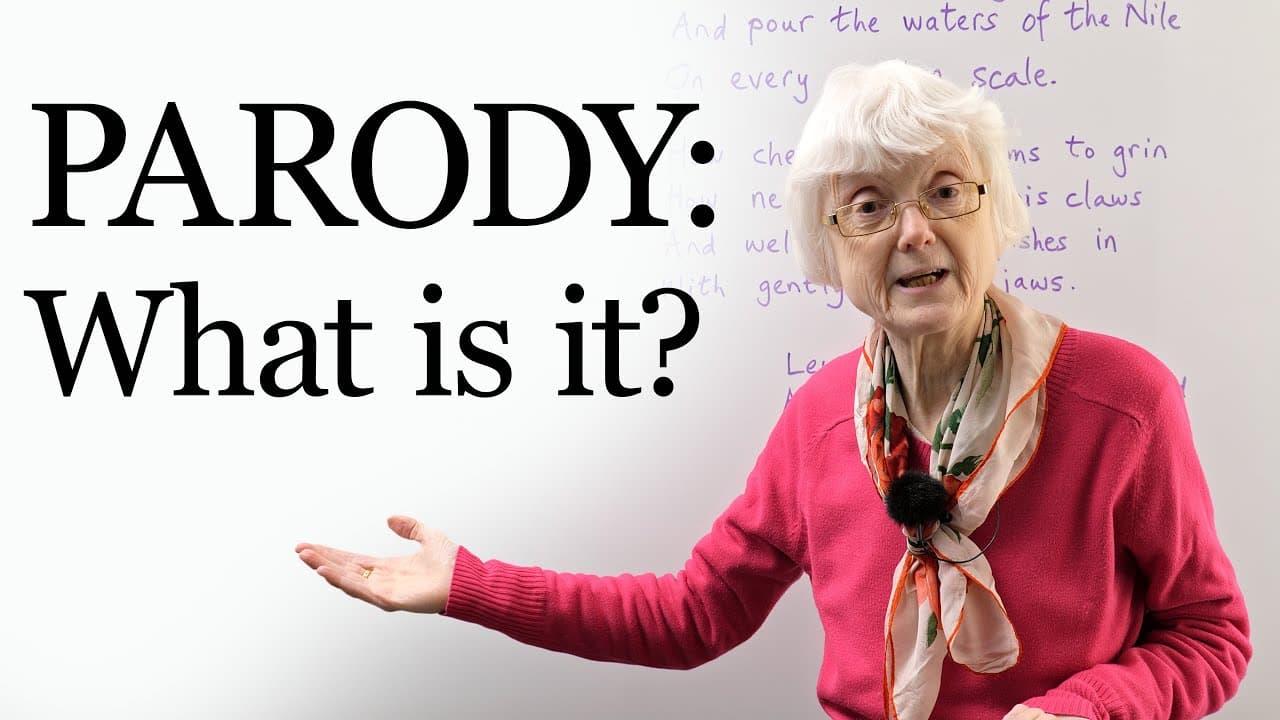
Learn about Poetry & Literature: PARODY
51.1K views
•
July 11, 2023
by
Learn English with Gill · engVid
YouTube video player
Learn about Poetry & Literature: PARODY

TL;DR

This video explores the concept of parody by analyzing two poems written by Isaac Watts and Lewis Carroll, highlighting their differences in tone and theme.

Transcript

Hello. I'm Gill at EngVid, and today we're looking at a couple of poems, and they are connected in a way because the one on the right is what's known as a parody of the one on the left. So, what is a parody? Okay. So, the one on the left was written at a certain date, this one, 1715, and the one on the right was, well, written/published in 1865, so... Read More

Key Insights

  • 💦 Parody is a clever and skillful way of making fun of or imitating a more serious work.
  • 🎮 The parody poems discussed in the video are written by Isaac Watts and Lewis Carroll.
  • 👋 The original poem promotes productivity and good behavior through the example of a busy bee.
  • 🐊 The parody poem reimagines the original, replacing the bee with a crocodile and emphasizing entertainment and humor.
  • ❓ The parody poem utilizes rhyming and a regular rhyme scheme to enhance its comedic effect.
  • 💨 Parody can be an effective way to highlight contrasts and create humor through exaggeration.
  • 💦 The intention behind a parody may differ from the original work, with humor taking precedence over moral lessons.

Install to Summarize YouTube Videos and Get Transcripts

Explore YouTube Video Summarizer or Get YouTube Transcript Extractor

Questions & Answers

Q: What is a parody?

A parody is a creative work that imitates and exaggerates the style and themes of another work in a humorous or satirical way.

Q: How do the two poems differ in tone and purpose?

While the original poem aims to teach children about the importance of productivity and good behavior, the parody poem focuses on entertainment and humor, without moralistic undertones.

Q: What is the significance of the changing subject from a bee to a crocodile?

The shift from a bee to a crocodile highlights the humorous and satirical nature of the parody. It creates a stark contrast between the diligent and productive bee and the predator-like crocodile.

Q: Why is rhyme important in the parody poem?

The use of rhyme in the parody poem adds to its comedic effect. It creates a mechanical and rhythmic pattern that enhances the humor and exaggeration of the poem.

Summary & Key Takeaways

  • The video discusses two poems, one written by Isaac Watts in 1715 and another by Lewis Carroll in 1865.

  • The first poem, "How doth the little busy bee," promotes productivity and good behavior through the example of bees and their honey-making.

  • The second poem, a parody of the first, reimagines the subject as a crocodile and uses humor to entertain without moralistic intent.


Read in Other Languages (beta)

English

Share This Summary 📚

Summarize YouTube Videos and Get Video Transcripts with 1-Click

Download browser extensions on:

Try YouTube Summary with ChatGPT & Claude or YouTube Transcript Generator

Explore More Summaries from Learn English with Gill · engVid 📚

Help a Charity, Save a Life thumbnail
Help a Charity, Save a Life
Learn English with Gill · engVid
The 12 Days of Christmas – Sing and Learn English! thumbnail
The 12 Days of Christmas – Sing and Learn English!
Learn English with Gill · engVid
Basic English – How and when to use LOOK, SEE, and WATCH thumbnail
Basic English – How and when to use LOOK, SEE, and WATCH
Learn English with Gill · engVid
English Pronunciation: How to say words ending with -OW: grow, cow, slow, now... thumbnail
English Pronunciation: How to say words ending with -OW: grow, cow, slow, now...
Learn English with Gill · engVid
English Pronunciation Practice: CH & SH thumbnail
English Pronunciation Practice: CH & SH
Learn English with Gill · engVid
English Grammar: Negative contractions of the verb "TO BE" thumbnail
English Grammar: Negative contractions of the verb "TO BE"
Learn English with Gill · engVid

Summarize YouTube Videos and Get Video Transcripts with 1-Click

Download browser extensions on:

Try YouTube Summary with ChatGPT & Claude or YouTube Transcript Generator

Apps & Extensions

  • Chrome Extension
  • Safari Extension
  • Edge Add-ons
  • Firefox Add-ons
  • iOS App
  • Android App

Key Features

  • YouTube Video Summarizer
  • Web & PDF Summarizer
  • Web & PDF Highlighter
  • Chat with PDF
  • Ask AI Clone
  • Audio Transcriber
  • Glasp Reader
  • Kindle Highlight Export
  • Idea Hatch

Integrations

  • Obsidian Plugin
  • Notion Integration
  • Pocket Integration
  • Instapaper Integration
  • Medium Integration
  • Readwise Integration
  • Snipd Integration
  • Hypothesis Integration

More Features

  • APIs
  • MCP Connector
  • Blog & Post
  • Embed Links
  • Image Highlight
  • Personality Test
  • Quote Shots

Company

  • About us
  • Blog
  • Community
  • FAQs
  • Job Board
  • Newsletter
  • Pricing
Terms

•

Privacy

•

Guidelines

© 2026 Glasp Inc. All rights reserved.