Cell signaling in yeast reproduction
TL;DR
Yeast cells use cell-cell signaling through mating factors to reproduce sexually and asexually, forming new diploid cells.
Transcript
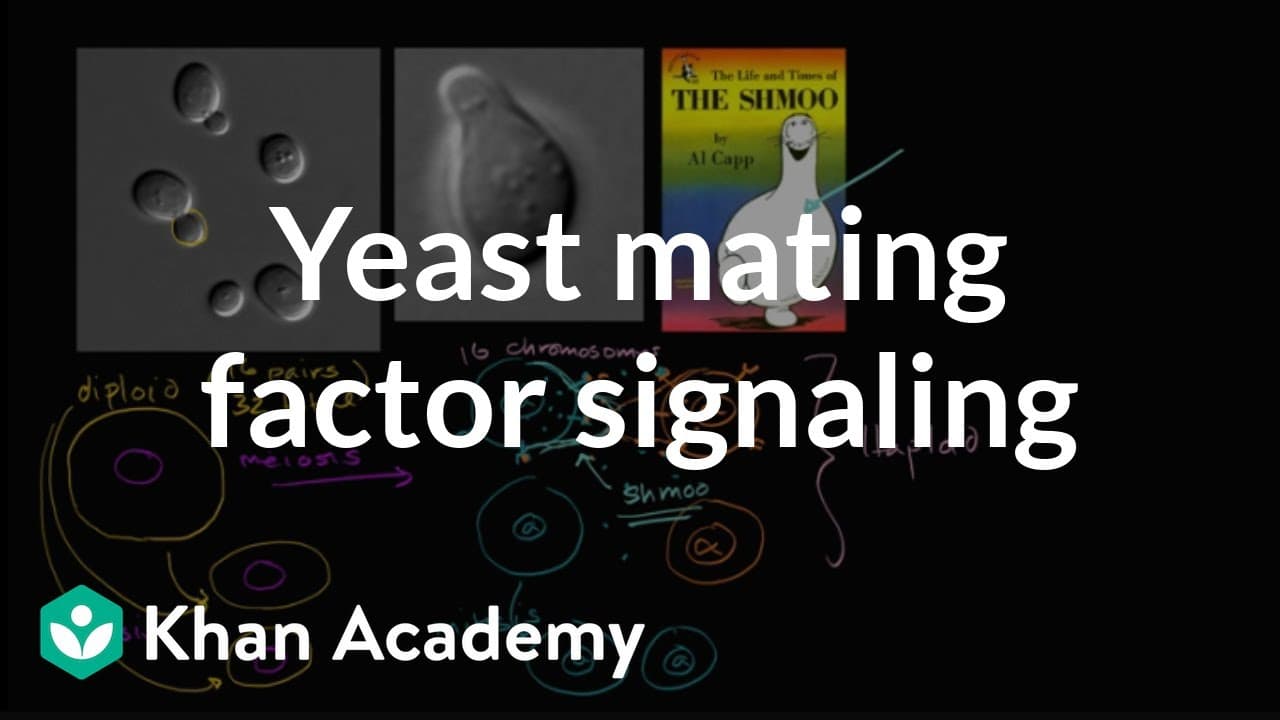
- All of the examples of cell-cell signaling that we've looked at so far have been cells within an organism, but what I want to do in this video is point out that you can also have cell-cell signaling between different organisms, and even between different unicellular organisms. And so what we have here, these are pictures of yeast cells. Yeast are... Read More
Key Insights
- ❓ Yeast cells can reproduce both sexually and asexually through mitosis and meiosis.
- 🅰️ Meiosis produces haploid cells of type a and type alpha.
- 🧑🏭 Mating factors released by haploid cells attract cells of the opposite type.
- 🥺 The bonding of mating factors to receptors leads to cell growth and the formation of diploid cells.
- 💁 Yeast cells can replicate even in haploid form through mitosis.
- 👶 The new diploid cells formed through sexual reproduction have a combination of genetic variations.
- ❓ The purpose of yeast cells exhibiting sexual reproduction when they may have the same ancestor is still a topic of study.
Install to Summarize YouTube Videos and Get Transcripts
Explore YouTube Video Summarizer or Get YouTube Transcript Extractor
Questions & Answers
Q: How do yeast cells reproduce both sexually and asexually?
Yeast cells can reproduce asexually through mitosis, where a small bud grows off the original cell. They can also reproduce sexually through meiosis, which produces haploid cells that can join together to form diploid cells.
Q: Do all haploid yeast cells have the ability to replicate on their own?
Yes, even haploid yeast cells, which are typically associated with sex cells, can replicate through mitosis. This means that a type a yeast cell, for example, can reproduce and produce two type a cells.
Q: What is the purpose of releasing mating factors or pheromones in yeast cells?
Yeast cells release mating factors or pheromones to signal their presence and attract cells of the opposite type. These factors bind to receptors on the opposite-type cells, leading to cell growth and the eventual formation of diploid cells.
Q: Why do yeast cells exhibit sexual reproduction even when the haploid cells may have the same ancestor molecule?
The reason for yeast cells having sexual reproduction, even when the haploid cells may have a common ancestor, is still an open question in biology. It remains to be studied why this type of reproduction occurs and how it benefits the yeast cells.
Summary & Key Takeaways
-
Yeast cells, which are unicellular eukaryotic organisms, can reproduce asexually through mitosis or sexually through meiosis.
-
Through meiosis, a diploid yeast cell can produce four haploid cells, either of type a or type alpha.
-
These haploid cells release mating factors or pheromones that bind to receptors on cells of the opposite type, leading to cell growth and the formation of diploid cells.
Read in Other Languages (beta)
Share This Summary 📚
Summarize YouTube Videos and Get Video Transcripts with 1-Click
Try YouTube Summary with ChatGPT & Claude or YouTube Transcript Generator
Explore More Summaries from Khan Academy 📚



Summarize YouTube Videos and Get Video Transcripts with 1-Click
Try YouTube Summary with ChatGPT & Claude or YouTube Transcript Generator