Newton's Second Law, Calculating Acceleration, With and Without Friction
TL;DR
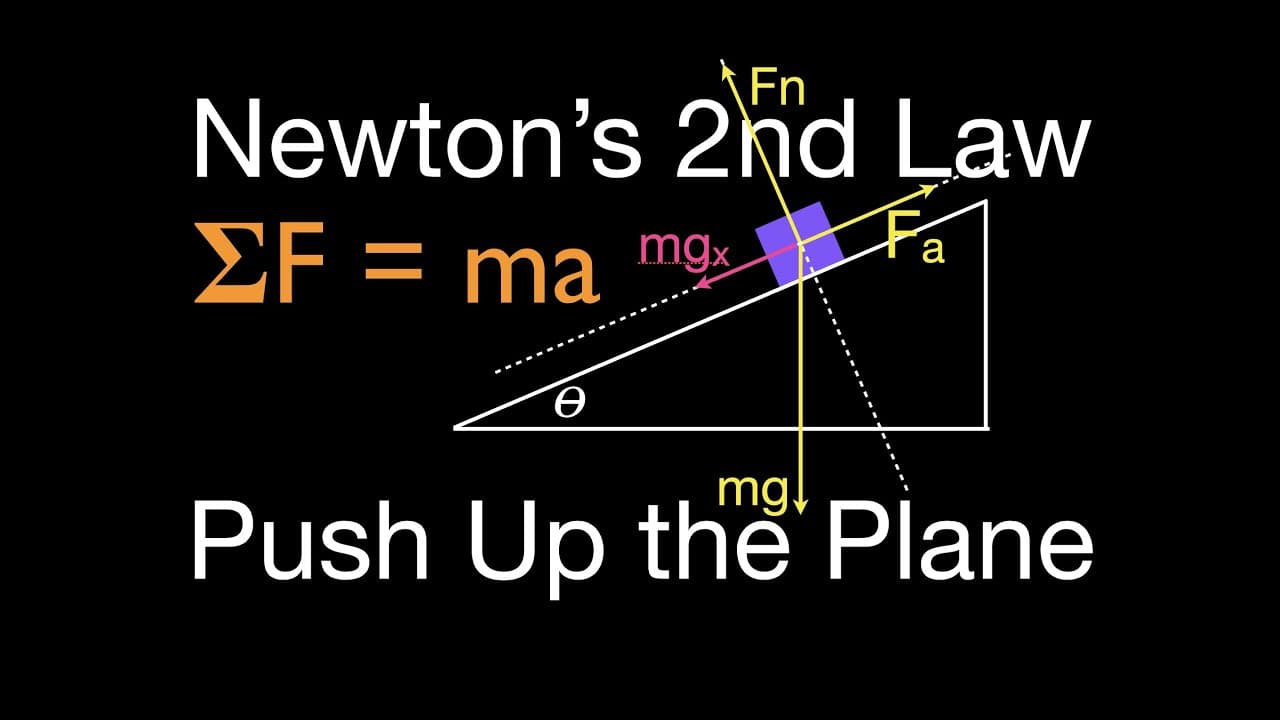
This video demonstrates how to calculate the acceleration of an object on an inclined plane using Newton's second law, with and without friction.
Transcript
in today's video we're going to go over another problem involving newton's second law inclined planes masses and we're going to be figuring out the acceleration of an object that we're going to be pushing up the inclined plane now before i get started please don't forget to subscribe to my channel step by step science get all my excellent physics c... Read More
Key Insights
- 👮♂️ Newton's second law, F=ma, can be used to solve problems involving objects on inclined planes.
- 🥶 Free body diagrams help identify the forces acting on the object and their components.
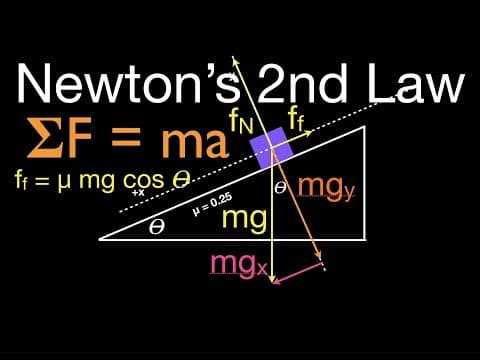
- ☺️ The x component of the force of gravity (mgx) and the friction force (Ff = μmgycosθ) can be calculated separately.
- 👻 Summing up the forces and dividing by the mass allows for the calculation of acceleration.
- 🪐 Friction reduces the net force and therefore the acceleration of the object.
- ✈️ The normal force counters the force of gravity and prevents the object from sinking into the inclined plane.
- 💁 Providing all necessary information, such as mass, applied force, angle of inclination, and friction coefficient, is crucial for solving the problem accurately.
Install to Summarize YouTube Videos and Get Transcripts
Explore YouTube Video Summarizer or Get YouTube Transcript Extractor
Questions & Answers
Q: What is the formula for Newton's second law?
Newton's second law states that the net force acting on an object is equal to the mass of the object multiplied by its acceleration (F=ma).
Q: How do you calculate the x and y components of the force of gravity?
The x component of the force of gravity (mgx) is calculated by multiplying the mass of the object by the sine of the angle of inclination. The y component (mgy) is calculated by multiplying the mass by the cosine of the angle.
Q: How is friction force calculated?
The friction force (Ff) is calculated by multiplying the coefficient of friction (μ) by the normal force (mgycosθ), where μ is the friction coefficient, m is the mass of the object, g is the acceleration due to gravity, and θ is the angle of inclination.
Q: What happens to the acceleration when there is friction?
When there is friction, the acceleration of the object will be less than when there is no friction. Friction acts in the opposite direction of motion, reducing the net force and thus the acceleration.
Q: What is the significance of the normal force in this problem?
The normal force (Fn) is equal in magnitude but opposite in direction to the y component of the force of gravity. It counteracts the force of gravity and keeps the object from sinking into the inclined plane.
Summary & Key Takeaways
-
The video presents two example problems of an object on an inclined plane, one without friction and one with friction.
-
Newton's second law (F=ma) is used to calculate the acceleration of the object.
-
Free body diagrams are drawn to identify the forces acting on the object, including gravity, applied force, normal force, and friction force.
Read in Other Languages (beta)
Share This Summary 📚
Summarize YouTube Videos and Get Video Transcripts with 1-Click
Try YouTube Summary with ChatGPT & Claude or YouTube Transcript Generator
Explore More Summaries from Step by Step Science 📚

Summarize YouTube Videos and Get Video Transcripts with 1-Click
Try YouTube Summary with ChatGPT & Claude or YouTube Transcript Generator