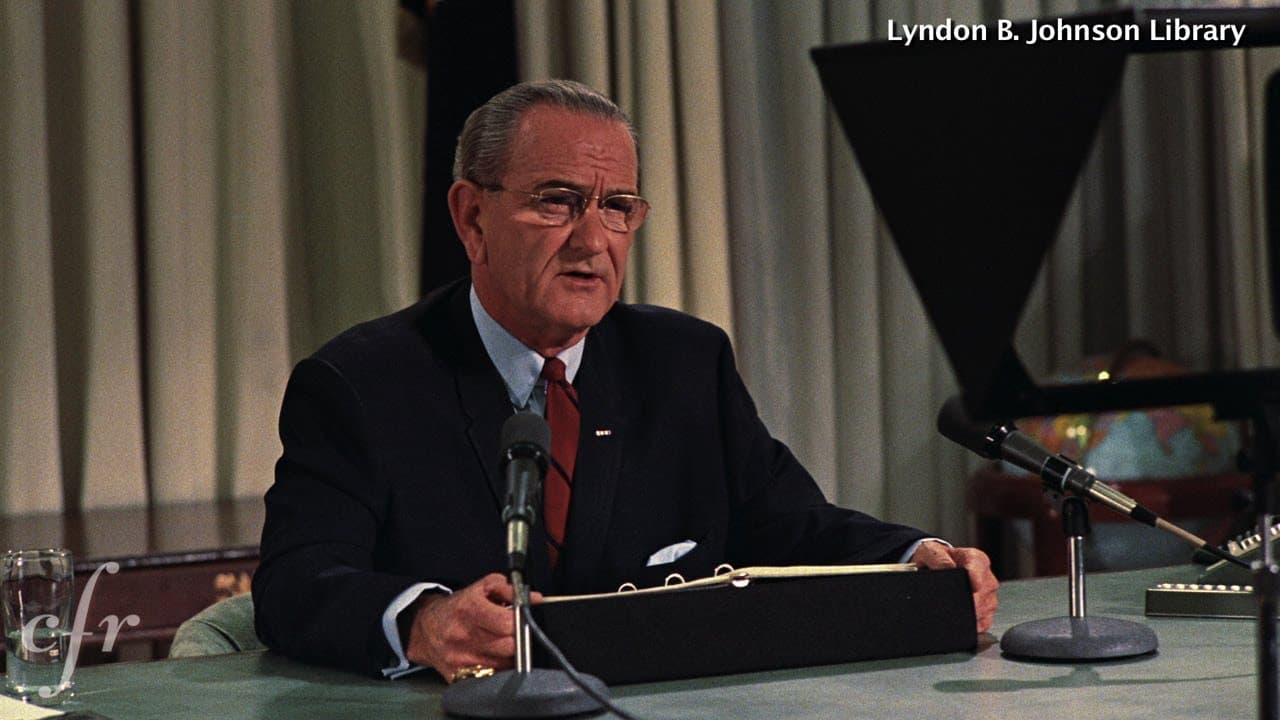
Lessons Learned: LBJ Announces He Will Not Seek Reelection
TL;DR
LBJ won't seek reelection due to Vietnam War backlash.
Transcript
Jim Lindsay: Political pundits love to talk about how foreign policy helps or hurts a presidential candidate. But the more interesting question may be, will foreign policy break a presidency once a candidate makes it to the White House? I’m Jim Lindsay, and this is Lessons Learned. Our topic today is Lyndon B. Johnson’s announcement on March 31,... Read More
Key Insights
- Lyndon B. Johnson became president after JFK's assassination and was later elected in a landslide in 1964, leveraging his popularity to pass significant domestic legislation.
- Despite domestic successes, LBJ's presidency is often overshadowed by the Vietnam War, where troop numbers surged from 16,000 to nearly 500,000 under his leadership.
- The Tet Offensive in 1968 exposed the gap between the Johnson administration's optimistic narrative and the harsh reality, significantly damaging his credibility.
- Growing anti-war sentiment, especially among young Americans, led to widespread protests and political challenges from within the Democratic Party.
- Senator Eugene McCarthy's strong showing in the New Hampshire primary and Robert Kennedy's candidacy intensified pressure on LBJ, contributing to his decision not to seek reelection.
- LBJ's announcement not to run highlighted the impact of foreign policy on presidential legacies, as seen in other presidencies like Truman and Carter.
- The video suggests that while foreign policy may not build a presidency, it can certainly break one, raising questions about the political risks of activist foreign policies.
- James M. Lindsay emphasizes the recurring theme of foreign policy challenges undermining presidential approval, urging viewers to consider why presidents pursue such policies despite historical lessons.
Install to Summarize YouTube Videos and Get Transcripts
Explore YouTube Video Summarizer or Get YouTube Transcript Extractor
Questions & Answers
Q: What domestic achievements is LBJ known for?
Lyndon B. Johnson is renowned for his Great Society programs, which included significant legislation such as the Civil Rights Act of 1964 and the Voting Rights Act of 1965. These laws aimed to eliminate racial discrimination and protect voting rights. Additionally, his administration introduced Medicare, providing health insurance to the elderly, marking a substantial expansion of the social safety net.
Q: How did the Vietnam War impact LBJ's presidency?
The Vietnam War significantly overshadowed LBJ's domestic achievements, as his administration escalated U.S. involvement, increasing troop numbers from 16,000 to nearly 500,000. The war's unpopularity grew, leading to widespread protests and political challenges. The Tet Offensive further damaged his credibility, ultimately contributing to his decision not to seek reelection due to declining public support.
Q: What was the Tet Offensive and its significance?
The Tet Offensive was a massive assault launched by North Vietnamese forces in January 1968, targeting key locations in South Vietnam, including Saigon. It contradicted the Johnson administration's optimistic claims of progress, exposing the harsh realities of the war. This event significantly undermined public confidence in LBJ's leadership and intensified anti-war sentiment, influencing his decision not to run for another term.
Q: Who were the key political challengers to LBJ in 1968?
In 1968, LBJ faced significant political challenges from within his own party. Senator Eugene McCarthy of Minnesota emerged as a notable challenger, gaining substantial support in the New Hampshire primary. Additionally, Senator Robert Kennedy announced his candidacy, intensifying pressure on Johnson. These challenges reflected growing dissatisfaction with LBJ's handling of the Vietnam War and contributed to his decision not to seek reelection.
Q: What lesson does LBJ's decision teach about foreign policy?
LBJ's decision not to seek reelection highlights the profound impact foreign policy can have on a presidency. While domestic achievements can build a president's legacy, foreign policy failures, like the Vietnam War, can overshadow successes and lead to political downfall. This lesson is evident in other presidencies, such as Truman's and Carter's, where foreign policy challenges eroded public support and political standing.
Q: How did public opinion shift regarding the Vietnam War?
Public opinion shifted dramatically against the Vietnam War during LBJ's presidency. Initially, there was some support, but as the war dragged on and casualties mounted, anti-war sentiment grew. By 1967, a majority of Americans viewed the war as a mistake. The Tet Offensive further fueled disillusionment, leading to widespread protests and political challenges, ultimately influencing LBJ's decision not to seek reelection.
Q: What role did the Vietnam War play in the 1968 Democratic primary?
The Vietnam War played a pivotal role in the 1968 Democratic primary, as it became a central issue that divided the party. Senator Eugene McCarthy's anti-war stance resonated with many voters, leading to a strong showing in the New Hampshire primary. Robert Kennedy's entry into the race further highlighted the party's divisions over the war, creating significant pressure on LBJ and contributing to his decision not to run.
Q: Why do presidents pursue activist foreign policies despite risks?
Presidents often pursue activist foreign policies despite the political risks because they may believe in the strategic importance of such actions or feel compelled to respond to international crises. However, history shows that these policies can lead to significant political costs if they become unpopular or fail to achieve their objectives, as seen in the cases of LBJ, Truman, and Carter. The pursuit of foreign policy activism reflects the complex interplay of domestic politics, international pressures, and presidential decision-making.
Summary & Key Takeaways
-
Lyndon B. Johnson's presidency, marked by significant domestic achievements, was ultimately overshadowed by the Vietnam War, leading to his decision not to seek reelection in 1968. Despite his landslide victory in 1964, the growing unpopularity of the war and political challenges within his own party forced his hand.
-
The Tet Offensive in 1968 was a turning point, contradicting the Johnson administration's positive assessments of the Vietnam War and leading to widespread disillusionment. This, coupled with strong opposition from figures like Eugene McCarthy and Robert Kennedy, pressured LBJ to step down.
-
James M. Lindsay's analysis underscores the lesson that foreign policy can break a presidency, as seen in the cases of Truman, Carter, and others. The video raises critical questions about the political wisdom of pursuing activist foreign policies given their potential to damage presidential legacies.
Read in Other Languages (beta)
Share This Summary 📚
Summarize YouTube Videos and Get Video Transcripts with 1-Click
Try YouTube Summary with ChatGPT & Claude or YouTube Transcript Generator
Explore More Summaries from Council on Foreign Relations 📚


Summarize YouTube Videos and Get Video Transcripts with 1-Click
Try YouTube Summary with ChatGPT & Claude or YouTube Transcript Generator