This is how we generate thousands of pdfs in seconds at work
TL;DR
Design flaws can arise from insufficient information, impacting system performance and user experience.
Transcript
all right here's another video where I want to share with you a real life work scenario that we basically ran into where you will Design something for a system and if you don't have enough information up front you will Design something bad right you will make a poor design and when you deploy it to production you will start running to issues where ... Read More
Key Insights
- 🎨 Adequate initial data collection is crucial to prevent design failures in software development.
- 👤 Agile methodologies advocate for iterative design, emphasizing user feedback to improve systems after deployment.
- 😒 The suggested solution outlines how to effectively use AWS services like SQS and Lambda for scalability.
- 🧑🎓 Understanding user behavior, such as how many classrooms a student has, directly impacts system architecture decisions.
- 🥺 Real-time classifications of user updates can lead to performance bottlenecks without careful design considerations.
- 🚩 Efficient error handling and the use of feature flags can significantly mitigate post-deployment issues.
- 👤 Continuous monitoring and adjustment are necessary to maintain system performance as user demands change.
Install to Summarize YouTube Videos and Get Transcripts
Explore YouTube Video Summarizer or Get YouTube Transcript Extractor
Questions & Answers
Q: What problem did the initial design encounter?
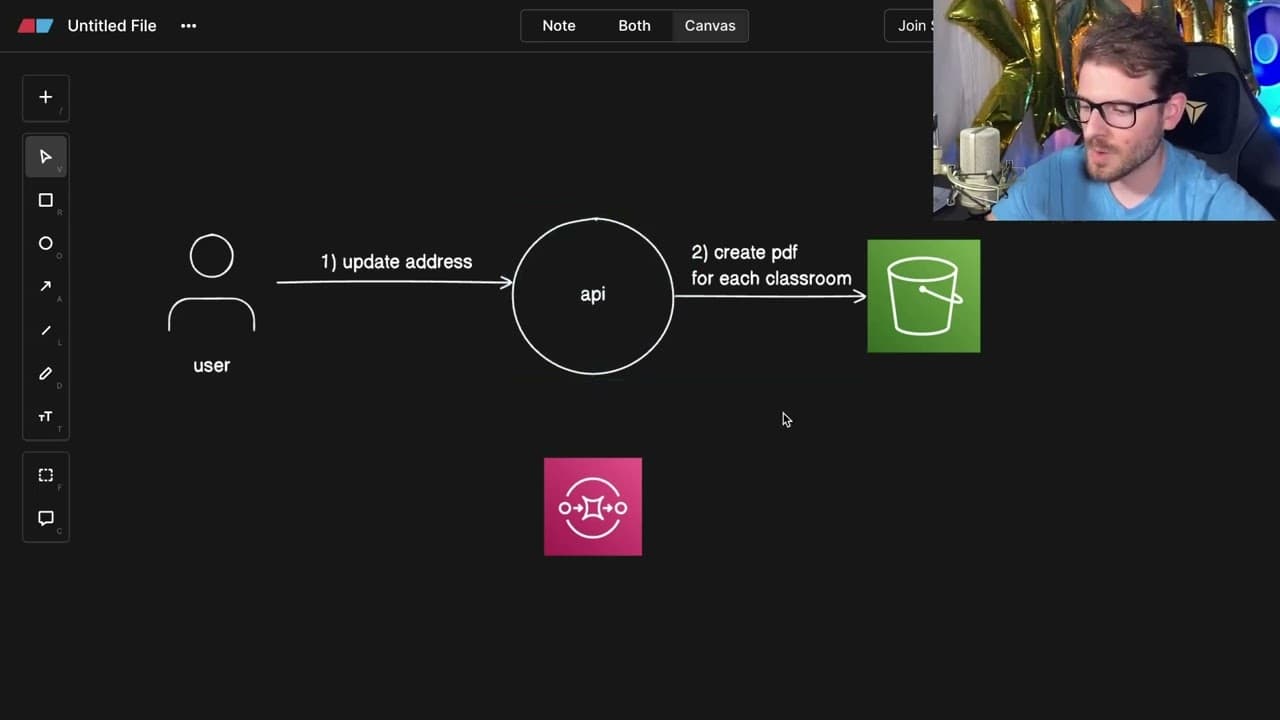
The initial design faced performance issues because it did not account for students with a large number of classrooms. When a user updated their address, the system required looping through potentially thousands of classrooms to generate PDFs, resulting in timeouts and failures, impacting user experience.
Q: How does the new solution improve the system’s performance?
The new solution leverages AWS SQS and Lambda to handle address updates. Instead of processing everything synchronously within the API, the system publishes events for PDF generation, allowing it to scale dynamically. This method ensures that the system can handle large volumes of requests without timing out.
Q: Why is sprint planning considered crucial in software design?
Sprint planning is crucial as it helps gather essential data points that influence design decisions. By understanding user requirements and potential edge cases, developers can create more robust systems that perform well in production. Proper planning helps avoid costly redesigns and negative user experiences.
Q: What are some potential challenges with the proposed solution?
One challenge is that not all users can utilize WebSockets for real-time updates, requiring alternative solutions like long polling to inform users of processing status. Additionally, ensuring that Lambda functions scale effectively and manage resources efficiently may require ongoing monitoring to prevent any performance issues.
Q: How does the presenter suggest gathering the necessary information during design?
The presenter suggests asking targeted questions to obtain accurate data during sprint planning, such as understanding the average number of classrooms a student might have. This information is vital for designing scalable solutions that can adapt to varying user needs effectively.
Q: Can you elaborate on how AWS services enhance the proposed design?
AWS services augment the proposed design by allowing on-demand scaling of processing capabilities through Lambda functions, which can handle multiple events simultaneously. S3 provides limitless storage for generated PDFs, and DynamoDB helps track processing states, facilitating a more organized and efficient backend architecture.
Q: What happens when a system fails after deployment?
If a system fails post-deployment due to poor design choices informed by incorrect assumptions, it can lead to negative consequences such as user dissatisfaction, high support costs, and damage to the organization’s reputation. Employing feature flags can mitigate risks by allowing teams to disable problematic features quickly.
Q: Why might parallel processing be beneficial in this context?
Parallel processing allows for tasks to be completed simultaneously rather than sequentially, which significantly reduces processing time. This approach is beneficial in scenarios where bulk data needs to be handled, as it leverages the cloud's scalability to process thousands of tasks quickly, improving overall system responsiveness.
Summary & Key Takeaways
-
The video discusses a real-life scenario where inadequate initial data led to a poorly designed system for processing user updates in an online classroom setting.
-
The presenter emphasizes the importance of collecting accurate data during sprint planning to avoid unexpected issues during production, especially when user requirements scale unexpectedly.
-
A solution involving AWS Lambda and SQS is proposed to handle high-volume tasks more efficiently, showcasing how distributed systems can improve performance and scalability.
Read in Other Languages (beta)
Share This Summary 📚
Summarize YouTube Videos and Get Video Transcripts with 1-Click
Try YouTube Summary with ChatGPT & Claude or YouTube Transcript Generator
Explore More Summaries from Web Dev Cody 📚




Summarize YouTube Videos and Get Video Transcripts with 1-Click
Try YouTube Summary with ChatGPT & Claude or YouTube Transcript Generator