Set Operations - Structured Query Language (SQL) - Database Management System
TL;DR
Learn about the set operations in SQL - union, intersection, and except - and how to use them to combine and compare relations.
Transcript
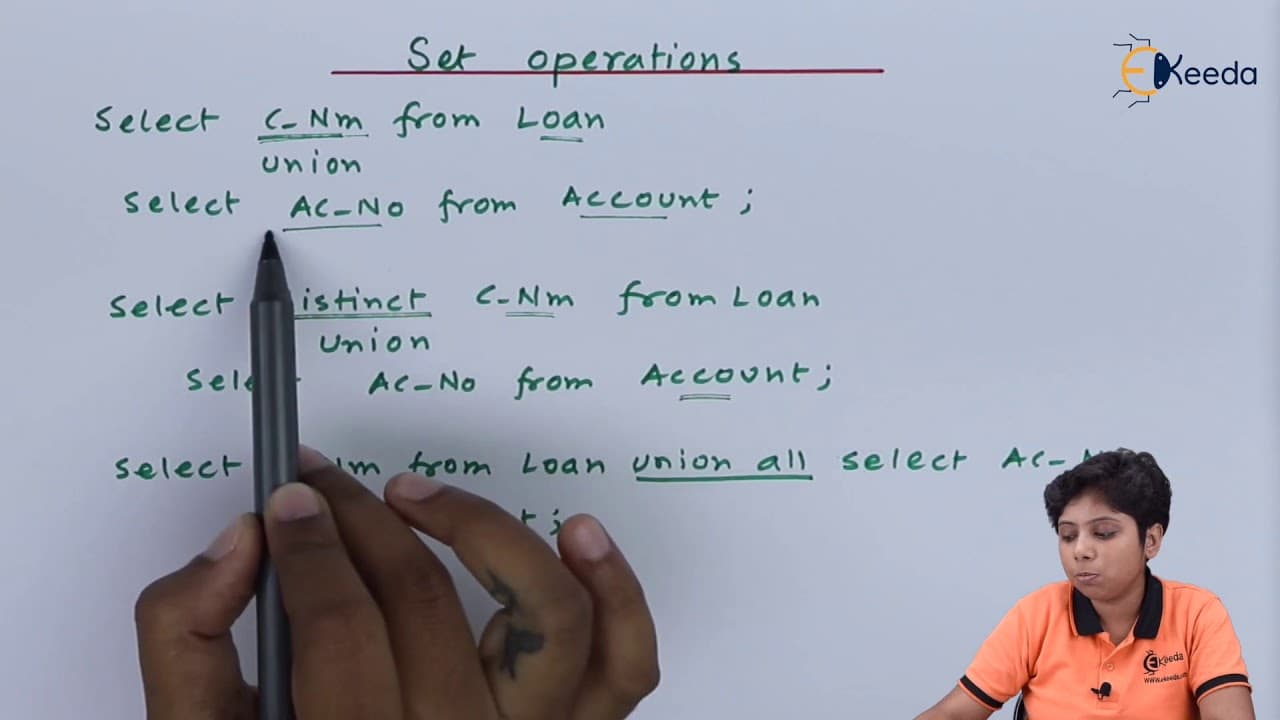
click the bell icon to get latest videos from ekeeda hello friends today we will discuss about the set operations on sql the set operations are union intersection and accept operation so we will discuss each of this using the sql queries and how to transfer the relation using this set operation the first operation we will use is the union operation... Read More
Key Insights
- 😫 The set operations in SQL (union, intersection, and except) are used to combine or compare relations based on their attributes.
- 👻 The union operation combines relations by joining all attributes into a single relation, allowing for distinct or duplicate values.
- 🎟️ The intersection operation finds common values between attributes of different relations, while the except operation finds the exception or missing values.
- 😫 The attributes used in the set operations must have the same data types, or there will be errors in the SQL query execution.
- 🇪🇺 The "distinct" keyword ensures only unique values are joined, while "union all" includes all values, even duplicates.
- 🉑 The accept all command removes all instances of duplicated values from the except operation's result, considering them as exceptions.
- 😨 Care should be taken while using the accept all command to avoid deleting necessary records.
Install to Summarize YouTube Videos and Get Transcripts
Explore YouTube Video Summarizer or Get YouTube Transcript Extractor
Questions & Answers
Q: What are the set operations in SQL?
The set operations in SQL are union, intersection, and except. They are used to combine or compare relations based on their attributes.
Q: How does the union operation work in SQL?
The union operation in SQL combines two relations, joining all attributes into a single relation. If attributes are missing in one relation, null values are used. The "distinct" keyword can be used to ensure only unique values are joined.
Q: Can duplicate values be included in the union operation on SQL?
Yes, if you want to include duplicate values, you can use the "union all" keyword instead of "union" to combine all values without eliminating duplicates.
Q: What does the intersect operation do in SQL?
The intersect operation in SQL finds common values between attributes of different relations. It compares the attributes and returns only the values that are present in both relations.
Q: Are there any restrictions on the data types for attributes used in the intersect operation in SQL?
Yes, the data types of attributes used in the intersect operation must be the same. If the data types do not match, there will be an error from the SQL end.
Q: How does the except operation work in SQL?
The except operation in SQL finds the difference or exception between two relations. It compares the attributes and returns the values that are present in the first relation but not in the second relation.
Q: Can the except operation be used with different data types in SQL?
No, just like the intersect operation, the attributes used in the except operation must have the same data types. If the data types don't match, the SQL query will throw an error.
Q: How can the accept all command be used in the except operation in SQL?
The accept all command can be used to include duplicate values in the except operation. It removes all instances of the duplicated values from the result, making sure they are considered exceptions.
Summary & Key Takeaways
-
The set operations in SQL (union, intersection, and except) allow the combination of two or more relations by joining all attributes into a single relation.
-
Using the union operation, duplicate or distinct values can be joined together, with null values representing missing attributes.
-
The intersection operation finds common values between attributes of different relations, while the except operation finds the difference or exception between attributes.
Read in Other Languages (beta)
Share This Summary 📚
Summarize YouTube Videos and Get Video Transcripts with 1-Click
Try YouTube Summary with ChatGPT & Claude or YouTube Transcript Generator
Explore More Summaries from Ekeeda 📚

Summarize YouTube Videos and Get Video Transcripts with 1-Click
Try YouTube Summary with ChatGPT & Claude or YouTube Transcript Generator