Captain Buzz: Smartphone Pilot - Computerphile
TL;DR
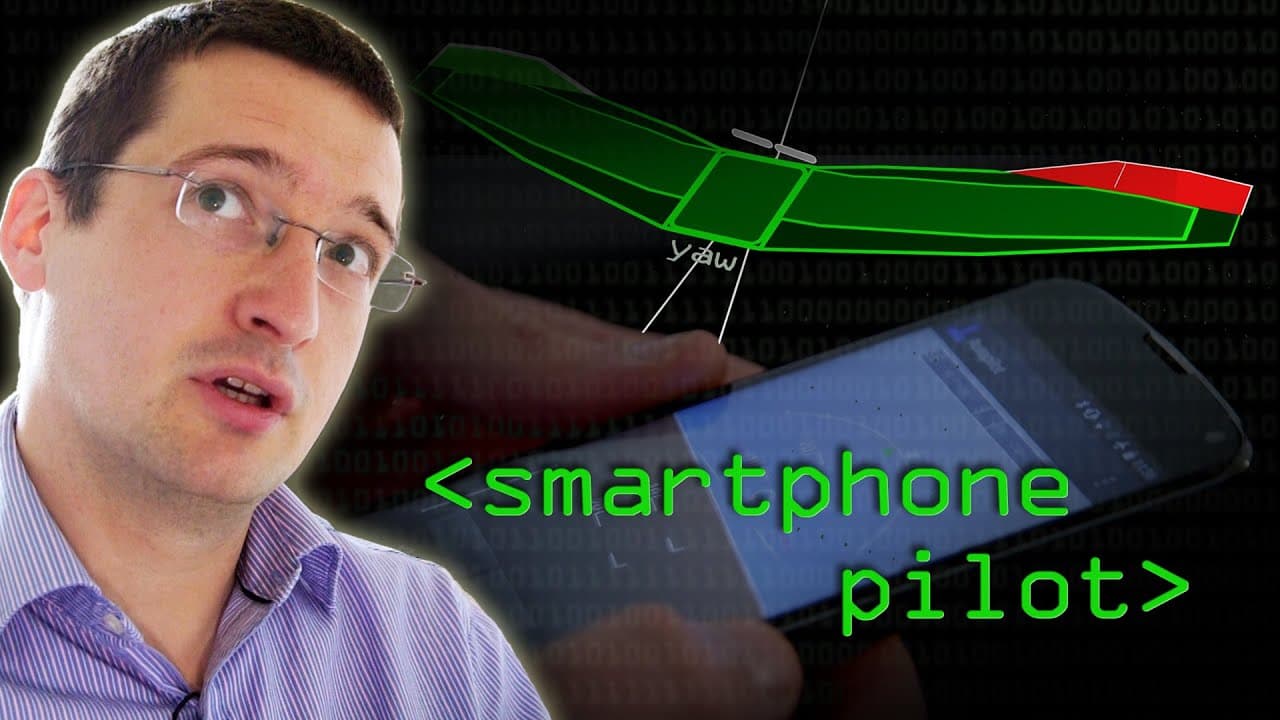
Researchers create an app that enables a smartphone to control the guidance, navigation, and control of a fully autonomous drone aircraft.
Transcript
we're members of the digital technology group here in the computer laboratory and we work on a whole range of computer science and engineering problems and most of the projects involve smartphones in some way and there's a little gang of us who are also quite keen on drones and we have hexacopters and quadcopters and fixed-wing aircraft and sometim... Read More
Key Insights
- 🎮 The researchers successfully created an app that allows a smartphone to control the guidance, navigation, and control of a fully autonomous drone aircraft.
- ✊ The smartphone contains all the necessary sensors and computational power to control the aircraft's flight, eliminating the need for additional hardware.
- 🎮 Control messages are transmitted through the headphone jack, utilizing electrical signals to control the motors that turn the aircraft's control surfaces.
- 👤 The system includes safety features such as a buddy box that allows the user to switch between manual and smartphone control, ensuring user control over the motor.
- 🇫🇮 Future applications of smartphone-controlled drones include optical flow-based navigation, collision prevention systems using Wi-Fi and Bluetooth, and mapping Wi-Fi and Bluetooth sources in an area.
- 🤗 This technology opens up possibilities for advanced functionalities and applications in the field of drone technology.
- 🐕🦺 Squarespace is the sponsor of the video, offering website building services.
Install to Summarize YouTube Videos and Get Transcripts
Explore YouTube Video Summarizer or Get YouTube Transcript Extractor
Questions & Answers
Q: How did the researchers integrate smartphones into the control of the drone aircraft?
The researchers utilized the sensors and computational power of smartphones, such as accelerometers, gyroscope, compass, and GPS, to control the drone's flight. Control messages are sent through the headphone jack to control the motors that turn the control surfaces of the aircraft.
Q: How does the smartphone communicate with the drone?
The smartphone communicates with the drone through the headphone jack, transmitting control messages in the form of electrical signals. These signals control the motors that turn the control surfaces of the aircraft.
Q: What safety features are implemented in the system?
The system includes a buddy box that allows the user to switch between manually flying the aircraft and allowing the smartphone to control it. This ensures that the user maintains control over the motor at all times for safety reasons.
Q: What are the potential future applications of smartphone-controlled drones?
The researchers believe that smartphone-controlled drones can be expanded to incorporate new functionalities, such as utilizing the cameras for optical flow-based navigation, implementing collision prevention systems using Wi-Fi and Bluetooth, and mapping out Wi-Fi and Bluetooth sources in an area.
Summary & Key Takeaways
-
Researchers at a digital technology group in a computer laboratory combine their interest in drones and smartphones to create an autonomous drone aircraft controlled by a smartphone app.
-
The smartphone contains all the necessary sensors and computational power to control the aircraft's flight, including accelerometers, gyroscope, compass, and GPS.
-
The control messages are transmitted through the headphone jack, utilizing electrical signals to control the motors that turn the aircraft's control surfaces.
Read in Other Languages (beta)
Share This Summary 📚
Summarize YouTube Videos and Get Video Transcripts with 1-Click
Try YouTube Summary with ChatGPT & Claude or YouTube Transcript Generator
Explore More Summaries from Computerphile 📚






Summarize YouTube Videos and Get Video Transcripts with 1-Click
Try YouTube Summary with ChatGPT & Claude or YouTube Transcript Generator