Higher Order Differential Equation when R.H.S = e^ax.V Problem 2
TL;DR
Learn how to convert hyperbolic functions into exponential functions and solve higher order differential equations with hyperbolic functions using the method of e to the power ax into v.
Transcript
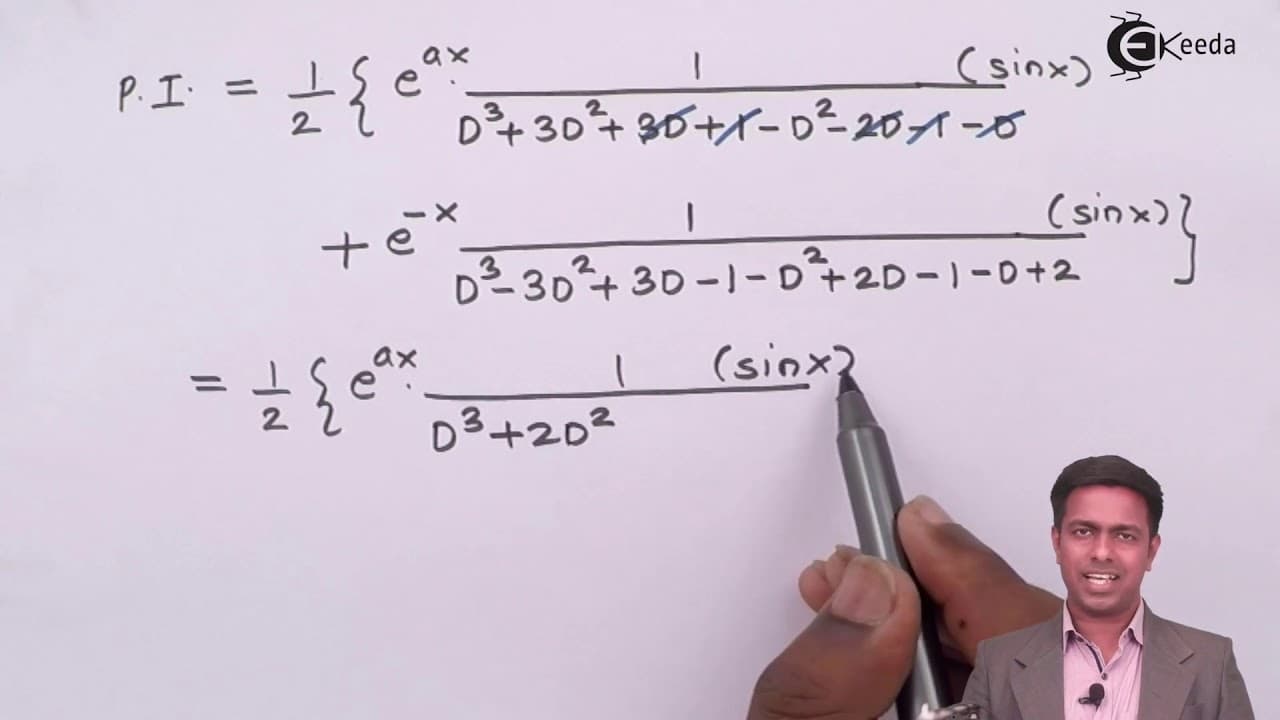
hello students so now let's start with the problem number two which is based on the higher order differential equation when the right hand side is e to the power ax into some function of x so yeah i have a right hand side which is a hyperbolic function so here we are going to see how to convert that hyperbolic function into exponential function and... Read More
Key Insights
- 🪈 Hyperbolic functions can be converted into exponential functions using Euler's formula in order to solve higher order differential equations.
- 🤭 The method of e to the power ax into v is used to solve linear differential equations with constant coefficients and hyperbolic function right hand sides.
- ✋ Finding the roots of the auxiliary equation is crucial for determining the complementary function in higher order differential equations.
- ❓ The particular integral is found by applying the 1/f(d) operator to the hyperbolic function, where f(d) is the function of the differential operator.
- ❎ Simplifying the particular integral may involve rationalizing denominators and replacing d square with -a square.
- ✋ The final solution to the higher order differential equation is obtained by adding the complementary function to the particular integral.
Install to Summarize YouTube Videos and Get Transcripts
Explore YouTube Video Summarizer or Get YouTube Transcript Extractor
Questions & Answers
Q: What is the first step in solving a higher order differential equation with a hyperbolic function on the right hand side?
The first step is to convert the hyperbolic function into an exponential function using Euler's formula. This allows us to use the method of e to the power ax into v to solve the equation.
Q: How do you find the complementary function for a given higher order differential equation?
To find the complementary function, you need to find the roots of the auxiliary equation. You can use either a calculator or the synthetic division method to find these roots.
Q: What is the difference between the complementary function and the particular integral?
The complementary function represents the general solution to the homogeneous equation (the equation without the right hand side). The particular integral represents a specific solution to the non-homogeneous equation (the equation with the right hand side).
Q: How do you find the particular integral for a given higher order differential equation with a hyperbolic function on the right hand side?
To find the particular integral, you need to apply the operator 1/f(d) to the right hand side, where f(d) is the function of the differential operator. This involves replacing d with d+a in the exponential term and expanding the brackets.
Summary & Key Takeaways
-
This video covers how to convert hyperbolic functions into exponential functions and solve higher order differential equations with hyperbolic functions.
-
The video explains the process of finding the complementary function and the particular integral for a given linear differential equation with constant coefficients.
-
The method involves converting the hyperbolic function into an exponential function using Euler's formula and then using the e to the power ax into v method to solve the equation.
Read in Other Languages (beta)
Share This Summary 📚
Summarize YouTube Videos and Get Video Transcripts with 1-Click
Try YouTube Summary with ChatGPT & Claude or YouTube Transcript Generator
Explore More Summaries from Ekeeda 📚




Summarize YouTube Videos and Get Video Transcripts with 1-Click
Try YouTube Summary with ChatGPT & Claude or YouTube Transcript Generator