Percent word problem example 5 | Decimals | Pre-Algebra | Khan Academy
TL;DR
The video explains how to find an unknown number when given its percentage value and another number.
Transcript
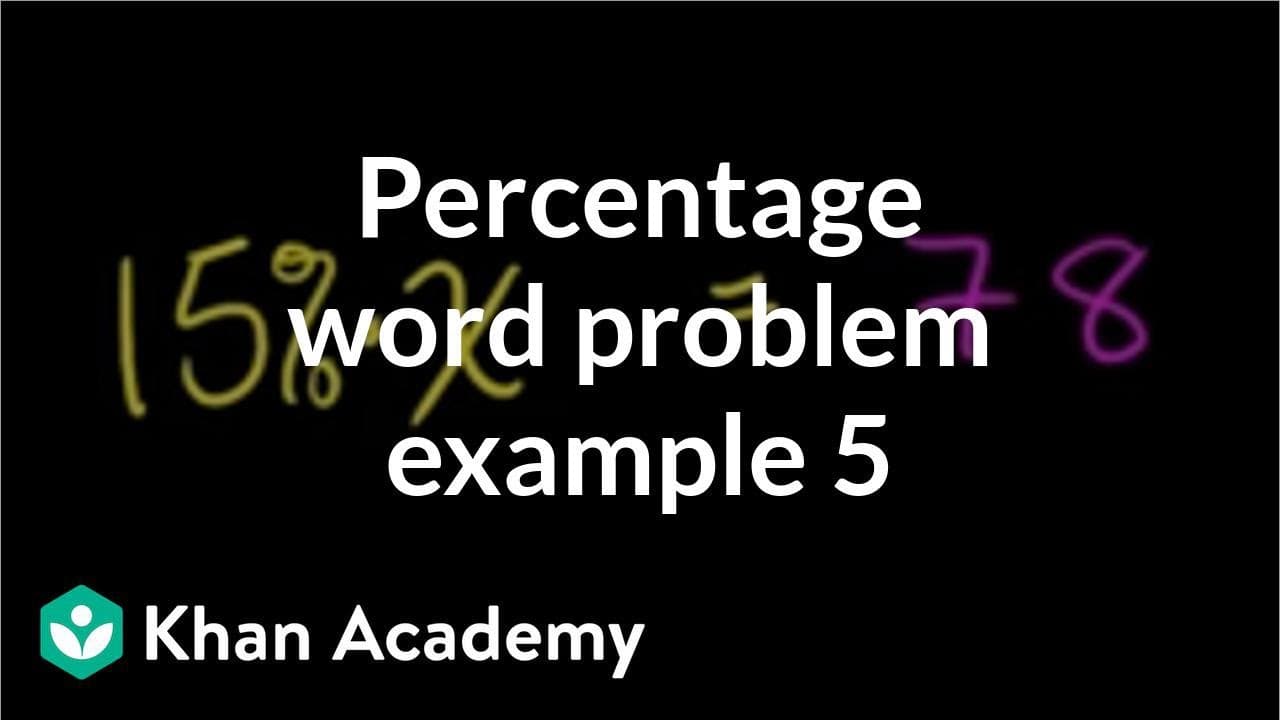
78 is 15% of what number? So there's some unknown number out there, and if we take 15% of that number, we will get 78. So let's just call that unknown number x. And we know that if we take 15% of x, so multiply x by 15%, we will get 78. And now we just literally have to solve for x. Now, 15% mathematically, you can deal directly with percentages, b... Read More
Key Insights
- 👻 Converting percentages to decimals simplifies calculations and allows for easy multiplication.
- 😫 Setting up an equation with the decimal multiplied by the unknown number helps solve for the missing value.
- 🙃 Dividing both sides of the equation by the decimal allows for the isolation and calculation of the unknown number.
- ⚾ Understanding the terminology of percentage, base, and amount can provide additional insight and clarity when solving percentage-related problems.
- #️⃣ The size of an unknown number can be estimated based on the given percentage. In this case, a small percentage (15%) indicates a large unknown number (520).
- ✖️ Converting a decimal into a percentage involves multiplying it by 100.
- ✖️ Knowledge of basic multiplication and subtraction is necessary to calculate the unknown number accurately.
Install to Summarize YouTube Videos and Get Transcripts
Explore YouTube Video Summarizer or Get YouTube Transcript Extractor
Questions & Answers
Q: How can we find an unknown number when given its percentage value and another number?
To find the unknown number, first, convert the percentage into a decimal. Then, set up an equation where the decimal multiplied by the unknown number is equal to the given number. Solve for the unknown number to find the solution.
Q: Why is it important to convert the percentage into a decimal?
Converting the percentage into a decimal helps simplify the calculations. It allows us to directly multiply the decimal by the unknown number to find its value. It is mathematically equivalent to multiplying the percentage by the unknown number divided by 100.
Q: How do we solve the equation to find the unknown number?
To solve the equation, divide both sides by the decimal value. This isolates the unknown number on one side of the equation. By performing the division, the unknown number can be calculated, giving the solution to the problem.
Q: What is the significance of understanding percentage, base, and amount in this context?
Understanding the terms percentage, base, and amount helps conceptualize the problem. The percentage represents the proportion being taken from the base or unknown number, which is sometimes referred to as the amount. By knowing these terms, it becomes easier to interpret and analyze a problem involving percentages.
Summary & Key Takeaways
-
The video teaches how to solve for an unknown number when its percentage value and another number is given.
-
By representing the percentage as a decimal and setting up an equation, it becomes easier to solve for the unknown number.
-
The video provides a step-by-step example of finding the unknown number when 15% of it is equal to 78.
Read in Other Languages (beta)
Share This Summary 📚
Summarize YouTube Videos and Get Video Transcripts with 1-Click
Try YouTube Summary with ChatGPT & Claude or YouTube Transcript Generator
Explore More Summaries from Khan Academy 📚



Summarize YouTube Videos and Get Video Transcripts with 1-Click
Try YouTube Summary with ChatGPT & Claude or YouTube Transcript Generator