Alcohol or ethanol fermentation | Cellular respiration | Biology | Khan Academy
TL;DR
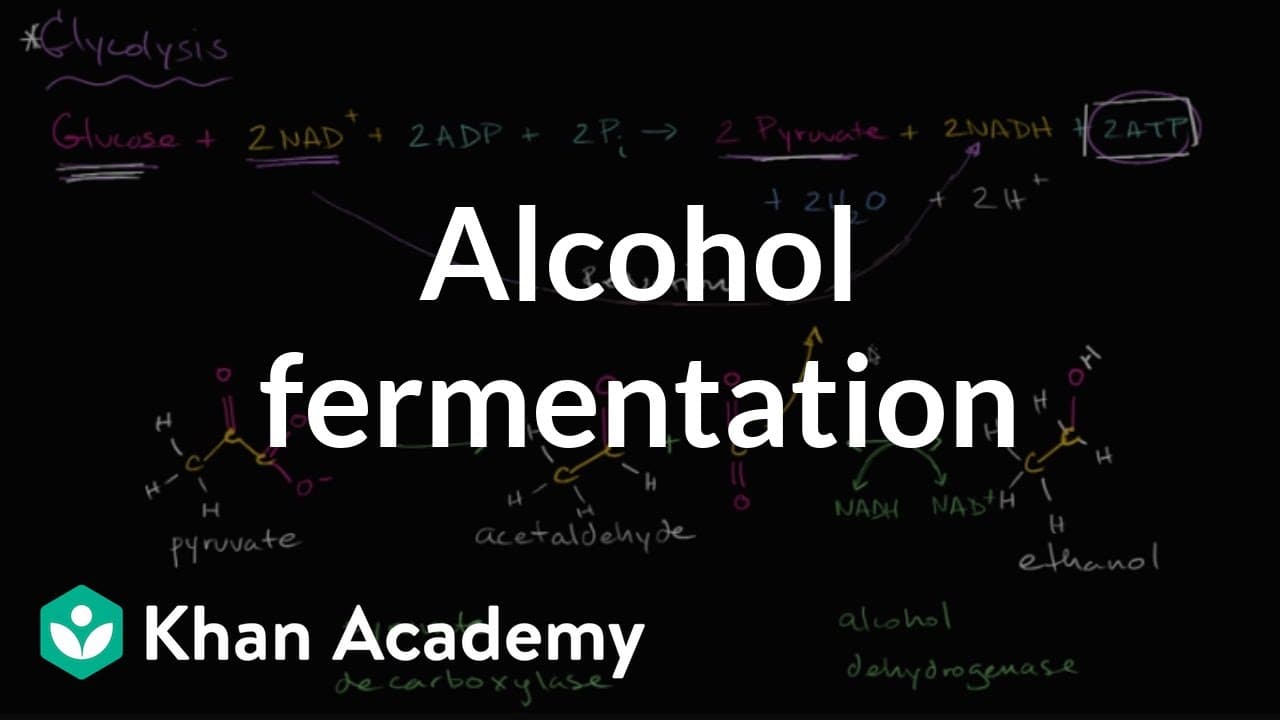
Ethanol fermentation is a process where yeast converts glucose into ethanol and carbon dioxide, commonly used for bread-making and alcohol production.
Transcript
- [Voiceover] We've already seen multiple times that glycolysis is the process where we start with a glucose molecule which has six carbons and we're able to break it down into two pyruvate molecules which each have three carbons. And in the process of doing so, we produce a net of two ATPs, we reduce NAD+ to NADH, we're adding a hydride anion, so ... Read More
Key Insights
- 😥 Glycolysis is the starting point of various fermentation processes, including ethanol fermentation.
- ❓ Ethanol fermentation involves the conversion of pyruvate to acetaldehyde and then to ethanol.
- 🖐️ Yeast plays a crucial role in ethanol fermentation, converting glucose to ethanol and carbon dioxide.
Install to Summarize YouTube Videos and Get Transcripts
Explore YouTube Video Summarizer or Get YouTube Transcript Extractor
Questions & Answers
Q: What is the main difference between lactic acid fermentation and alcohol fermentation?
The main difference lies in the end products. Lactic acid fermentation converts pyruvate to lactic acid, while alcohol fermentation converts pyruvate to acetaldehyde and then ethanol.
Q: Why is ethanol fermentation important in bread-making?
Ethanol fermentation plays a crucial role in bread-making as it produces carbon dioxide, which gives the bread its fluffy texture. It also produces trace amounts of ethanol, contributing to its flavor.
Q: How is yeast involved in ethanol fermentation?
Yeast, categorized as fungi, performs glycolysis and alcohol fermentation. It digests sugar, converts pyruvate to acetaldehyde, and then to ethanol, enabling alcohol production.
Q: What is the significance of ethanol fermentation in society?
Ethanol fermentation has significant societal importance as it is used in alcohol production, such as wine-making, and in bread-making for the fluffiness and flavor of the bread.
Summary & Key Takeaways
-
Glycolysis is the initial process where glucose is broken down into pyruvate, producing ATP and NADH.
-
In lactic acid fermentation, pyruvate is converted to lactic acid, while in alcohol fermentation, pyruvate is converted to acetaldehyde and then to ethanol.
-
Ethanol fermentation is utilized in bread-making, where yeast digests sugar, undergoes glycolysis, and produces carbon dioxide for the fluffiness of the bread, as well as trace amounts of ethanol.
Read in Other Languages (beta)
Share This Summary 📚
Summarize YouTube Videos and Get Video Transcripts with 1-Click
Try YouTube Summary with ChatGPT & Claude or YouTube Transcript Generator
Explore More Summaries from Khan Academy 📚



Summarize YouTube Videos and Get Video Transcripts with 1-Click
Try YouTube Summary with ChatGPT & Claude or YouTube Transcript Generator