Introduction to Unsymmetrical Bending - Unsymmetrical Bending - Structural analysis 1
TL;DR
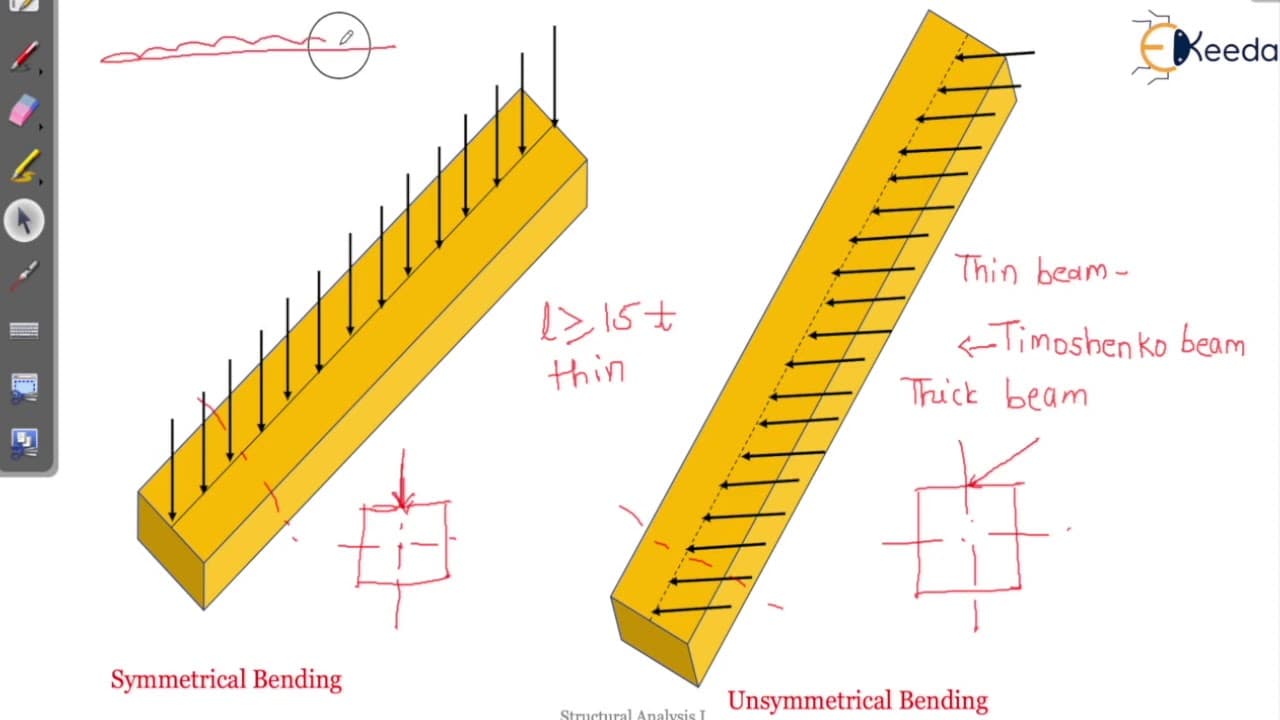
This content discusses the concept of unsymmetrical bending in steel beams and its causes, including load line inclination and unsymmetrical cross-sections.
Transcript
hello students also we are at the end of this particular uh structure analysis uh you know it's the end of the unit so it's just unsymmetrical bending and shear center unsymmetrical bending name itself unsymmetrical bending which is not symmetrical right that is unsymmetrical but unsymmetrical bending of what what is that bending you know and for w... Read More
Key Insights
- 😁 Unsymmetrical bending in steel beams can occur due to load line inclination or unsymmetrical cross-sections.
- 😁 Thin beams have negligible deformation due to shear, while thick beams consider shear deformation.
- ✈️ Bending stresses in simple bending are assumed to be perpendicular to the plane of loading, but unsymmetrical bending occurs when they are not.
- 🫥 Symmetrical cross-sections can also cause unsymmetrical bending if the load line is inclined.
Install to Summarize YouTube Videos and Get Transcripts
Explore YouTube Video Summarizer or Get YouTube Transcript Extractor
Questions & Answers
Q: What is unsymmetrical bending?
Unsymmetrical bending refers to the bending of a beam that is not symmetrical, either due to the inclination of the load line or the unsymmetrical cross-section of the beam.
Q: When does unsymmetrical bending occur in symmetrical cross-sections?
Unsymmetrical bending can occur in symmetrical cross-sections when the load line is inclined to both principal centroidal axes of the section.
Q: How does the deformation due to shear differ in thin and thick beams?
In thin beams, deformation due to shear is negligible, while in thick beams, shear deformation is considered.
Q: What are the assumptions in Euler's beam theory?
Euler's beam theory assumes that the length of the beam is much greater than its lateral dimension, the plane cross-section remains plane before and after bending, and stresses in the lateral direction are negligible.
Summary & Key Takeaways
-
Unsymmetrical bending occurs in steel beams when the load line is inclined or the cross-section is unsymmetrical.
-
Thin beams have negligible deformation due to shear, while thick beams consider shear deformation.
-
Bending stresses in simple bending are assumed to be perpendicular to the plane of loading, but unsymmetrical bending occurs when they are not.
Read in Other Languages (beta)
Share This Summary 📚
Summarize YouTube Videos and Get Video Transcripts with 1-Click
Try YouTube Summary with ChatGPT & Claude or YouTube Transcript Generator
Explore More Summaries from Ekeeda 📚



Summarize YouTube Videos and Get Video Transcripts with 1-Click
Try YouTube Summary with ChatGPT & Claude or YouTube Transcript Generator