Metal Oxide Semiconductor Filed Effect Transistors MOSFETs - Microwave Engineering
TL;DR
This video provides an introduction to Metal-Oxide-Semiconductor Field-Effect Transistors (MOSFETs) and discusses their structure, symbols, characteristics, and equivalent circuitry.
Transcript
click the bell icon to get latest videos from equator hello friends I welcome you all to this video here we have solid-state devices with respect to the microwave energy especially the microwave transistors so so far after learning the bipolar Junction transistors of the homo Junction and hetero Junction type we have switched to the field effect tr... Read More
Key Insights
- ✊ MOSFETs are popular for power amplification and voltage control over microwave frequencies.
- 📳 MOSFETs can be either enhancement mode or depletion mode and can have n-channel or p-channel configurations.
- 🤬 The symbols used to represent the four types of MOSFETs differ in the representation of the substrate connection and the direction of the arrow pointing to the device.
- ⚡ The drain current in a MOSFET is affected by various factors such as electron mobility, capacitance, gate voltage, and drain voltage.
- ⚾ The operating frequency of a MOSFET can be determined based on its transconductance and other parameters.
Install to Summarize YouTube Videos and Get Transcripts
Explore YouTube Video Summarizer or Get YouTube Transcript Extractor
Questions & Answers
Q: What are the four terminals of a MOSFET and what is their purpose?
The four terminals of a MOSFET are the source, drain, gate, and substrate. The source and drain terminals control the flow of current, the gate terminal controls the device operation, and the substrate acts as a fourth connection point.
Q: What is the difference between enhancement and depletion mode in MOSFETs?
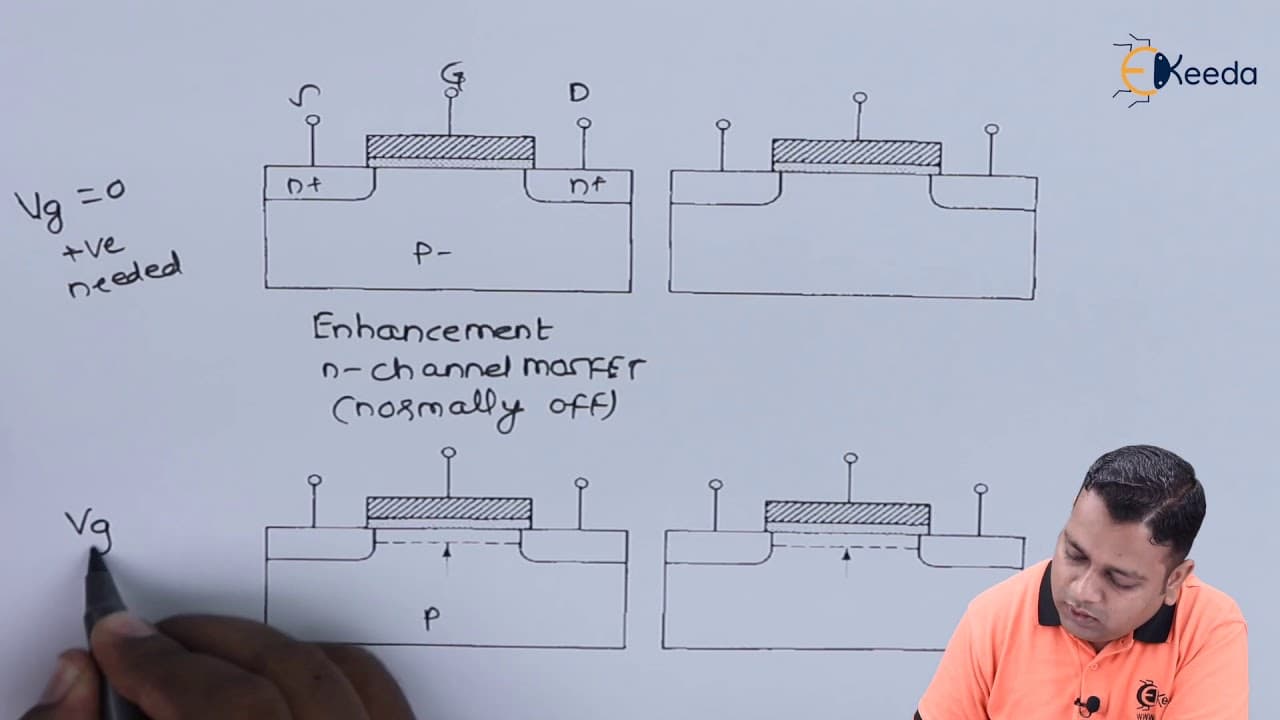
In enhancement mode MOSFETs, the device is normally off and requires a positive gate voltage to turn it on. In depletion mode MOSFETs, the device is normally on and requires a negative gate voltage to turn it off.
Q: How is the structure of a MOSFET different from other field-effect transistors?
MOSFETs have a structure consisting of a metal electrode, an insulating layer (usually silicon dioxide), and a semiconductor material (such as silicon). This structure allows for voltage control and power amplification over a wide range of frequencies.
Q: What are the different symbols used to represent the four types of MOSFETs?
The symbols for the four types of MOSFETs (n-channel enhancement, n-channel depletion, p-channel enhancement, and p-channel depletion) differ in the representation of the substrate connection and the direction of the arrow pointing to the device.
Q: How do drain voltage and drain current change in the linear and saturation regions of a MOSFET?
In the linear region, increasing the drain voltage results in a linear increase in drain current. In the saturation region, the drain current remains constant even as the drain voltage increases.
Q: How is the drain current (ID) in a MOSFET calculated?
The drain current in a MOSFET can be calculated using the equation: ID = (uCox / L) * [(VG - VT) * VD - VDS^2/2], where u is the electron mobility, Cox is the insulator capacitance, L is the channel length, VG is the gate voltage, VT is the threshold voltage, and VD and VDS are the drain voltage and source voltage, respectively.
Q: What is transconductance in a MOSFET?
Transconductance represents the relationship between the change in drain current and the change in gate voltage. It is expressed as the differential of the drain current with respect to the differential of the gate voltage.
Q: What is the equivalent circuit of a common source MOSFET?
The equivalent circuit of a common source MOSFET includes a gate terminal, a source terminal, a drain terminal, and various components such as input capacitance, output capacitance, and equivalent conductances.
Summary & Key Takeaways
-
Metal-Oxide-Semiconductor Field-Effect Transistors (MOSFETs) have four terminals: source, drain, gate, and substrate.
-
MOSFETs are made up of a metal, an insulating layer (oxide), and a semiconductor material (such as silicon).
-
MOSFETs can operate in enhancement or depletion mode and can be either n-channel or p-channel devices.
Read in Other Languages (beta)
Share This Summary 📚
Summarize YouTube Videos and Get Video Transcripts with 1-Click
Try YouTube Summary with ChatGPT & Claude or YouTube Transcript Generator
Explore More Summaries from Ekeeda 📚






Summarize YouTube Videos and Get Video Transcripts with 1-Click
Try YouTube Summary with ChatGPT & Claude or YouTube Transcript Generator