Applying the Hardy-Weinberg equation | Biomolecules | MCAT | Khan Academy
TL;DR
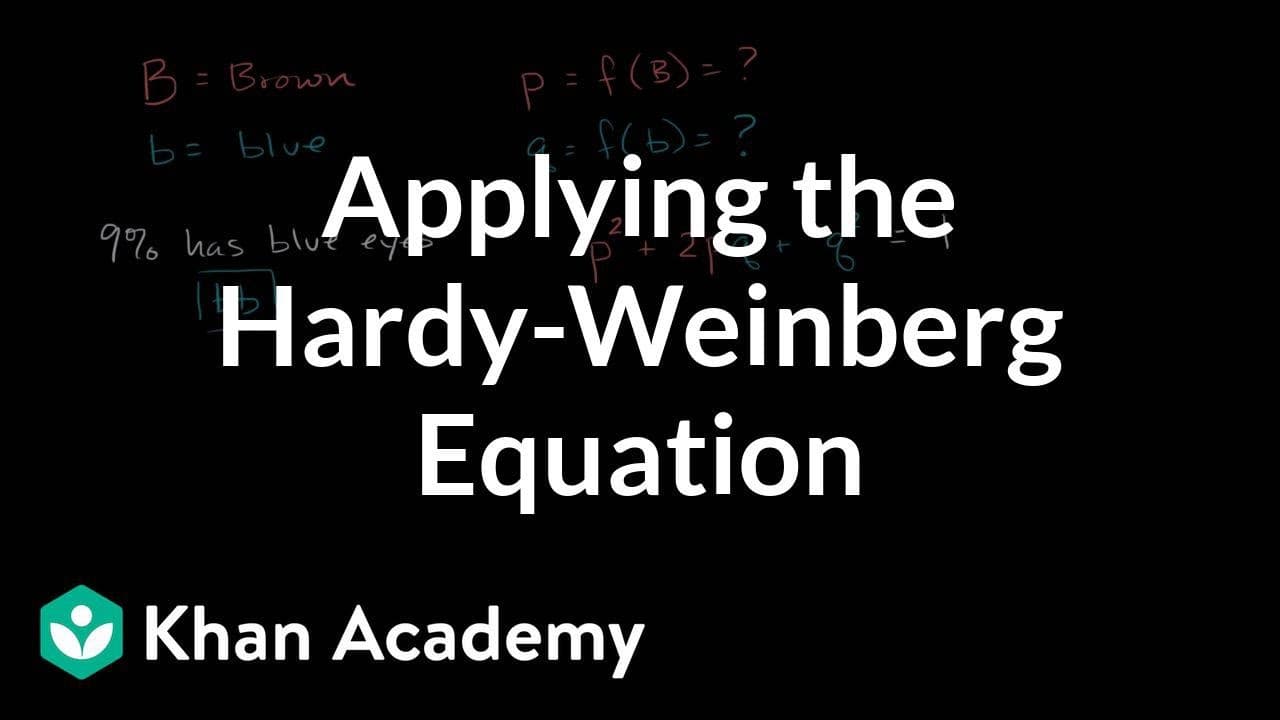
The video explains how to determine allele frequencies in a population using the Hardy-Weinberg equation.
Transcript
Voiceover: Let's stick with this idea, the simplification, that there's a gene for eye color, and it only comes with two variants. It has the dominant variant, which codes for brown eye color, and it has the recessive variant, which codes for blue eye color. So if either one of your alleles is this capital B, you're going to have brown eyes, the on... Read More
Key Insights
- 😃 The simplified example of eye color and the Hardy-Weinberg equation can help us understand how allele frequencies are determined in a population.
- 😃 The observed frequency of a phenotype, such as blue eyes, can be used to calculate the frequency of a recessive allele.
- ❓ By assuming there are only two alleles and using the Hardy-Weinberg equation, we can determine the frequencies of both dominant and recessive alleles in a population.
Install to Summarize YouTube Videos and Get Transcripts
Explore YouTube Video Summarizer or Get YouTube Transcript Extractor
Questions & Answers
Q: How can we determine the allele frequencies in a population using the Hardy-Weinberg equation?
The Hardy-Weinberg equation allows us to calculate allele frequencies. By observing the phenotype (such as blue eyes) and making assumptions about genotypes, we can solve for the frequencies of both dominant and recessive alleles.
Q: Why is it necessary to consider the genotype frequency of blue-eyed individuals in the population?
Blue eyes can only occur in individuals who are homozygous recessive for the eye color gene. By determining the frequency of this genotype, we can deduce the frequency of the recessive allele in the population.
Q: How can we calculate the frequency of the recessive allele using the observed frequency of the blue-eyed phenotype?
The frequency of the recessive allele can be determined by taking the square root of the percentage of individuals with the blue-eyed phenotype. This frequency is represented by the variable "q" in the Hardy-Weinberg equation.
Q: How does the Hardy-Weinberg equation help us gain knowledge about a population?
The Hardy-Weinberg equation enables us to calculate allele frequencies and genotype frequencies in a population. This information is useful in various fields, such as determining carrier frequencies for genetic diseases.
Summary & Key Takeaways
-
The video explores the simplified idea of a gene for eye color, with two variants: dominant for brown eyes and recessive for blue eyes.
-
Using the Hardy-Weinberg equation, the video shows how to calculate the frequencies of dominant and recessive alleles based on the observed phenotype of blue-eyed individuals in a population.
-
The calculations reveal that 30% of the population carries the recessive allele, while 70% carries the dominant allele. Additionally, 49% of individuals are homozygous dominant, and 42% are heterozygous for eye color.
Read in Other Languages (beta)
Share This Summary 📚
Summarize YouTube Videos and Get Video Transcripts with 1-Click
Try YouTube Summary with ChatGPT & Claude or YouTube Transcript Generator
Explore More Summaries from Khan Academy 📚



Summarize YouTube Videos and Get Video Transcripts with 1-Click
Try YouTube Summary with ChatGPT & Claude or YouTube Transcript Generator