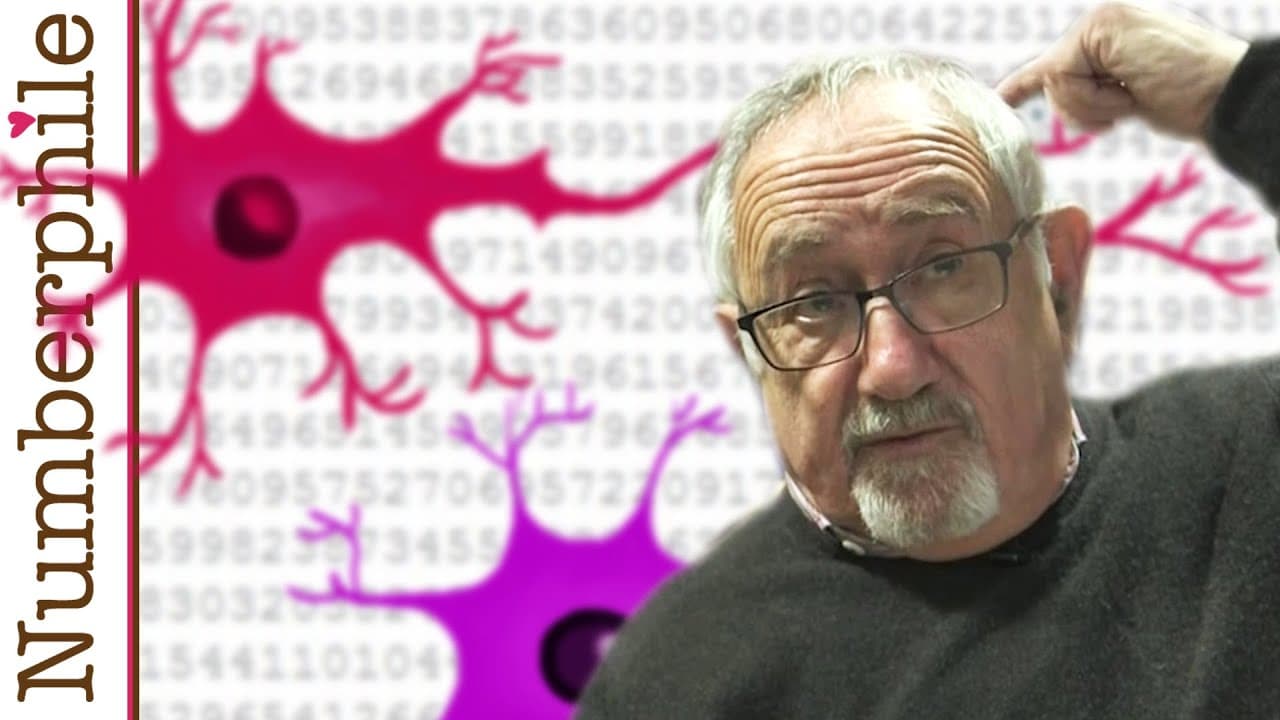
How do brains count? - Numberphile
TL;DR
Animals and humans have a shared mechanism for extracting numerosity or the number of things from the environment, which has implications for various aspects of their lives.
Transcript
We and many other creatures share a mechanism for what you might call extracting numerosity, or the number of things, from the environment. It's really very important for all sorts of creatures and for all sorts of reasons.
- (Brady: Extracting numerosity from) (the environment, what does that mean?) What I mean by this is that a fish needs to kno... Read More
Key Insights
- 🛟 Numerosity extraction is a shared mechanism among different creatures, serving various purposes for making decisions and interacting with their environment.
- 🙈 Accumulator mechanisms, similar to those seen in frogs and monkeys, may exist in human brains and play a role in numerosity representation.
- 🥺 Dyscalculia, a mathematical learning disorder, may result from dysfunctions in the accumulator mechanism, leading to difficulties with representing numerosities and learning arithmetic.
- 🖤 The lack of recognition and support for dyscalculia is attributed to societal attitudes and the allocation of research funding towards dyslexia.
Install to Summarize YouTube Videos and Get Transcripts
Explore YouTube Video Summarizer or Get YouTube Transcript Extractor
Questions & Answers
Q: How do animals extract numerosity from the environment?
Animals extract numerosity based on specific objects or sounds relevant to their needs. For example, fish pay attention to other fish swimming around, while lions focus on the number of roars and distinct roarers they hear.
Q: Do animals need to know exact numbers or is estimative quantity enough?
While estimative quantity may be sufficient in some cases, animals sometimes need to know the exact numerosity. For instance, lions defending against invading lions need to know if there is just one more of them to make a decision to fight or flee.
Q: Is there evidence of an accumulator mechanism in animals?
Yes, evidence suggests that certain animals, such as frogs, possess neurons that function as accumulators. These neurons fire more as the animal experiences more things, establishing a monotonic relationship between the number and firing rate.
Q: Why haven't accumulators been observed in human brains yet?
Examining accumulators in human brains is challenging due to ethical constraints on invasive procedures. However, studies on epilepsy patients and brain stimulation have shed some light on specific areas in the brain that respond to particular numerosities and arithmetic operations.
Summary & Key Takeaways
-
Extracting numerosity from the environment is crucial for animals and humans to make decisions and navigate their surroundings.
-
Animals like fish use numerosity to determine the size of a shoal, while lions use it to assess the number of invading lions in their territory.
-
Different creatures have specific ways of extracting numerosity, such as lions focusing on the number of roars they hear and fish paying attention to other swimming fish.
Read in Other Languages (beta)
Share This Summary 📚
Summarize YouTube Videos and Get Video Transcripts with 1-Click
Try YouTube Summary with ChatGPT & Claude or YouTube Transcript Generator
Explore More Summaries from Numberphile 📚




Summarize YouTube Videos and Get Video Transcripts with 1-Click
Try YouTube Summary with ChatGPT & Claude or YouTube Transcript Generator