How to Prune Regression Trees, Clearly Explained!!!
TL;DR
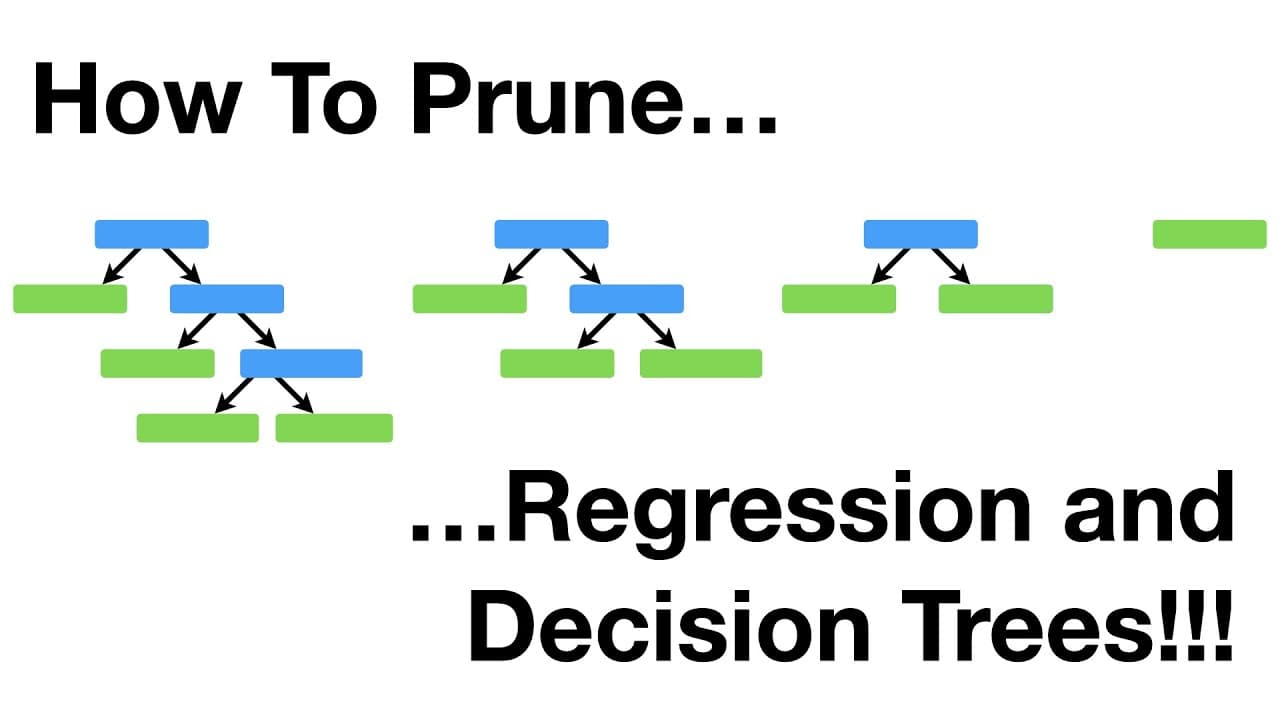
Pruning regression trees helps prevent overfitting by removing unnecessary leaves and improving the tree's performance on testing data.
Transcript
smelly stat smelly stat how are they training you I hope they're using stat quest hello I'm Josh stormer and welcome to stat quest today we're going to talk about how to prune regression trees there are several methods for pruning regression trees the one we'll talk about in this quest is called cost complexity pruning aka weakest link pruning we'l... Read More
Key Insights
- 🌲 Regression trees can overfit the training data, resulting in poor generalization on testing data.
- 🌲 Pruning regression trees by removing leaves and replacing them with averages helps prevent overfitting.
- 🌲 Cost complexity pruning calculates a tree score based on the sum of squared residuals and a penalty for tree complexity.
- 🌲 The value of alpha, the tuning parameter, affects the selection of the pruned tree.
- ❎ Cross-validation is used to determine the optimal alpha value that minimizes the sum of squared residuals on the testing data.
- 🌲 The optimal pruned tree represents a balance between complexity and fitting the data well.
- 👶 Pruning can improve the performance of regression trees on new observations.
Install to Summarize YouTube Videos and Get Transcripts
Explore YouTube Video Summarizer or Get YouTube Transcript Extractor
Questions & Answers
Q: How does overfitting affect regression trees?
Overfitting occurs when a regression tree captures the noise or outliers in the training data too closely, leading to poor generalization on testing data. It can cause the tree to fit the training data too well, resulting in worse performance on new observations.
Q: How does pruning help prevent overfitting?
Pruning removes some leaves from the regression tree and replaces them with average values, reducing the complexity and capturing fewer outliers. This helps prevent overfitting by creating a simpler tree that generalizes better to new data.
Q: What is cost complexity pruning?
Cost complexity pruning, also known as weakest link pruning, is a method for pruning regression trees. It involves calculating a tree score based on the sum of squared residuals and a tree complexity penalty. By selecting the tree with the lowest tree score, we can find the optimal pruned tree.
Q: How is pruning regression trees optimized?
The optimal pruned tree is found by iteratively increasing the value of alpha, the tuning parameter, and calculating the tree score for each potential pruned tree. Cross-validation is used to determine the best alpha value that minimizes the sum of squared residuals on the testing data.
Summary & Key Takeaways
-
Regression trees can overfit the training data, leading to poor performance on testing data.
-
Pruning regression trees involves removing some leaves and replacing them with averages, reducing overfitting and improving performance.
-
Cost complexity pruning, also known as weakest link pruning, is one method used to prune regression trees.
Read in Other Languages (beta)
Share This Summary 📚
Summarize YouTube Videos and Get Video Transcripts with 1-Click
Try YouTube Summary with ChatGPT & Claude or YouTube Transcript Generator
Explore More Summaries from StatQuest with Josh Starmer 📚




Summarize YouTube Videos and Get Video Transcripts with 1-Click
Try YouTube Summary with ChatGPT & Claude or YouTube Transcript Generator