How to Optimize Assembly Line Balancing
TL;DR
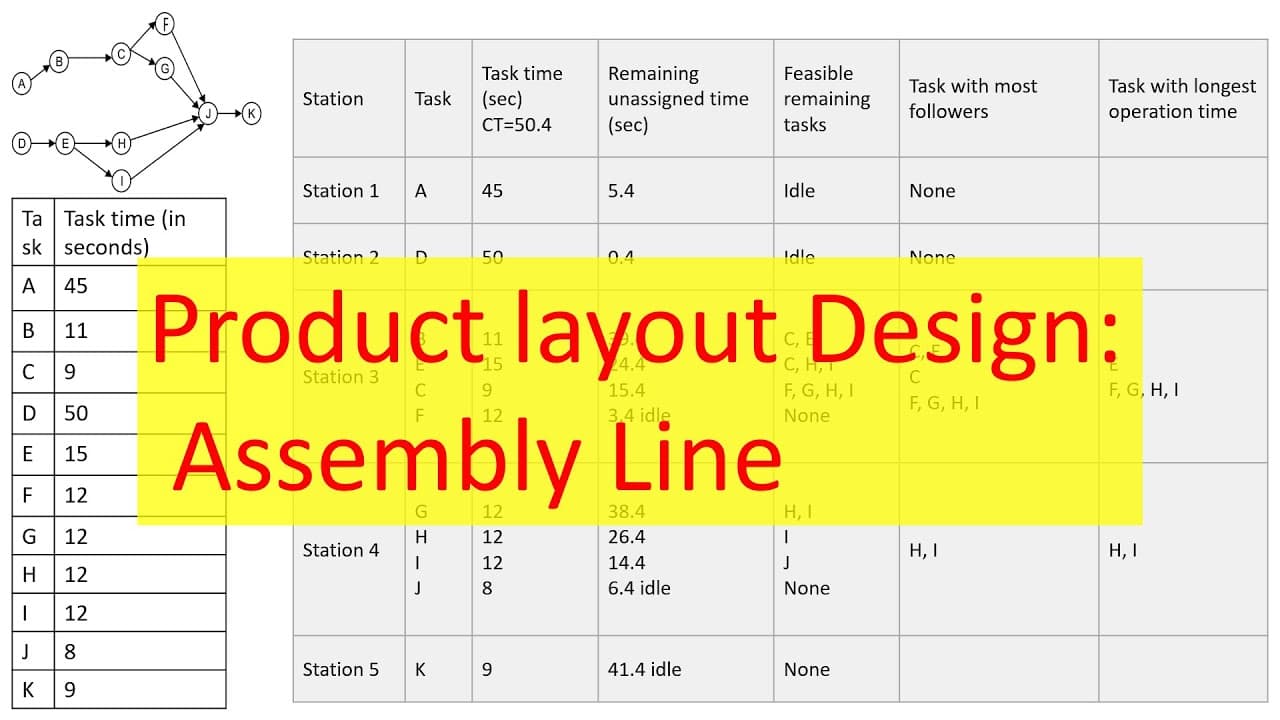
Line balancing is critical for optimizing assembly lines, ensuring each workstation operates at maximum efficiency without bottlenecks. This involves creating a precedence diagram, calculating workstation cycle times, finding the minimum number of workstations needed, and assigning tasks effectively. Achieving a 77% efficiency reveals areas for improvement in task allocation.
Transcript
hello everybody and welcome to product layout design using line balancing previously we have discussed about different types of layout but just to remind something about product layout product layout consists of a number of process arrangement one after another in a land produce standardized product or services in a relatively high volume when we r... Read More
Key Insights
- 🔊 Product layout design involves arranging processes in sequence for high-volume standardized production.
- 🫥 Line balancing ensures equal production rates and minimizes bottlenecks in the assembly line.
- ⌛ Cycle time represents the time required for a workstation to finish assigned tasks.
- ⌛ The minimum number of workstations can be calculated by dividing the sum of task times by cycle time.
- ⌛ Task assignment rules prioritize tasks based on time requirements, precedence relationships, and cycle time constraints.
- ⌛ Efficiency can be evaluated by dividing the sum of task times by the actual number of workstations times the cycle time.
- 🫥 An efficiency of 77% indicates imbalance or idle time in the assembly line.
Install to Summarize YouTube Videos and Get Transcripts
Explore YouTube Video Summarizer or Get YouTube Transcript Extractor
Questions & Answers
Q: What is product layout and when is it used?
Product layout involves arranging processes in sequence for high-volume standardized production. It is used when standardized products or services need to be produced efficiently.
Q: What is line balancing and why is it important?
Line balancing is the process of assigning tasks to workstations to ensure equal production rates and minimize bottlenecks. It is important to maintain maximum efficiency in the production process.
Q: How is cycle time calculated?
Cycle time is calculated by dividing the production time per day by the required output per day in units. It represents the time required for a workstation to finish all assigned tasks.
Q: What are the steps in balancing an assembly line?
The steps include drawing a precedence diagram, determining cycle time, calculating the minimum number of workstations, selecting task assignment rules, assigning tasks to workstations, evaluating efficiency, and rebalancing if necessary.
Summary & Key Takeaways
-
Product layout consists of arranging processes in sequence to produce standardized products or services in high volume.
-
Line balancing ensures equal production rates and minimizes bottlenecks by assigning tasks to workstations.
-
Steps in balancing an assembly line include drawing a precedence diagram, determining cycle time, calculating the minimum number of workstations, and assigning tasks.
Read in Other Languages (beta)
Share This Summary 📚
Summarize YouTube Videos and Get Video Transcripts with 1-Click
Try YouTube Summary with ChatGPT & Claude or YouTube Transcript Generator
Explore More Summaries from Solomon Getachew 📚



Summarize YouTube Videos and Get Video Transcripts with 1-Click
Try YouTube Summary with ChatGPT & Claude or YouTube Transcript Generator