What Are Neural Networks and How Do They Work?
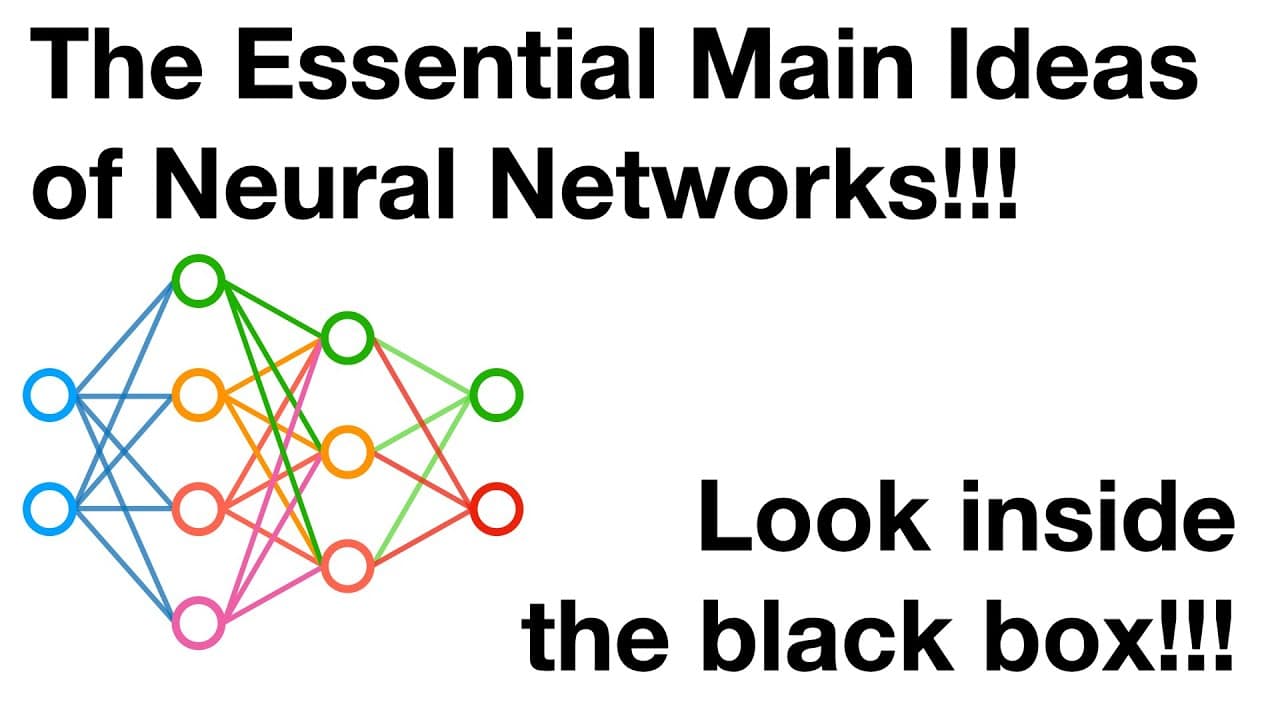
TL;DR
Neural networks are algorithms that leverage interconnected nodes to fit complex patterns in data, enabling accurate predictions. They transform inputs to outputs through activation functions and hidden layers, using a method called backpropagation to estimate parameters. This allows them to adapt their shapes to various datasets and effectively capture relationships within the data.
Transcript
Neural networks... seem so complicated, but they're not! StatQuest! Hello! I'm Josh Starmer and welcome to StatQuest! Today, we're going to talk about neural networks, part one: inside the black box! Neural networks, one of the most popular algorithms in machine learning, cover a broad range of concepts and techniques. however, people call them a b... Read More
Key Insights
- 🎰 Neural networks are a popular machine learning algorithm known for their ability to fit complex patterns in data.
- 🫥 Activation functions play a critical role in shaping the output of neural network nodes, allowing them to fit squiggly lines to data.
- ❓ Backpropagation is a method used to estimate parameter values for neural networks, improving their fit to the data.
- 🍵 Neural networks can handle datasets of varying complexity, adjusting their shapes to accurately predict outcomes.
- 🔠 Hidden layers in neural networks consist of nodes that transform inputs to outputs, enabling intricate modeling of data.
- 🏛️ Choosing the appropriate activation function and number of hidden layers is essential for building an effective neural network.
- 🫥 Neural networks are capable of fitting a squiggly line to almost any dataset, making them versatile and powerful tools in machine learning.
Install to Summarize YouTube Videos and Get Transcripts
Explore YouTube Video Summarizer or Get YouTube Transcript Extractor
Questions & Answers
Q: Why are neural networks called "black boxes"?
Neural networks are often referred to as black boxes because their inner workings are not easily interpretable. It can be hard to understand exactly how they arrive at their predictions or decisions.
Q: What are activation functions in a neural network?
Activation functions are the curved or bent lines within neural network nodes. They shape the output of each node and are crucial in creating the squiggly lines that fit the data. Different activation functions can be chosen depending on the desired behavior of the network.
Q: How are parameter values estimated in a neural network?
Backpropagation is a method used to estimate parameter values in a neural network. It involves iteratively adjusting the parameters based on the difference between the predicted and actual output, gradually improving the network's fit to the data.
Q: How can neural networks handle complex datasets?
Neural networks have the ability to fit squiggly lines to data, even in cases where a straight line would be insufficient. By using activation functions and parameter estimates, neural networks can create flexible and complex shapes that accurately represent the data.
Summary & Key Takeaways
-
Neural networks are popular algorithms in machine learning that can be difficult to understand due to their complexity.
-
This video series aims to break down the components and techniques of neural networks to provide a step-by-step understanding.
-
Part one introduces what neural networks do and how they do it, using a simple dataset to demonstrate the process.
Read in Other Languages (beta)
Share This Summary 📚
Summarize YouTube Videos and Get Video Transcripts with 1-Click
Try YouTube Summary with ChatGPT & Claude or YouTube Transcript Generator
Explore More Summaries from StatQuest with Josh Starmer 📚
Summarize YouTube Videos and Get Video Transcripts with 1-Click
Try YouTube Summary with ChatGPT & Claude or YouTube Transcript Generator